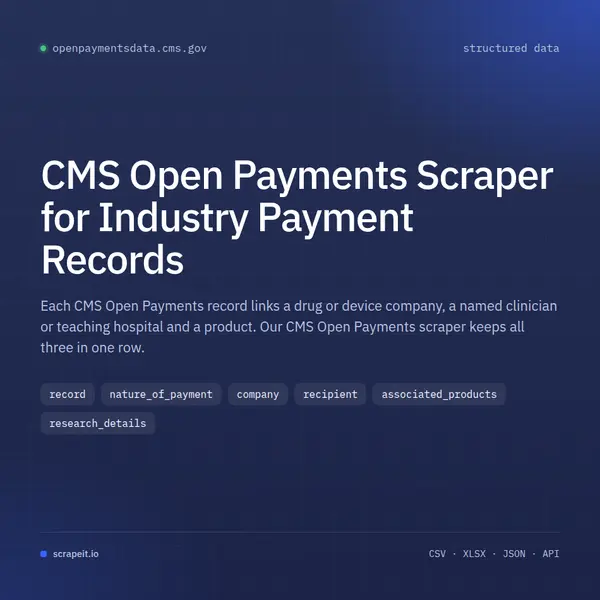
CMS Open Payments Scraper for Industry Payment Records

Each CMS Open Payments record links a drug or device company, a named clinician or teaching hospital and a product. Our CMS Open Payments scraper keeps all three in one row.

Plans from €169 a month · Free project assessment · Reply within 1 business day

CSV · Excel · JSON · XML · FTP · SFTP · Amazon S3 · Google Cloud

openpaymentsdata.cms.gov
CMS Open Payments Scraper for Industry Payment Records
openpaymentsdata.cms.govwhat you get
Typical fields for health sites
namespecialtyaddresspriceratingreviews
Delivery

API, JSON feed or CSV, XLSX and JSON files

Schedule

One-time, monthly, weekly, daily or 3 times a day

CMS Open Payments Data as a Managed Service

  1. You send

    CMS Open Payments pages, filters, fields and a schedule

  2. We run the scrapers

    Built, monitored and repaired by our team

  3. You receive the data

    API, JSON feed or CSV, XLSX and JSON files

You tell us which side of the ledger matters - a list of manufacturers, a set of NPIs, teaching hospitals in chosen states, or one specialty - and we build the crawl around the profiles that answer it. We run it, repair it when the search tool changes and hand over a stable table with field documentation. Profiles render with scripts and page their record tables, so rendering, pacing and proxy rotation are part of the service rather than your problem. A one-off extract suits a compliance review; runs timed to each annual publication and its later update suit ongoing monitoring. A free project assessment comes first, and a sample before any contract.

CMS Open Payments Data: Fields in Each Record

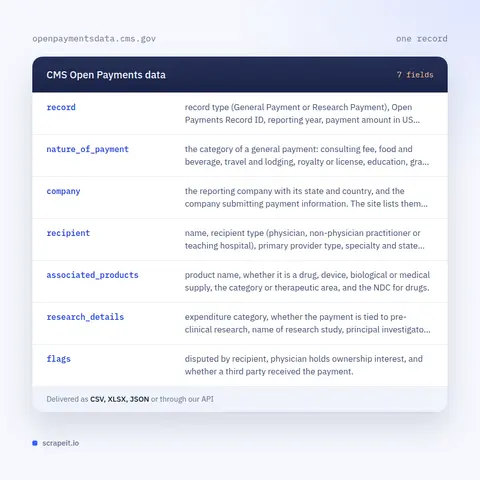
Every payment has its own record page, addressed by program year, record type and an Open Payments Record ID. That record ID is the key we keep each row stable on, and the page names payer, recipient and product together. We split them into columns:

  • Recordrecord type (General Payment or Research Payment), Open Payments Record ID, reporting year, payment amount in US dollars, date of payment, form of payment such as cash or cash equivalent or in-kind items and services, and the number of payments included in the transaction.
  • Nature of paymentthe category of a general payment: consulting fee, food and beverage, travel and lodging, royalty or license, education, grant, debt forgiveness, acquisitions, long term medical supply or device loan, space rental or facility fees (a teaching hospital category), or compensation for services such as speaking.
  • Companythe reporting company with its state and country, and the company submitting payment information. The site lists them separately, and they need not be the same company.
  • Recipientname, recipient type (physician, non-physician practitioner or teaching hospital), primary provider type, specialty and state license; on profiles also the NPI and practice address.
  • Associated productsproduct name, whether it is a drug, device, biological or medical supply, the category or therapeutic area, and the NDC for drugs.
  • Research detailsexpenditure category, whether the payment is tied to pre-clinical research, name of research study, principal investigators, the ClinicalTrials.gov ID and a link to the study, wherever the company filled them in.
  • Flagsdisputed by recipient, physician holds ownership interest, and whether a third party received the payment.

Free-text fields arrive as the company submitted them, so we keep the original wording beside any normalised value: a study name can run to a full protocol title, and one device appears in capitals on one record and in brand spelling on the next.

CMS Open Payments Data: Fields in Each Record
Profiles, Totals and History Across Program Years

Profiles, Totals and History Across Program Years

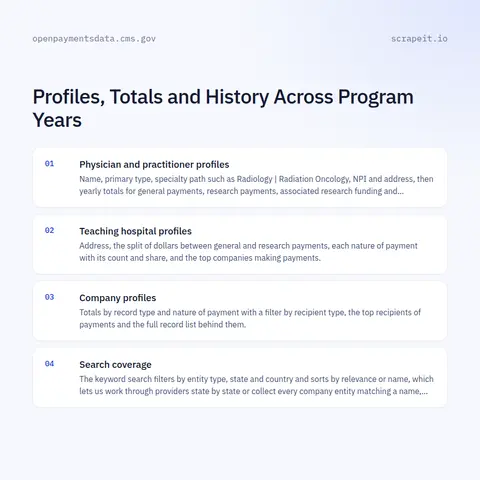
Single records answer who paid whom. Profile pages answer how much and how often, and most projects start there.

  • Physician and practitioner profilesname, primary type, specialty path such as Radiology | Radiation Oncology, NPI and address, then yearly totals for general payments, research payments, associated research funding and ownership and investment, with a chart that sets the person's figure against the specialty mean and the US mean.
  • Teaching hospital profilesaddress, the split of dollars between general and research payments, each nature of payment with its count and share, and the top companies making payments.
  • Company profilestotals by record type and nature of payment with a filter by recipient type, the top recipients of payments and the full record list behind them.
  • Search coveragethe keyword search filters by entity type, state and country and sorts by relevance or name, which lets us work through providers state by state or collect every company entity matching a name, such as a manufacturer and its foreign affiliates.
  • Historythe site displays seven years of records at a time. Runs repeated after each publication keep every year you collected in one table, and show any record whose amount or dispute flag differs between one release and the next.

About the CMS Open Payments Database

Source
openpaymentsdata.cms.gov
Category
health sites
Delivery
API, JSON feed, CSV, XLSX
Plans
From €169 a month
Get a quote

Open Payments is the federal transparency program run by the Centers for Medicare and Medicaid Services. Drug and medical device manufacturers and group purchasing organizations report what they pay or give to physicians, to non-physician practitioners such as physician assistants and nurse practitioners, and to teaching hospitals, and CMS publishes those records at openpaymentsdata.cms.gov. The site states that a published financial relationship is not in itself a sign that anything improper took place.

Records fall into three types. General payments cover everything outside a research agreement, from a lunch during a sales visit to a consulting fee or a royalty. Research payments are made under a research agreement or protocol and may name the study and its principal investigators. Ownership and investment interest covers stakes held by physicians or their immediate family members and does not apply to teaching hospitals or non-physician practitioners.

Publication follows a yearly cycle: companies report a program year, recipients get the chance to dispute records, and CMS publishes in June, with a further update announced on the home page. A practitioner shows up in search only after receiving at least one payment within the displayed years, so the database maps industry relationships rather than every provider in the country.

25Developers
500+Customers
1.5BPages extracted
15,000+Hours saved for our clients

CMS Open Payments scraping plans and pricing

Airplane

€199one-time

Setup fee included

100,000
One-time
Up to 5 days
7 days

Helicopter

€169/ mo

Setup fee €499

250,000
Monthly
Up to 5 days
14 days

Glasses

€229/ mo

Setup fee €499

1,000,000
Weekly
Up to 5 days
30 days

Microscope popular

€349/ mo

Setup fee €499

2,000,000
Daily
Same day
60 days

DNA

€549/ mo

Setup fee €799

3,000,000
3 times daily
Same day
90 days

Delivery: CSV, JSON or XLSX files, our API or a JSON feed. MCP server on request.

Full plan details

Why Scrape CMS Open Payments

The records connect three parties that rarely meet in one table anywhere else: a manufacturer, a named clinician or hospital, and a product.

  • Conflict-of-interest reviewHospitals, journals and research offices match staff NPIs against payments and ownership interest before a committee seat, a guideline panel or a publication.
  • Key opinion leader mappingConsulting fees, speaking compensation and royalties by specialty show which physicians a company relies on, and for which product.
  • Competitive intelligencePayments tagged with associated products and therapeutic area show how much a rival spends behind a launch, on which specialties and in which states.
  • Research sponsorshipResearch payments with study names and principal investigators reveal which teaching hospitals run industry-sponsored studies and for whom.
  • Journalism and policy workTotals by state, specialty or nature of payment, followed across program years, show where industry money concentrates and how food and beverage compares with fees.

About ScrapeIt

ScrapeIt is a managed web scraping company: we build, run and maintain crawlers and deliver the results as files or through our API. For a federal transparency registry like CMS Open Payments that means a schema keyed on the record ID that holds across publication cycles, with every field documented. Clinicians and hospitals appear here in their professional capacity; we collect what the registry publishes about that role, there is no patient data in it, and we build no dossiers on individuals. Personal data is handled under GDPR.

FAQ

Still unsure? Write to info@scrapeit.io

Do you offer a CMS Open Payments API for payment records?

Yes. The ScrapeIt CMS Open Payments API returns the record ID, payer, recipient with NPI, nature of payment, amount and associated products as JSON from an endpoint we host, refreshed on the schedule you set. The same records also come as CSV or XLSX files, a JSON feed or a load straight into your database.

Is it legal to scrape CMS Open Payments?

Yes. Every record on the site - payer, recipient, amount, nature of payment and product - is published by CMS for anyone to read without an account. We collect only publicly available data - everything a visitor can see on CMS Open Payments - and we collect it legally.

Can you build a CMS Open Payments dataset for a list of NPIs or companies?

Yes. Physician and practitioner profiles carry the NPI, and company profiles list every recipient a manufacturer paid, so we can start from your NPI list, a set of manufacturers or the teaching hospitals of chosen states. Each row keeps the Open Payments Record ID, so files from later runs join on the same key.

How often is CMS Open Payments data updated?

Once a year, with a later data update. A new program year is published in June, after companies submit their records and recipients have had the chance to dispute them, and the home page names the date of the next update. We schedule runs after each release and mark the records whose values changed.

How do you scrape CMS Open Payments research payments with study names?

From the research payment record, which adds the name of research study, principal investigators, expenditure category, a pre-clinical flag and a ClinicalTrials.gov ID when the company supplied one. We reach those records through teaching hospital and company profiles and keep each study name exactly as filed. On a physician profile, associated research funding shows research money paid to an institution where that physician is named as investigator.

How it works

  1. 1

    Make a request

    You share your needs, expectations, and desired timeframe. We'll suggest the best solution based on your request and budget.

  2. 2

    We configure the crawlers

    Our specialists configure the crawlers and extract a sample dataset for your review before proceeding with the full-scale extraction.

  3. 3

    Collect and deliver

    Once you approve the sample, we launch the project and start full data collection. We gather, filter, and structure the data for easy use, delivering it on time in your preferred format.

  4. 4

    Maintain and support

    Our team manages ongoing processes, monitors website changes, and supports all data extraction cycles. We can also help integrate data into your systems or create dashboards to simplify analysis.

Request a quote

Tell us which sites, which fields and how often. A couple of lines is enough to start.

  • We reply within 1 business day
  • A sample dataset before the full run
  • We sign an NDA on request
  • Delivery by API, JSON feed or files
Which sites, which fields, how often. A couple of lines is enough.

This form is protected by Google reCAPTCHA, which loads when you start filling it in; the Google Privacy Policy and Terms of Service apply. If you prefer not to use it, email us at info@scrapeit.io. Privacy & Cookie Policy

We reply within 1 business day. No obligation.

CMS Open Payments data from €169/month. Free project assessment, reply within 1 business day.