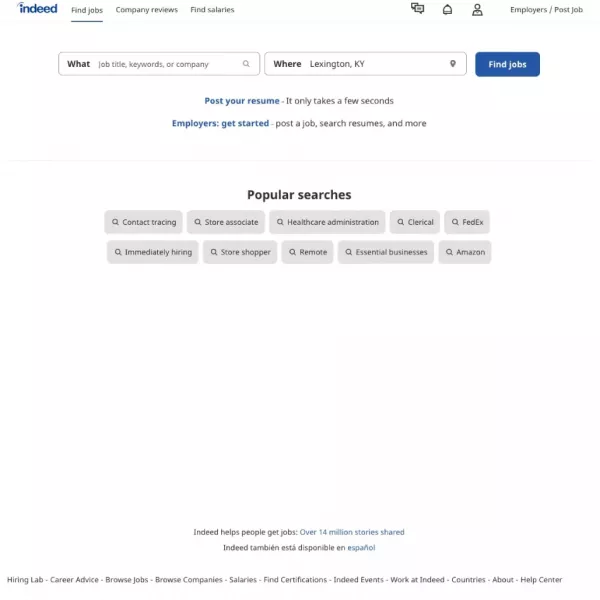
How Indeed Is Put Together
Indeed runs two businesses on one surface. Employers post jobs into it directly, and it also indexes postings from employer career sites, applicant tracking systems and other boards. That second channel is why one real vacancy can appear several times under slightly different titles.
A posting lives at a viewjob URL keyed by the jk parameter, a hexadecimal job key. The key identifies one Indeed record, not one vacancy, so a role arriving both as a direct post and as an ATS feed carries more than one key. Search runs at /jobs with the query in q and the location in l, and pages advance through a start offset in steps of ten. Paging is bounded, so a broad query cannot be exhausted by turning pages; wide briefs get split by title, location and date window instead.
Indeed also operates national sites - indeed.de, indeed.fr, indeed.co.in among them. These are separate result sets with their own locale, currency and employer mix, not translations of one index, so a multi-country brief is several crawls and the merge afterwards is the real work. Indeed was founded in 2004, is part of Recruit Holdings, and carries listings in more than 60 countries and over two dozen languages.
Indeed is defensive about automated traffic, so pacing, rendering and proxy rotation are built into every crawl we run - that handling is our job, not yours. What comes out is every public posting field: title, employer, location, salary, job type, description, posting date and the jk key.
Get a Quote