Glassdoor scraper for employer ratings, reviews and jobs

Glassdoor shows a signed-out visitor employer ratings, the newest reviews, pay ranges and the whole job search. Our Glassdoor scraper collects that public layer. We never log in.

Plans from €169/month · Free project assessment · Reply within 1 business day

Glassdoor Scraper
Solutions

Glassdoor scraping from the public pages

The request is usually a list: employers by name or Glassdoor address, a set of job titles and cities, or an industry in one country. We resolve each employer to its numeric employer ID, build crawlers for the profile tabs you need - About, Reviews, Pay and benefits, Jobs, Interviews - and run them on your schedule.

Two things are fixed. We work only from what Glassdoor shows without an account: no sign-in, no member-only archives. And the site screens automated visitors closely, so pacing, proxy rotation, rendering and CAPTCHA handling are included, together with repairs when page layouts change. A free project assessment tells you which of your fields are public before you commit, and a sample can be ordered for a handful of employers.

What our Glassdoor data scraper extracts

Every employer on Glassdoor has a numeric employer ID that appears in the address of each of its tabs. It is the key that joins the tables below.

  • Employer snapshot - name, employer ID, the parent company line, website, headquarters, industry, company size band, revenue band, company type, year founded, number of office locations, mission and description, and the Engaged Employer badge.
  • Headline ratings - the overall employer rating out of five, the number of ratings behind it, the share who would recommend to a friend, the CEO name and CEO approval, and the share with a positive business outlook.
  • Workplace factor ratings - career opportunities, compensation and benefits, culture and values, diversity and inclusion, senior management and work/life balance, where the profile shows them.
  • Company reviews - for the reviews a signed-out visitor is shown: star rating, date, headline, job title, current or former employee with length of service, location, the recommend, CEO approval and business outlook marks, and the Pros and Cons text, each with its review ID.
  • Salaries - per job title, the pay range per year and the number of salaries submitted, for the titles listed publicly.
  • Interviews - the summary block: interview difficulty, the positive-experience share, how candidates got the interview, typical time to hire and the mix of interview stages.
  • Job listings - job title, employer and its rating, location, the salary range with its Employer provided or Glassdoor est. label, the Easy Apply flag, skills, the full description and the listing ID.

Review authors are anonymous on Glassdoor and stay so in the data: there are no names to collect, and we do not try to link reviews to people.

What our Glassdoor data scraper extracts
Glassdoor review scraper: slices, peers and history

Glassdoor review scraper: slices, peers and history

Beyond the main tabs, an employer profile branches into pages that are easy to miss and useful to have.

  • Review slices. Glassdoor keeps separate review pages per job title and per office location, each with its own count, and per topic such as pay, management or culture. They show how sentiment differs between engineering and sales, or between head office and a regional site.
  • Ratings by demographic group. The Reviews tab shows a signed-out visitor the first of its ratings by demographic group and keeps the rest for members.
  • Pay and benefits summaries. The Pay and benefits tab carries a benefits page and a short summary of what employees say about pay.
  • Peer sets. Profiles list similar companies with their ratings and review counts, a ready comparison group for benchmarking.
  • History. Glassdoor shows today's rating and a single figure for its change over the last 12 months, so a one-off Glassdoor scrape is a snapshot. A weekly or monthly run stores the rating, recommend share, CEO approval, review count and open job count per employer, so you can see the quarter in which a score turned and how hiring moved with it.
  • Job market view. A job search by title and city returns a result count, salary ranges and employer ratings, which builds a pay and demand series per role and location.

What Glassdoor keeps for signed-in members - the deeper review archive, individual interview write-ups, the full salary table - stays outside the dataset.

About Glassdoor and its country sites

Glassdoor is a workplace review site and a job board in one. Current and former employees post anonymous company reviews, salary reports, benefit reviews and interview accounts; employers claim a profile and post jobs. The brand belongs to Indeed, Inc., and the two sites share a login.

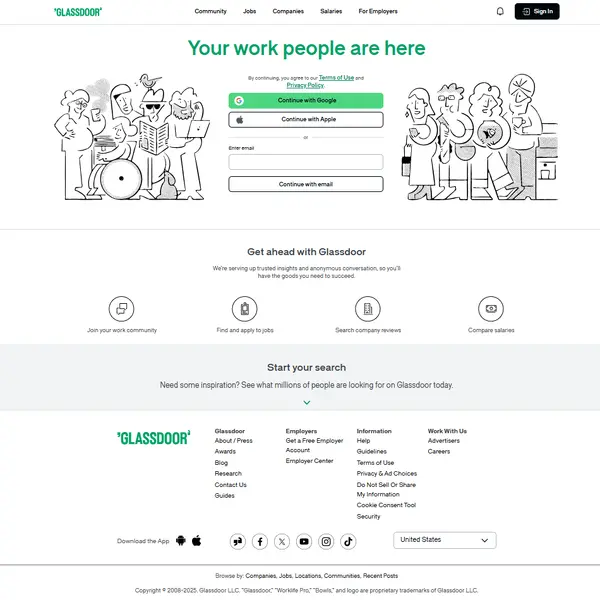
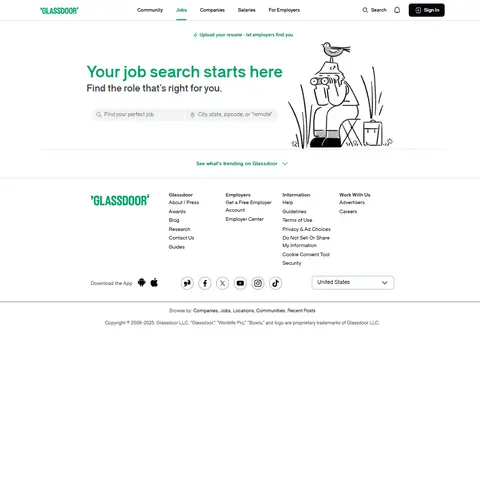
The main navigation leads with Community, Jobs, Companies and Salaries, and an employer profile sits under Companies with its About, Reviews, Pay and benefits, Jobs and Interviews tabs. Glassdoor rounds each score to one decimal and attaches a label to it, from Excellent through Positive and Average to Slightly Negative and Negative. Its help pages say that recent reviews weigh more in the overall rating, and that CEO approval and workplace factor ratings are optional answers, so they rest on fewer responses than the review count suggests.

Glassdoor runs country sites - glassdoor.co.uk, glassdoor.ca, glassdoor.co.in, glassdoor.com.au, glassdoor.de, glassdoor.fr and more, with two language editions each for Canada, Switzerland and Belgium. The domain matters. Reviews are displayed in the language of the site, and an employer with a localised profile shows a rating built from reviews in that country, so a German and a US rating for one company can differ. We record the site every row came from.

Get a Quote
dev_w
25

Developers

customers
500+

Customers worldwide

pages
1 500 000 000+

Pages extracted

stime
15000+

Hours saved for our clients

Plans

Glassdoor Scraping Plans and Pricing

Airplane

€199 / one-time

setup fee - included

Data limits100,000
Frequencyone-time
Run timeup to 5 days
Data storing7 days

Helicopter

€169 / mo

setup fee €499

Data limits250,000
Frequencymonthly
Run timeup to 5 days
Data storing14 days

Glasses

€229 / mo

setup fee €499

Data limits1,000,000
Frequencyweekly
Run timeup to 5 days
Data storing30 days

DNA

€549 / mo

setup fee €799

Data limits3,000,000
Frequency3 times daily
Run timesame day
Data storing90 days

Delivery: CSV, JSON or XLSX files, our API or a JSON feed. MCP server on request.

Full plan details →

Why scrape Glassdoor reviews and ratings

Candidates check an employer on Glassdoor before they answer a recruiter, and its numbers are specific enough to manage against.

  • Employer branding. HR and communications teams follow their own rating, recommend share and CEO approval next to named competitors, and read Pros and Cons by job title to see what drives the score.
  • Talent intelligence. Recruiters and staffing firms compare pay ranges by job title and city, interview difficulty and time to hire across the employers they compete with.
  • Investment research. Analysts treat rating trend, business outlook and open job counts as early signals on a company, and need them as a dated series, not a screenshot.
  • Compensation benchmarking. Salary ranges with the number of salaries submitted behind them show what a role pays at each employer and how well supported the figure is.
  • Job market analysis. Listings with Employer provided pay show which firms publish salaries, for which roles and at what level.

Teams that scrape Glassdoor data themselves usually stall on upkeep - employer IDs to resolve, country sites to keep apart, tabs whose layout changes; a managed feed removes that work.

Our Blog

Reads Our Latest News & Blog

Learn how to use web scraping to solve data problems for your organization

How Artificial Intelligence Is Used In Web Scraping

How Artificial Intelligence Is Used In Web Scraping

Leveraging advances in technology, the AI-powered web scraper has skyrocketed in demand and is helping to expand capabilities by automating tedious daily tasks and speeding up data collection from thousands of websites several times over.

What is Web Scraping and What is it Used For?

What is Web Scraping and What is it Used For?

Web scraping is a method of obtaining web data by extracting it from pages of web resources with the help of a program, that is, in automatic mode. It is used to syntactically convert web pages into more usable forms.

Web Scraping for Machine Learning

Web Scraping for Machine Learning

If you specialize in machine learning, you need to feed large amounts of data to the algorithms. Web scraping is the easiest and the most efficient method of collecting the data from all over the Internet.

scrapeit logo

About ScrapeIt

ScrapeIt is a managed data collection service: we write the crawlers, run them, fix them and send you the result. On job and employer sites we hold two lines - we never log in or go behind a paywall, and we do not build profiles of individuals; personal data is handled under GDPR. You receive employer-level and listing-level data with a documented schema, as CSV, Excel, JSON or JSONLines, sent to SFTP, Amazon S3, Google Cloud Storage or your database.

FAQ

Do you offer a Glassdoor API for employer ratings and reviews?

Yes. The ScrapeIt Glassdoor API returns employer ID, overall rating, recommend to a friend share, CEO approval, the reviews shown publicly with Pros and Cons, and salary ranges by job title as JSON through an endpoint that we host and refresh on your schedule. The same records are also delivered as CSV or XLSX files, a JSON feed or a direct load into your database.

Is it legal to scrape Glassdoor?

Yes. Employer snapshots, rating percentages, the reviews shown to signed-out visitors, pay ranges by job title and job listings are open to anyone on Glassdoor without an account. We collect only publicly available data - everything a visitor can see on Glassdoor - and we collect it legally.

Which Glassdoor reviews can you collect without logging in?

We collect the reviews Glassdoor displays to a signed-out visitor on an employer's review pages, including the separate pages per job title and per location, with rating, date, role, employment status, Pros and Cons. The deeper archive is for signed-in members, and we never log in. The summary figures - overall rating, recommend share, CEO approval, business outlook - cover all reviews and are always included.

What does the Glassdoor job scraper return for each listing?

Each row carries job title, employer, employer rating, location, the salary range and whether it is employer provided or a Glassdoor estimate, the Easy Apply flag, skills, the full description and the listing ID. Searches are set by title, city and country site, and the result count is stored with each of them.

How often should a Glassdoor dataset be refreshed?

Glassdoor says an overall rating takes about seven business days to reflect new reviews, so daily runs add little for ratings. Weekly or monthly runs suit rating, review and salary tracking. Job listings move faster, and daily runs are usual when they serve as a hiring signal.

How does it Work?

Step 1 - Make a Request

You share your needs, expectations, and desired timeframe. We’ll suggest the best solution based on your request and budget.

Step 2 - Configuring Custom Web Crawlers

Our specialists configure the crawlers and extract a sample dataset for your review before proceeding with the full-scale extraction.

Step 3 - Collect and Deliver

Once you approve the sample, we launch the project and start full data collection. We gather, filter, and structure the data for easy use, delivering it on time in your preferred format.

Step 4 - Maintain and Support

Our team manages ongoing processes, monitors website changes, and supports all data extraction cycles. We can also help integrate data into your systems or create dashboards to simplify analysis.

Request a Quote

Tell us more about you and your project information.
Which sites, which fields, how often. A couple of lines is enough.

This form is protected by Google reCAPTCHA, which loads when you start filling it in. If you prefer not to use it, email us at info@scrapeit.io. Privacy & Cookie Policy

We reply within 1 business day. No obligation.

Glassdoor data from €169/month. Free project assessment, reply within 1 business day.

scrapiet

Scrapeit Sp. z o.o.
10/208 Legionowa str., 15-099, Bialystok, Poland
KRS: 0000996672
NIP: 5423457175
REGON: 523384582