eFinancialCareers Scraper for Finance Hiring Data

A managed eFinancialCareers scraper for banking jobs, employer names, financial centres and published compensation, delivered on your schedule as CSV, JSON, XLSX or an API.

eFinancialCareers Scraper
Solutions

How the Service Runs

eFinancialCareers scraping runs here as a managed service. You describe the slice you want, by sector, seniority, financial centre or employer list, and we build the crawler, run it and keep it working when the site changes. Anti-bot handling is part of the managed service: proxy rotation, CAPTCHA solving and adaptive crawling that paces itself and adapts when layouts move. You do not build or maintain that layer. We promise no perfection, only that the failures are ours to fix, and nothing behind a login is touched.

Delivery is CSV, JSON, XLSX, a hosted API, or a push straight to S3, Google Sheets, a database or a BI tool. Schedules run hourly, daily, weekly or on demand, with deduplication on the posting id and changed records flagged if that suits your pipeline. Pricing follows volume and frequency, and the first sample is free so you can check the fields before committing.

Fields in an eFinancialCareers Dataset

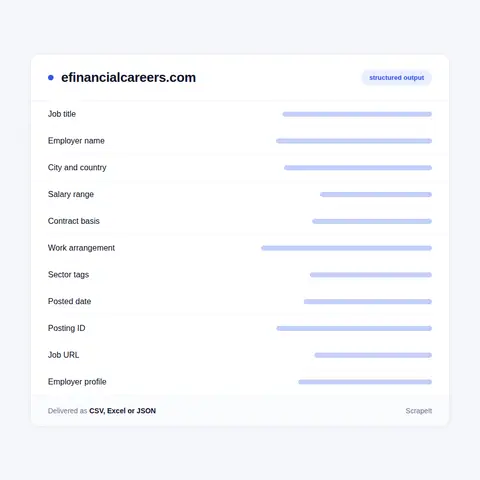
Every record is keyed on the numeric posting id that closes the job URL. The readable words in front of it are decoration and can change without changing the vacancy, so the id is what your warehouse should join on. A standard eFinancialCareers data extract carries:

  • Posting id and canonical URL - the stable numeric key plus the live address of the advert.
  • Job title as published, with a normalised title and seniority band beside it.
  • Employer exactly as printed, flagged as a direct hirer, a finance recruitment agency or an undisclosed advertiser, because the board carries all three.
  • Location split into city, country and the board's own region, with the work arrangement it states: hybrid, in-office, remote, flexible or temporarily remote.
  • Contract basis as printed, covering permanent, contract, temporary and internship adverts.
  • Compensation kept twice: the published string verbatim, and parsed currency, lower bound, upper bound and period, with a flag when the advert gives words instead of a number.
  • Sector and discipline tags the posting carries, from banking and trading through accounting, audit, risk, compliance and legal to quantitative research and data science.
  • Dates and status - the posted date on the advert, plus our own first-seen and last-seen stamps and a live or closed marker.
  • Full description as plain text and as HTML, with requirements, qualifications and any regulatory or language conditions.
  • Employer profile link and directory id where the advertiser has a company page.

Output is limited to posting and employer data. Recruiter names, direct emails and phone routes are excluded by default rather than on request, and candidate profiles or CVs behind a login are never collected. Where an advert names an individual in its body copy, that copy is a job description; if you need such records handled as personal data under the GDPR, we strip the field before delivery.

Fields in an eFinancialCareers Dataset
How Pay Is Published, and What a Salary Dataset Can Honestly Say

How Pay Is Published, and What a Salary Dataset Can Honestly Say

Compensation here is employer-stated, unverified and incomplete. Some adverts give a clean annual band in the local currency. Contract roles often give a day rate instead. Some give a sentence rather than a field, describing a base salary with performance-linked upside in prose. Many give the single word Competitive and nothing more. Bonus is rarely a structured field at all, which matters in a sector where the bonus is most of the number, and carried interest, sign-on and deferred stock almost never appear.

So a pay dataset built from this source is partial by nature, and you should know that before you buy. What it supports is a directional read: how advertised bands for a compliance officer in London moved across four quarters, or how a New York band compares with a Singapore one for the same title and seniority. What it does not support is a claim about what people are actually paid. We keep the raw string beside the parsed numbers so your analysts can see the coverage rate on any slice and decide whether it carries the conclusion they want to draw.

Timing is equally plain. A posting stops being reachable once it closes, and the advert goes away rather than staying on as an archive. Anything you want in a time series has to be captured while it is live, so we run on a schedule, stamp first-seen and last-seen on every record, and keep closed vacancies in your history after the source has dropped them.

What eFinancialCareers Covers

eFinancialCareers is a sector job board for financial services and the technology that runs it. A general board lists a credit analyst next to a delivery driver; this one sorts work the way the industry does. Its own labels include front office, middle office, buy-side and sell-side, and role families run down to the desk: sales and trading, investment banking, asset management, private equity, hedge funds, wealth management, risk, compliance, audit, quantitative analysis, operations and engineering inside banks and funds. That taxonomy is why buyers scrape eFinancialCareers rather than a horizontal board, which cannot show a bank slowing front office hiring while adding compliance and model risk headcount.

One global inventory is served through local front ends. The .com, .co.uk, .de, .fr, .ch, .hk, .sg and .com.au sites present the same postings, and a vacancy reached through the UK domain carries the identifier it has on the Hong Kong one. Coverage follows the financial centres: London, New York, Hong Kong, Singapore, Dubai, Frankfurt, Zurich and Paris, grouped into Africa, Asia, Australasia, Europe, the Gulf, North America and South America. In early September 2026 the index held roughly 71,000 live vacancies and the employer directory listed 527 company profiles.

Ownership matters if you scope more than one board. DHI Group, which owns Dice, sold majority control to eFinancialCareers management in 2021 and kept a minority stake. The two run as separate businesses with separate inventories and separate identifier schemes, so no posting key crosses between them; a role on both is matched on employer, title and location.

Get a Quote

dev_w
25

Developers

customers
500+

Customers worldwide

pages
1 500 000 000+

Pages extracted

stime
15000+

Hours saved for our clients

Plans

Airplane

€199 / one-time

setup fee - included

Data limits100,000
Frequencyone-time
Run timeup to 5 days
Data storing7 days

Helicopter

€169 / mo

setup fee €499

Data limits250,000
Frequencymonthly
Run timeup to 5 days
Data storing14 days

Glasses

€229 / mo

setup fee €499

Data limits1,000,000
Frequencyweekly
Run timeup to 5 days
Data storing30 days

DNA

€549 / mo

setup fee €799

Data limits3,000,000
Frequency3 times daily
Run timesame day
Data storing90 days

Who Buys Finance Recruitment Data and Why

Hiring is the earliest public signal a bank or fund gives off. A headcount plan reaches a job board months before it reaches an annual report, and on a sector board it arrives already sorted by desk.

Salary benchmarking. Reward teams and consultancies track advertised pay by role family, seniority and centre, then set London against New York, Singapore and Dubai on one title. Advertised pay moves faster than survey cycles, so it sanity checks a benchmark between surveys rather than replacing one.

Competitor hiring and headcount signals. Counting live vacancies per employer each quarter shows where a rival is building. A run of quantitative analysis and model validation seats reads differently from sales and trading seats, and a drift from front office towards compliance and operations shows in the mix long before anyone announces it.

Talent supply and market entry. Recruitment firms and internal talent teams use vacancy tracking to size demand for a skill before opening a desk, and see which centres absorb it. Fintech and data vendors read the same feed as a go-to-market list: a firm advertising for collateral management specialists is a firm with a collateral management problem.

Job market intelligence. Analysts, trade press and index builders use the series to publish hiring trends for banking jobs and to put a number behind a story about where finance adds or sheds people.

Our Blog

Reads Our Latest News & Blog

Learn how to use web scraping to solve data problems for your organization

How Artificial Intelligence Is Used In Web Scraping

How Artificial Intelligence Is Used In Web Scraping

Leveraging advances in technology, the AI-powered web scraper has skyrocketed in demand and is helping to expand capabilities by automating tedious daily tasks and speeding up data collection from thousands of websites several times over.

What is Web Scraping and What is it Used For?

What is Web Scraping and What is it Used For?

Web scraping is a method of obtaining web data by extracting it from pages of web resources with the help of a program, that is, in automatic mode. It is used to syntactically convert web pages into more usable forms.

Web Scraping for Machine Learning

Web Scraping for Machine Learning

If you specialize in machine learning, you need to feed large amounts of data to the algorithms. Web scraping is the easiest and the most efficient method of collecting the data from all over the Internet.

scrapeit logo

Why Teams Use ScrapeIt

ScrapeIt is a managed web scraping agency. We are not a tool you have to learn, and not a proxy subscription with a support queue attached. We take the brief, write the extraction, run the infrastructure and hand back clean, validated data in the format and on the cadence you asked for, with a named engineer when something needs changing.

Tell us the scope and the volume and you get a sample file and a quote, usually within a working day.

FAQ

Does eFinancialCareers have a public API for job data?

Not for a data buyer. The API it documents is a recruiter posting API: it lets employers and agencies create, update and remove their own adverts, and it needs a provider key, a password and a client key issued by eFinancialCareers to a paying account. There is no open search or read endpoint that returns other companies' postings, and no public developer signup. That is the gap this service fills. We run the extraction and hand you the feed the API does not offer, as CSV, JSON, XLSX or an API of your own.

Can you get salary data from eFinancialCareers?

Where the advert publishes it, yes, and we return both the raw line and parsed currency, minimum, maximum and period. Coverage is partial and we will not pretend otherwise. A large share of postings say Competitive instead of a figure, some describe pay in a sentence, and bonus is usually prose rather than a field. We report the coverage rate for your slice with the first sample, so you can judge whether the compensation data is dense enough for the benchmarking you have in mind.

Do I need to scrape the UK, Hong Kong and Singapore sites separately?

No. The country sites are localised front ends over one global inventory, and the same vacancy carries the same posting id whichever domain you reach it through. We collect once and filter by location, so London, New York, Hong Kong, Singapore, Dubai, Frankfurt, Zurich and Paris arrive in a single deduplicated set instead of you paying several times for the same record.

Is eFinancialCareers the same company as Dice?

Not any more. DHI Group, the owner of Dice, sold majority control to the eFinancialCareers management team in 2021 and retained a minority stake. The boards are run as separate businesses, hold separate inventories and use separate identifier schemes, so nothing joins them on a key. If you buy both from us, we match overlapping technology roles on employer, title and location and mark them, so your counts do not double.

How often can you refresh the data, and in what format?

Hourly, daily, weekly or on demand, whichever fits the decision the data feeds. Files arrive as CSV, JSON or XLSX, or through an API, S3, Google Sheets or a direct database load. Because a closed posting stops being reachable, frequent runs are what give you a usable history: we stamp first-seen and last-seen on every record and keep expired vacancies in your archive, so vacancy tracking and hiring trends survive after the source removes the advert.

How does it Work?

Step 1 - Make a Request

You share your needs, expectations, and desired timeframe. We’ll suggest the best solution based on your request and budget.

Step 2 - Configuring Custom Web Crawlers

Our specialists configure the crawlers and extract a sample dataset for your review before proceeding with the full-scale extraction.

Step 3 - Collect and Deliver

Once you approve the sample, we launch the project and start full data collection. We gather, filter, and structure the data for easy use, delivering it on time in your preferred format.

Step 4 - Maintain and Support

Our team manages ongoing processes, monitors website changes, and supports all data extraction cycles. We can also help integrate data into your systems or create dashboards to simplify analysis.

Request a Quote

Tell us more about you and your project information.
Which sites, which fields, how often. A couple of lines is enough.

We reply within 1 business day. No obligation.

scrapiet

Scrapeit Sp. z o.o.
10/208 Legionowa str., 15-099, Bialystok, Poland
NIP: 5423457175
REGON: 523384582