Careerjet Scraper for Job Aggregator and Salary Data

Careerjet hosts none of the vacancies it lists - it indexes them from other sites and sends applicants onward. Our Careerjet scraper keeps the ad, the source it came from and the id that ties them.

Careerjet Scraper
Solutions

Delivery, Coverage and Getting Past the Careerjet Bot Check

Recruitment agencies use Careerjet job data to see who is hiring in a market before the vacancy reaches their desk. Compensation teams pull the salary rows to benchmark by title and city. Boards and aggregators read the source field to find where their own inventory is being republished. Researchers read posting volume by sector and country as a demand signal.

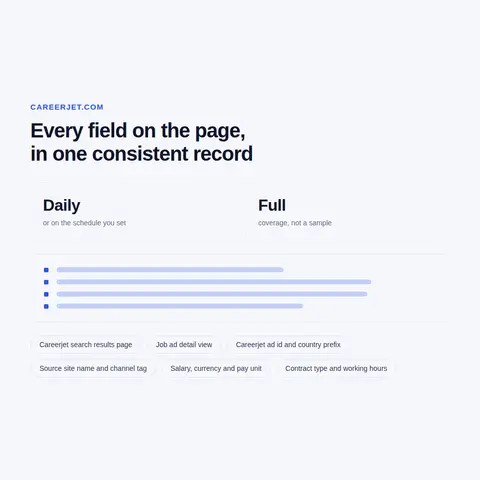
Careerjet challenges automated traffic, and a Careerjet scraper that ignores that collects a verification screen instead of jobs. Our runs include anti-bot handling, proxy rotation and CAPTCHA solving, at request rates low enough to stay unobtrusive, with the paths the robots file excludes left alone. The paging parameter is among them, so coverage comes from slicing the query space - keyword, location, radius, contract type, working hours and date window - rather than walking deep result pages. Delivery is CSV, JSON, XLSX or an API endpoint on the schedule you set.

Fields in a Careerjet Job Data Export

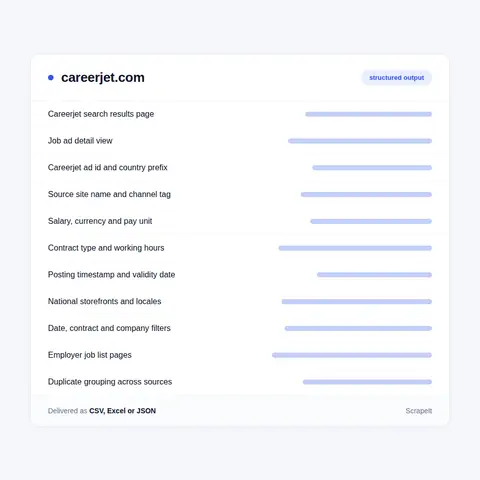
A Careerjet record has two layers. The result card carries the title, the employer with a link to its Careerjet job list, one or more locations, an ellipsis-trimmed snippet, the relative age of the ad and, on a minority of cards, a printed rate such as 12.50 pounds per hour. Contract type, working hours, the full description and the name of the site the posting came from live only on the ad page. We extract Careerjet data from both layers and keep the link between them.

  • Careerjet ad id from the /jobad/ path, its country prefix and the canonical ad address
  • Job title, employer name and the employer's /company/ job list page
  • Location as printed, split into locality, region and country
  • Salary as displayed, plus currency code, minimum, maximum and pay unit - year, month, week, day or hour
  • Contract type - permanent, contract, temporary, training or interim - and working hours, full-time or part-time
  • Exact posting timestamp, the validity date stamped on the ad, and the relative label the card prints
  • Full description body, kept as plain text and as the original markup
  • Source display name and origin host, with the channel tag that marks an applicant tracking feed
  • Apply route: the Apply easily badge for integrated partners who take the application on Careerjet, or the outbound link for everything else
  • Employer logo reference where Careerjet holds one
  • The query that surfaced the ad, its rank on that page, the locale and the storefront domain
  • A duplicate group id joining the records we judge to be one vacancy

Three fields need care. The age on the card is relative and translated - 1 day ago in Britain, 2 Tage her in Germany - while the structured data behind the page carries a real timestamp; we take the timestamp and keep the label beside it. The country inside that structured data arrives in the local language, so a German ad reads Deutschland where a British one reads United Kingdom. And employment type is sometimes a list rather than a single value, so a German apprenticeship comes through as full time and intern at once. Normalising all three belongs in the extraction, not in your afternoon.

Fields in a Careerjet Job Data Export
Careerjet Salary Data, Duplicates and the Ninety-Day Clock

Careerjet Salary Data, Duplicates and the Ninety-Day Clock

Be honest about salary before you buy it. Careerjet computes no pay estimate of its own; it republishes whatever the source ad stated. So the salary column is filled on a minority of rows, and there it can be a single figure, a range, or a rate per hour, day, week, month or year. The structured data behind each ad splits that into a currency code, a minimum, a maximum and a unit, which is what makes Careerjet salary data comparable at all - but an average from it describes advertisers who publish pay, not the market. We deliver the parsed figure, the raw string and a flag for ads that carry nothing.

Duplication here is structural. One vacancy reaches the index from the employer site, again through the applicant tracking system, and again through a board that syndicated it, and each arrival becomes its own record with its own id and source host. Matching on the ad address never collapses them. What works is employer and title after normalisation, location, posting date and a fingerprint of the description body, which the source supplies almost verbatim. We keep every raw record and add a group id, so you can count ads, count vacancies, or study the gap.

The validity date is a trap worth naming: it sits exactly ninety days after the posting timestamp, a fixed window rather than a closing date supplied by the employer. Real disappearance is measured by revisiting ids already seen. Careerjet company pages are filtered job lists with a count and a follow button, not employer profiles - no ratings, reviews or pay pages. Recruiter names and contact details are personal data and not part of a standard delivery.

How Careerjet Indexes Jobs It Does Not Host

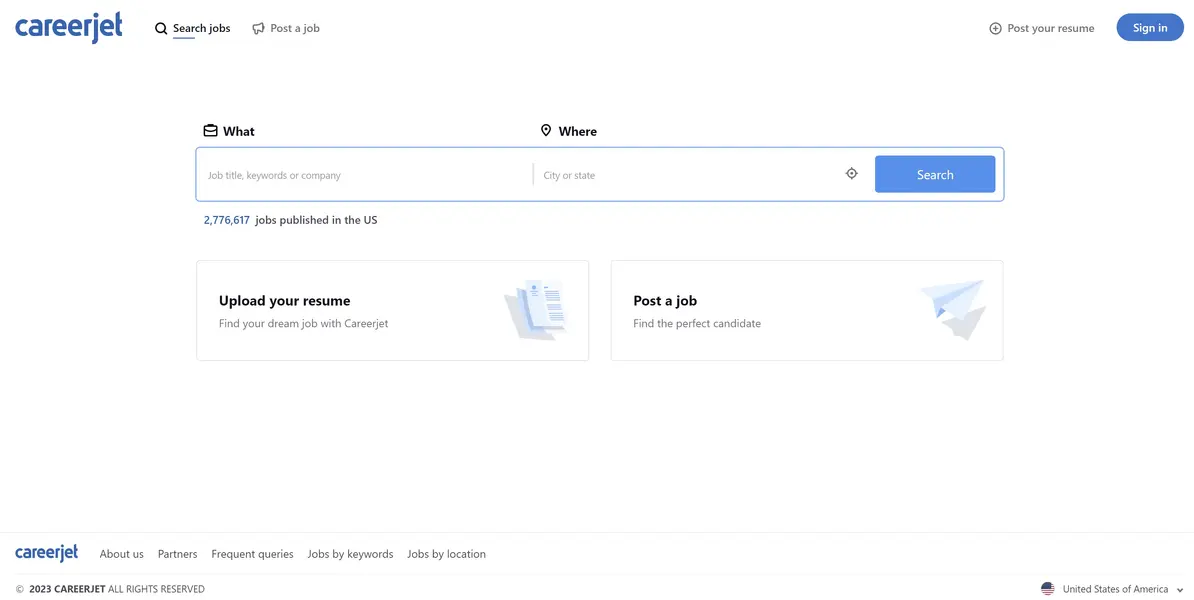
Careerjet is a job search engine, not a job board. It hosts none of the vacancies it lists: crawlers that Careerjet calls smart agents index postings from employer career sites, recruitment agencies, applicant tracking systems and rival boards, and every apply route hands the visitor back to the source site. Careerjet currently puts its own reach at over 90 countries, interfaces in 28 languages and over 58,000 websites scanned every day.

That makes a Careerjet scraper a different job from scraping a board. A board owns its rows. Careerjet owns a copy of the ad plus a pointer, and the pointer is the part nobody else publishes: every ad page names its origin twice, once as a display name and once as the origin host. That host can be an employer domain such as www.asda.com, a competing board such as www.stepstone.de, or an applicant tracking feed carrying a channel tag such as www.join.com.ats.organic.

The national storefronts are not one index in different skins. The country switcher currently lists 128 sites, and they do not all sit on the careerjet domain: French-speaking markets run on optioncarriere, Spanish-speaking markets on opcionempleo, China and Thailand on career-jet, Morocco and Tunisia on almehan. France is optioncarriere.com and Spain is opcionempleo.com, so a European brief written around careerjet.fr collects nothing.

Ad addresses stay uniform everywhere: /jobad/ plus a two-letter country code and a thirty-two character hex string, so the country of a record is readable from its id. Everything around them is localised, the search endpoint included - /search/jobs in Britain, /suchen/stellenangebote in Germany - and so are the canonical keyword slugs.

Get a Quote
dev_w
25

Developers

customers
500+

Customers worldwide

pages
1 500 000 000+

Pages extracted

stime
15000+

Hours saved for our clients

Plans

Airplane

€199 / one-time

setup fee - included

Data limits100,000
Frequencyone-time
Run timeup to 5 days
Data storing7 days

Helicopter

€169 / mo

setup fee €499

Data limits250,000
Frequencymonthly
Run timeup to 5 days
Data storing14 days

Glasses

€229 / mo

setup fee €499

Data limits1,000,000
Frequencyweekly
Run timeup to 5 days
Data storing30 days

DNA

€549 / mo

setup fee €799

Data limits3,000,000
Frequency3 times daily
Run timesame day
Data storing90 days

What Careerjet Job Market Data Shows That One Board Cannot

Scrape Careerjet and you are not sampling one publisher's inventory. You are sampling what an aggregator found across career sites, agencies, applicant tracking systems and competing boards in one country, with the origin of each ad attached. That is the difference between counting a board's business and reading a labour market.

Because the source host travels with every row, Careerjet job data answers questions a single board cannot. Which employers publish only on their own careers page and never buy a listing. Which agencies dominate a city for a given title. Which applicant tracking system a company runs, readable from the feed tag. How much of a board's inventory is republished agency stock rather than direct demand. A site operator in the search box makes that slice explicit: a query pins to one origin host, and Careerjet gives that search its own canonical page.

Run the same slices weekly and hiring trends appear: posting volume by sector, region and contract type, how long a title stays live, and where advertised pay is moving. A recruitment data feed built this way compares across countries: the field set is identical on every storefront, only labels and currency change.

One caveat we state up front: Careerjet sells placement. A direct posting is priced per job, and indexed jobs can be promoted through Boost, on a pay per click or pay per application basis, so position in a result list is not a pure relevance signal. We record the rank, and we do not treat ordering as evidence about demand.

Our Blog

Reads Our Latest News & Blog

Learn how to use web scraping to solve data problems for your organization

How Artificial Intelligence Is Used In Web Scraping

How Artificial Intelligence Is Used In Web Scraping

Leveraging advances in technology, the AI-powered web scraper has skyrocketed in demand and is helping to expand capabilities by automating tedious daily tasks and speeding up data collection from thousands of websites several times over.

What is Web Scraping and What is it Used For?

What is Web Scraping and What is it Used For?

Web scraping is a method of obtaining web data by extracting it from pages of web resources with the help of a program, that is, in automatic mode. It is used to syntactically convert web pages into more usable forms.

Web Scraping for Machine Learning

Web Scraping for Machine Learning

If you specialize in machine learning, you need to feed large amounts of data to the algorithms. Web scraping is the easiest and the most efficient method of collecting the data from all over the Internet.

scrapeit logo

How a Careerjet Scraping Project Runs at ScrapeIt

ScrapeIt is a managed service, not software you install. A Careerjet scraping project starts with your list - the countries, sectors and job titles that matter. We build the crawler, run it on your schedule, watch it when Careerjet changes its markup, and hand over clean files.

You approve a sample before the full run. Field names, the deduplication rule and the salary split are agreed on that sample, so what arrives in month three matches what you signed off in week one. When a layout change breaks a selector, the rework is ours.

FAQ

Does Careerjet have a public API, and is it enough on its own?

Yes, and this is the honest version. There is a partner Careerjet Job Search API: you open a publisher account, receive a key and call the query endpoint over basic authentication. It takes a locale code, keywords, location, contract type, working hours, radius and a sort by relevance, date or salary, and returns a hit count plus job objects with title, company, date, locations, a salary split into currency, minimum, maximum and unit, a short excerpt and a url. It does not return the full description or the site the ad came from, and depth is capped at ten pages of a hundred results - so a query reporting six thousand hits still returns about a thousand rows.

Do I have to scrape each Careerjet country site separately?

Yes, and the domain list is the first thing to get right. Careerjet runs a separate storefront per country with its own index, locale and currency, and not all of them are careerjet addresses: French-speaking markets sit on optioncarriere, Spanish-speaking markets on opcionempleo, China and Thailand on career-jet, Morocco and Tunisia on almehan. France and Spain in particular are not careerjet domains at all. The field set is identical everywhere, so once labels and currencies are normalised the countries merge cleanly into one table with a storefront column.

How complete is Careerjet salary data?

Incomplete by nature, and we would rather say so now. Careerjet publishes no estimate of its own: pay appears only when the source ad stated it, which leaves a salary on a minority of rows. Where it is there, it may be one figure or a range, quoted per hour, day, week, month or year, and it is normalised into a currency code with a minimum, a maximum and a unit. We deliver that parsed form, the original string and an explicit flag for ads with no pay at all, so any benchmark you build is measured against a base you can see rather than a silent gap.

The same vacancy appears several times. Can you deduplicate it?

We can, and on an aggregator that is real work rather than a checkbox. One job enters the index from the employer site, from the applicant tracking system and from a board that syndicated it, and each arrival is a separate record with its own id and source host. Comparing addresses will never merge them. We match on normalised employer and title, location, posting date and a fingerprint of the description text, then keep every raw row and add a group id. You can count listings, count vacancies, or use the ratio between them as a signal about how an employer distributes its jobs.

How often can you refresh the data, in what formats, and what do you leave out?

Runs can be one-off, monthly, weekly, daily or several times a day, and every row carries the timestamp of the run that produced it. Delivery is CSV, JSON, XLSX or an API endpoint, with the schema agreed on a sample before the full crawl. We read the robots file first and design the crawl inside it, and we keep to public ad and employer information: the resume database sits behind a paid recruiter subscription and is out of scope, and recruiter names, phone numbers and email addresses are personal data that we do not collect by default.

How does it Work?

Step 1 - Make a Request

You share your needs, expectations, and desired timeframe. We’ll suggest the best solution based on your request and budget.

Step 2 - Configuring Custom Web Crawlers

Our specialists configure the crawlers and extract a sample dataset for your review before proceeding with the full-scale extraction.

Step 3 - Collect and Deliver

Once you approve the sample, we launch the project and start full data collection. We gather, filter, and structure the data for easy use, delivering it on time in your preferred format.

Step 4 - Maintain and Support

Our team manages ongoing processes, monitors website changes, and supports all data extraction cycles. We can also help integrate data into your systems or create dashboards to simplify analysis.

Request a Quote

Tell us more about you and your project information.
Which sites, which fields, how often. A couple of lines is enough.

We reply within 1 business day. No obligation.

scrapiet

Scrapeit Sp. z o.o.
10/208 Legionowa str., 15-099, Bialystok, Poland
NIP: 5423457175
REGON: 523384582