FedEx Scraper for Rate Books, Surcharges and Tracking Data

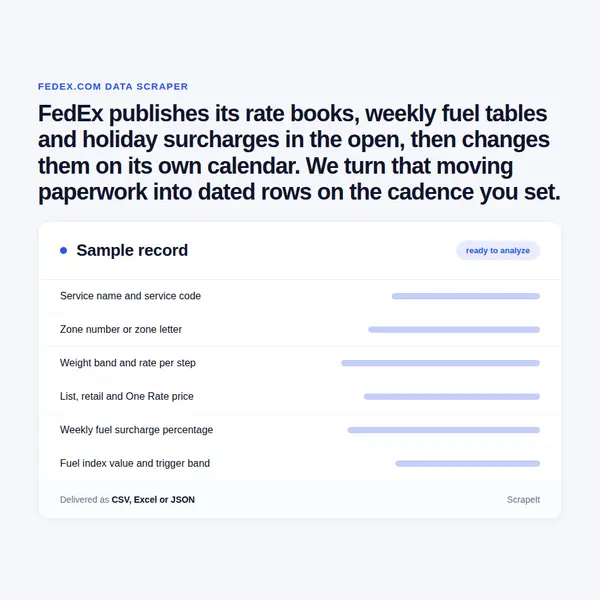
FedEx publishes its rate books, weekly fuel tables and holiday surcharges in the open, then changes them on its own calendar. We turn that moving paperwork into dated rows on the cadence you set.

FedEx Scraper
Solutions

Managed FedEx Scraping, Built and Kept Running by Us

The site turns away plain automated clients across much of its estate, the rate books arrive as PDF and spreadsheet rather than as HTML, and the locator sits on a different host with its own grammar. That mix is exactly the work we take on: anti-bot handling, proxy rotation and CAPTCHA solving, document parsing that turns a rate workbook into typed rows, and one pass per country site so every row carries the market, currency, index and effective date it was really published under. We build the FedEx scraper, run it on your cadence, watch it and repair it when a table moves or a fee is renamed. Delivery is CSV, JSON, XLSX or an API endpoint with a documented schema and stable column names. We pace collection, keep to public pages and published documents, and send a paid sample before any larger commitment.

Fields a FedEx Scraper Pulls from Rate Books, Tracking and Locations

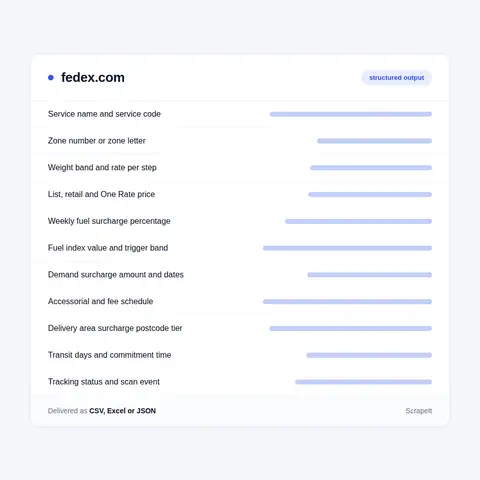
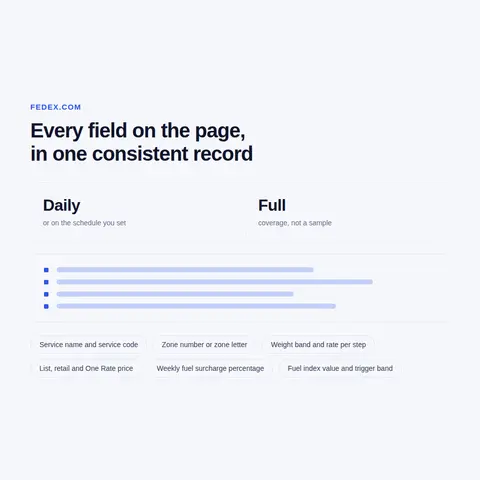
We extract FedEx data as dated rows. Each row carries the service, lane, zone, weight step, effective date, currency and country site it came from, because without those a tariff figure means nothing six weeks later.

  • Rate grids: one row per service, zone and weight step. Domestic express tables run zone 2 through zone 8 plus grouped offshore columns; export and import tables use zone letters instead; the ground tab splits into contiguous zones plus separate Hawaii, Alaska, intra-Oahu and intra-Alaska columns, with Canada on its own pair of zones. Envelope and Pak rows sit above the pound steps, and express freight is quoted per pound.
  • Fuel: effective week, index value and percentage, with one series tied to on-highway diesel for ground services and another to Gulf Coast jet fuel for everything else, plus a per-pound figure for domestic express freight and a per-kilo figure for airport-to-airport freight. The trigger ladders give the price band and the step size.
  • Demand surcharges: surcharge name, the services it hits, amount per package and the dated band it runs in, plus the peaking-factor ladder that prices the residential charge off a shipper's own volume.
  • Services and commitments: service name, transit days, commitment time, money-back guarantee status, packaging type, dimensional weight rule and declared value ceiling.
  • Locations: location id, location type, street address, city, region, postal code, country, phone, coordinates, opening hours by weekday and two separate last-pickup schedules, one for express and one for ground.
  • Tracking: tracking number, carrier code, service type, latest status with its scan code, scan events with timestamp, place and event type, delay reason by type and sub-type, the estimated delivery window, weight, dimensions and delivery attempt count.
  • Restrictions: prohibited commodity lists per country, dangerous goods categories and the dated service alerts that suspend a lane.

What the carrier keeps private we leave alone. Negotiated account rates, invoices, shipment contents and a recipient's name, address or signature are not published, so we do not supply them, and we do not follow shipments a client has no standing to see.

Fields a FedEx Scraper Pulls from Rate Books, Tracking and Locations
FedEx Country Sites, Three Fuel Clocks and the Locations Network

FedEx Country Sites, Three Fuel Clocks and the Locations Network

Point of sale is part of the record here, not a display preference. The same week can carry three different fuel percentages depending on which FedEx document you open, because the index behind each differs. International express in Europe is priced off the Gulf Coast spot price for kerosene-type jet fuel and moves weekly. Regional economy services are priced off the European Commission automotive gas oil price in euros per litre, also weekly, with the new figure posted around the Friday before it takes effect. The British domestic surcharge runs monthly off the national statistics forecourt diesel price in pence per litre, with a stated one month lag between index month and billing month.

Publishing habits differ as much as the indexes. The British surcharge pages carry the full weekly history and the complete trigger ladder; the American fuel page shows two weeks plus a short slice of each table and pushes the rest into the Service Guide. Ground and home delivery ride diesel while everything else rides jet fuel, so two series on one page diverge inside the same week. The developer material moves on its own clock, with an announcements feed dating every API change, outage and deprecation.

The location network is a dataset of its own and lives on a separate host. Addresses follow a locale, region, city and location id grammar, every local-language locale is mirrored in English, and branded branches add child pages per service - printing and copying, banners and signs, passport photos, packing supplies. As of September 2026 the United States directory currently reports about 23,167 locations.

What FedEx Publishes Openly and What Stays Behind an Account

FedEx Corporate Services runs fedex.com as a reference library rather than a storefront. There is no catalogue to page through and nothing to add to a basket: the public layer is a stack of rate books, tariff tables, service descriptions, regulatory lists and a store locator, republished on a calendar the carrier sets itself. Every market sits on its own path of the same domain - en-us, es-us, de-de, fr-fr, ja-jp, zh-cn, ar-ae and the rest - and each one carries a different subset of those documents under different path words, which is why a country by country pass is the only honest way to cover the carrier.

The numbers live in documents, not in pages. The FedEx Service Guide carries the terms of carriage and the fee definitions. The Standard List Rates workbook carries the grids themselves, split into United States, United States export, United States import and ground tabs, priced by service, by zone and by weight step. Around them sit retail rates, FedEx One Rate flat pricing, the delivery area and pickup area postcode tiers, the weekly fuel tables and a surcharge change sheet for the year ahead. Most are posted as a PDF and a spreadsheet at once, which is why a FedEx price feed is a parsing job as much as a crawl.

Shipment status is the one thing keyed to a single package rather than to a tariff. A tracking number returns a status, a scan history and a delivery schedule; the signature image, the full sender and recipient detail and everything behind a login stay with the parties to the shipment. That line matters, and we work on the public side of it.

Get a Quote

dev_w
25

Developers

customers
500+

Customers worldwide

pages
1 500 000 000+

Pages extracted

stime
15000+

Hours saved for our clients

Plans

Airplane

€199 / one-time

setup fee - included

Data limits100,000
Frequencyone-time
Run timeup to 5 days
Data storing7 days

Helicopter

€169 / mo

setup fee €499

Data limits250,000
Frequencymonthly
Run timeup to 5 days
Data storing14 days

Glasses

€229 / mo

setup fee €499

Data limits1,000,000
Frequencyweekly
Run timeup to 5 days
Data storing30 days

DNA

€549 / mo

setup fee €799

Data limits3,000,000
Frequency3 times daily
Run timesame day
Data storing90 days

Who Buys FedEx Price and Surcharge Data, and What the Series Answers

Parcel spend sits near the top of the controllable lines in an e-commerce cost model, and almost none of it is a single number. An invoice is a list rate, minus a negotiated discount, plus a fuel percentage that moved this week, plus whatever accessorial fired on that particular package. Teams that benchmark carrier contracts rebuild that stack from the published side, and to do it they need the list grid, the fuel table for the right week and the fee schedule that was live on the ship date.

Freight audit and parcel consulting firms are the heaviest users. They reprice historical shipments against current published rates to show a client what a renegotiation is worth, and that only works if the rate history is dated and complete. Logistics software vendors need the same grids to drive rate shopping inside a warehouse system. Retailers and marketplaces use the service and transit layer to promise a delivery date at checkout without calling a carrier on every page view.

Competing carriers and postal operators read the surcharge calendar rather than the base rates, because that is where policy shows: when a peak surcharge starts, how steep the holiday step is, which fee is new this year, which lane just moved a zone. Analysts and trade press follow the same series, and customs and compliance teams watch the prohibited item lists and service alerts to know which destinations are effectively closed. None of it can be answered by a single snapshot; the value sits in the same document collected again and again with its effective date attached.

Our Blog

Reads Our Latest News & Blog

Learn how to use web scraping to solve data problems for your organization

How Artificial Intelligence Is Used In Web Scraping

How Artificial Intelligence Is Used In Web Scraping

Leveraging advances in technology, the AI-powered web scraper has skyrocketed in demand and is helping to expand capabilities by automating tedious daily tasks and speeding up data collection from thousands of websites several times over.

What is Web Scraping and What is it Used For?

What is Web Scraping and What is it Used For?

Web scraping is a method of obtaining web data by extracting it from pages of web resources with the help of a program, that is, in automatic mode. It is used to syntactically convert web pages into more usable forms.

Web Scraping for Machine Learning

Web Scraping for Machine Learning

If you specialize in machine learning, you need to feed large amounts of data to the algorithms. Web scraping is the easiest and the most efficient method of collecting the data from all over the Internet.

scrapeit logo

ScrapeIt, and How the Work Splits Between Us

ScrapeIt is a managed web scraping agency. You name the services, lanes, countries and refresh rate; we write the crawler, run it on schedule, monitor it and fix it when the target moves. There is nothing to install and nothing to maintain on your side. You get documented output in the format you asked for, stable column names, and a named contact who knows the project. We also tell you plainly what is collectable and what is not before you commit to anything.

FAQ

Does FedEx have a public API we could use instead of scraping?

Yes, with limits worth knowing. The developer portal publishes a REST catalog covering Ship, Rates and Transit Times, Basic Integrated Visibility (the former Track API), Address Validation, Service Availability, Locations Search, Pickup, duty and tax estimates, trade documents and ground end-of-day close, plus a tracking webhook. Access is OAuth based and tied to a carrier account attached to your organization, daily quotas and a per-project rate limit apply, and the sandbox is virtualized: it returns predefined replies, not real rates. The catalog exists to run your own shipping, not to hand over a dataset, so published rate books stay the practical source for market-wide work.

Which FedEx fields can you extract, and which are simply not published?

We take what the public layer holds: list rate grids by service, zone and weight, retail and flat rate pricing, weekly fuel percentages with their index values and trigger bands, demand surcharge amounts with their date ranges, accessorial and fee schedules, delivery and pickup area postcode tiers, service descriptions and commitments, prohibited item lists by country, dated service alerts, and the locator with hours, coordinates and last pickup times. Negotiated account rates, invoices, shipment contents and anything behind a login are not published, so we do not supply them, and we collect no personal data about senders or recipients.

How often do FedEx rates and surcharges change, and how often should we collect?

They run on different clocks. The general rate increase lands once a year in early January and is announced months ahead, with next year's rate book posted beside the current one. Fuel is weekly for American and international services and monthly for the British domestic surcharge. Peak demand surcharges are published as dated bands and revised during the season, and the residential demand charge is recalculated every week from the shipper's own volume. Weekly collection covers fuel and demand; a daily pass on the change pages catches a mid-season revision the day it appears; rate books need a check whenever a new effective date is announced.

Can you collect FedEx rates and surcharges for more than one country?

Yes, and here it matters more than usual. Each country site carries its own documents under its own path words, its own currency and its own fuel methodology, so a single global table built from one market is wrong by construction. We run each market as its own pass and stamp every row with the site, language, currency, index used and effective date. Where one market publishes more history than another - the British surcharge pages carry the full weekly series while the American page carries only the current weeks - we say which series a row came from instead of blending them.

What formats do you deliver, and is scraping FedEx legal?

Delivery is CSV, JSON, XLSX or a REST endpoint on your schedule, with a documented schema and stable column names. On the legal side, be clear eyed. The fedex.com terms of use state that the site is for current and potential customers of the carrier and that non-authorized scripting technologies to obtain information from it are prohibited, while tracking updates and signature proof of delivery are offered on the basis that you are the shipper, recipient or payor. We take public pages and published documents, defeat no access control, and follow no shipment a client cannot claim. Take your own legal advice for your jurisdiction and use, and we will scope collection to what it allows.

How does it Work?

Step 1 - Make a Request

You share your needs, expectations, and desired timeframe. We’ll suggest the best solution based on your request and budget.

Step 2 - Configuring Custom Web Crawlers

Our specialists configure the crawlers and extract a sample dataset for your review before proceeding with the full-scale extraction.

Step 3 - Collect and Deliver

Once you approve the sample, we launch the project and start full data collection. We gather, filter, and structure the data for easy use, delivering it on time in your preferred format.

Step 4 - Maintain and Support

Our team manages ongoing processes, monitors website changes, and supports all data extraction cycles. We can also help integrate data into your systems or create dashboards to simplify analysis.

Request a Quote

Tell us more about you and your project information.
Which sites, which fields, how often. A couple of lines is enough.

We reply within 1 business day. No obligation.

scrapiet

Scrapeit Sp. z o.o.
10/208 Legionowa str., 15-099, Bialystok, Poland
NIP: 5423457175
REGON: 523384582