ShipStation Scraper for Plan Pricing, Carrier Discounts and the Integrations Directory

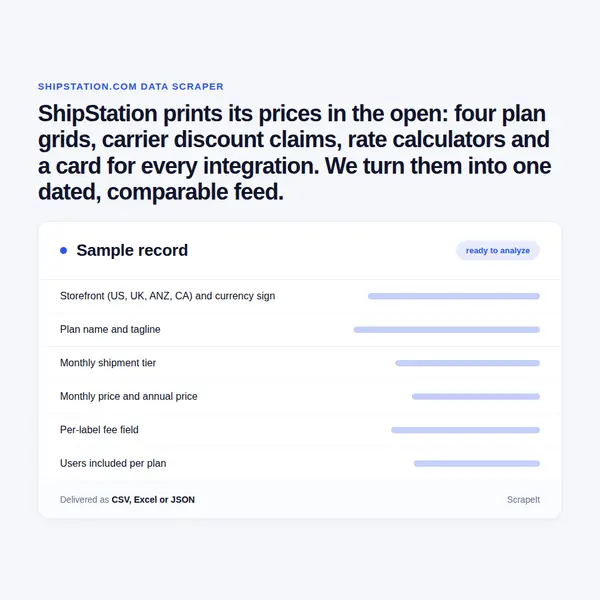
ShipStation prints its prices in the open: four plan grids, carrier discount claims, rate calculators and a card for every integration. We turn them into one dated, comparable feed.

Plans from €169/month · Free project assessment · Reply within 1 business day

ShipStation Scraper
Solutions

ShipStation shipping rates and plan grids, collected on your schedule

The plan grids keep most tiers inside dropdowns, the calculators answer only when asked with a parcel, and the directory loads 24 cards at a time, so a plain copy of the page misses most of what ShipStation shows. We run the whole path: one collector per storefront, a fixed set of postcode pairs and parcel profiles for ShipStation shipping rates, parsers that turn every tier, claim and card into typed rows, and anti-bot handling, proxy rotation and CAPTCHA solving wherever a page pushes back. We extract ShipStation data as JSON through our API or as CSV and XLSX files: grids and discount pages weekly or daily, the directory with a change record for every card. No logins, no paywalls.

ShipStation pricing, carrier discounts and calculator quotes, field by field

The ShipStation subscription plans are published tier by tier, but the same plan names sit on different ladders, currencies and tax rules in each storefront, so every row we deliver carries the storefront, currency sign, tax note, billing period and the date it was read.

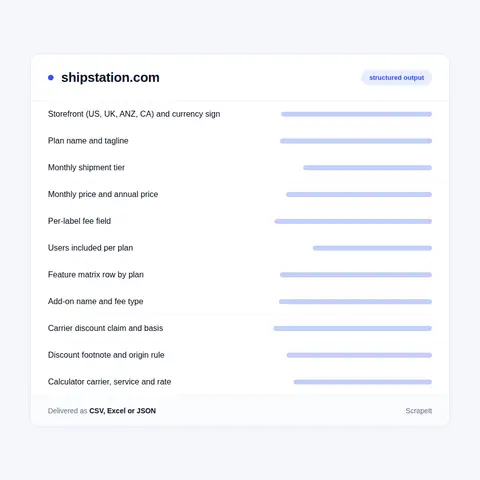
  • Plan grid: plan (Free, Starter, Standard, Premium), tagline, monthly shipment tier, monthly price, annual price at the advertised 20% saving, users included (1, 3, 10 or 15) and the per-label fee field. The ShipStation pricing tiers currently run from 50 to 100,000 shipments a month, and the ShipStation monthly cost for Starter at 50 shipments reads $14.99 in the US, GBP 10 in the UK, $19.99 on the Canadian page and $22.00 on ANZ. ShipStation UK pricing is quoted before VAT, ShipStation Australia includes GST and shows Custom price for Standard and Premium from 10,000 shipments, and ShipStation Canada pricing shows higher figures than the US grid at every tier. Whether ShipStation will charge per label is answered by the grid itself: the per-label fee field reads 0.000 on all four storefronts.
  • Feature matrix and fine print: every row of the full comparison - order, shipping, returns, tracking, automation, analytics, inventory, warehouse and support features - plus the ShipStation LTL freight rows that only the US grid shows, the Fulfillment, 3PL Manager and Dropship Manager add-ons, and FAQ notes such as the extra carrier connection fees for older plans, with a different registration cutoff on ANZ than in the US and Canada.
  • Discount claims: carrier, service, claimed saving, its basis (retail rates or Daily Rates) and the footnote. The US carrier page promises up to 84% off retail from UPS, USPS and DHL Express for continental US origins only; the Canadian home page lists up to 84% off Purolator Ground and 42% off Canpar Ground for Canada origins.
  • Calculator quotes: the ShipStation rate calculator takes origin and destination postcode, weight, dimensions, delivery window and address type, and returns carrier, service, package type, rate, delivery estimate and a Cheapest, Fastest or Best Value badge. Its "starting from" tables add fixed reference points, such as ShipStation USPS rates from $6.98 for Ground Advantage and Aramex Standard from $6.26 on ANZ.

ShipStation pricing, carrier discounts and calculator quotes, field by field
ShipStation integrations directory: carriers, marketplaces and store platforms

ShipStation integrations directory: carriers, marketplaces and store platforms

The integrations directory is the public map of who connects to ShipStation. It currently holds 481 cards (September 2026): 185 carriers, 65 ecommerce tools, 59 marketplaces, 35 online stores and shopping carts, 32 fulfillment and logistics providers, 21 order and inventory management tools, 11 listing and multichannel tools and 10 ERP and accounting systems. Country tags are led by the US, Canada, the UK, Australia and France, and the ANZ edition adds two local carrier cards of its own.

  • Directory card: title, excerpt, logo, product line, integration type, country tags and card URL.
  • Card page: how the connection works - your own carrier account or rates bought through ShipStation - the services it exposes and the order data it syncs. The Royal Mail card lists Tracked 24, Tracked 48, Tracked and Signed and International Tracked with delivery days, size and weight limits and compensation up to GBP 150; the ShipStation integration with Shopify card says 6-digit HS codes flow into customs declarations, and the Etsy card lists coupon code and discount amount among synced fields.
  • Change history: published and modified dates on every card. New ShipStation carriers arrive in blocks, like the LTL cards for ABF, Estes, Old Dominion, Saia and XPO, all published on one day in July 2026, and channels such as the ShipStation TikTok Shop card or the Walmart card built around Ship with Walmart show up as dated additions.

ShipStation data scraping: four storefronts, one public layer

A ShipStation scraper has to start with the fact that shipstation.com is four storefronts, not one. ShipStation is US shipping software for online sellers: it pulls orders from stores and marketplaces, compares carrier rates, buys and prints labels, and runs returns, inventory and warehouse work in one place. The site points visitors from the UK and Ireland to the en-gb edition, Australia and New Zealand to en-au and Canada to en-ca, while everyone else stays on the US site, and each edition keeps its own price grid, carrier line-up and discount claims. ShipStation now sits inside ShipStation Global, the group formed when its owner Auctane merged with WWEX Group, which also runs Worldwide Express and Unishippers; the US plans let users bring their own Worldwide Express or Unishippers LTL account.

The public layer is unusually complete. Plan pages list the shipment tiers with their prices, the integrations directory has a card for each carrier, marketplace, cart, ERP and app, carrier pages quote discounts off retail rates, rate calculators carry "starting from" tables, and blog posts follow carrier rate changes with their effective dates. The account itself - orders, labels, postage balance, negotiated contract rates, reports - sits behind a sign-in and stays out of scope, so ShipStation data scraping here means what any prospect can read before starting a trial.

Get a Quote

dev_w
25

Developers

customers
500+

Customers worldwide

pages
1 500 000 000+

Pages extracted

stime
15000+

Hours saved for our clients

Plans

ShipStation Scraping Plans and Pricing

Airplane

€199 / one-time

setup fee - included

Data limits100,000
Frequencyone-time
Run timeup to 5 days
Data storing7 days

Helicopter

€169 / mo

setup fee €499

Data limits250,000
Frequencymonthly
Run timeup to 5 days
Data storing14 days

Glasses

€229 / mo

setup fee €499

Data limits1,000,000
Frequencyweekly
Run timeup to 5 days
Data storing30 days

DNA

€549 / mo

setup fee €799

Data limits3,000,000
Frequency3 times daily
Run timesame day
Data storing90 days

Why teams track ShipStation plans and every ShipStation price increase

Teams scrape ShipStation for four reasons, and each of them needs a history rather than a single read.

  • Software price comparison: review sites, ShipStation alternatives lists and pages such as ShipStation vs Pirate Ship need current ShipStation prices per plan, tier and country, not last year's screenshot.
  • Competitor monitoring: rival shipping platforms watch the ladder gain or lose steps, a free plan shown on one storefront and missing from another, features moving between plans and the date each ShipStation price increase went live. A ShipStation price tracker built on dated rows shows what changed, where and when.
  • Integration mapping: carriers, marketplaces and app vendors check who is listed in which country, what each card promises and which rivals joined since the last read.
  • Discount benchmarking: shippers set ShipStation carrier rates and claims - a ShipStation UPS discount of up to 83% off Daily Rates, a ShipStation FedEx discount of up to 72% on FedEx International Connect Plus from Canada - against their own contract before they renegotiate.

Our Blog

Reads Our Latest News & Blog

Learn how to use web scraping to solve data problems for your organization

How Artificial Intelligence Is Used In Web Scraping

How Artificial Intelligence Is Used In Web Scraping

Leveraging advances in technology, the AI-powered web scraper has skyrocketed in demand and is helping to expand capabilities by automating tedious daily tasks and speeding up data collection from thousands of websites several times over.

What is Web Scraping and What is it Used For?

What is Web Scraping and What is it Used For?

Web scraping is a method of obtaining web data by extracting it from pages of web resources with the help of a program, that is, in automatic mode. It is used to syntactically convert web pages into more usable forms.

Web Scraping for Machine Learning

Web Scraping for Machine Learning

If you specialize in machine learning, you need to feed large amounts of data to the algorithms. Web scraping is the easiest and the most efficient method of collecting the data from all over the Internet.

scrapeit logo

ScrapeIt, the managed team behind your ShipStation dataset

ScrapeIt is a managed web scraping agency, not a tool to configure. You name the storefronts, plans, carriers and directory filters; we build the collectors, run them on the schedule each page needs, watch them and repair them when ShipStation reshapes a grid or renames a plan. You get documented columns that stay stable and a named engineer who knows the project. A sample comes first, so you can hold it against the pricing page you see before anything is scheduled.

FAQ

Do you offer a ShipStation API?

Yes. The ScrapeIt ShipStation API returns what ShipStation publishes as dated JSON: plan, shipment tier, monthly and annual price, currency, tax note and per-label fee for each storefront; feature rows and add-ons; discount claims with carrier, service, claimed saving and footnote; calculator quotes for your parcel profiles; and integration cards with type, country tags, services and change dates. It runs on the schedule you set, and every delivery is also available as CSV and XLSX.

How much does ShipStation cost in each country, and how current is your data?

It depends on the storefront. At 50 shipments a month Starter is $14.99 in the US, GBP 10 in the UK, $19.99 on the Canadian page and $22.00 including GST on ANZ, and the ShipStation free plan appears only on the UK page, at GBP 0 for one user and one store; elsewhere the entry point is a 30-day trial. We read all four grids weekly by default, or daily around an announced change, and keep every version, so each price move is dated to the collection that first saw it.

Can you track ShipStation discounted rates by carrier and country?

Yes, as published claims. We record carrier, service, claimed saving, basis and footnote per storefront and page: up to 87% off USPS retail prices and up to 81% on DHL Express international in the US, up to 76% off UPS Standard and 84% off Purolator Ground in Canada, up to 78% off Parcelforce in the UK, where ShipStation Evri labels start at GBP 2.25 excluding VAT. The same carrier can carry different claims on different pages, so every row keeps its source URL.

Which carriers does ShipStation support, and can you map them by country?

Yes. The directory tags 185 carriers: USPS, UPS, FedEx and DHL Express in the US; Royal Mail, Evri, Parcelforce and DPD in the UK; Canada Post, Purolator and Canpar in Canada; Australia Post, Aramex and CouriersPlease on ANZ; and US LTL lines such as ABF, Estes and Old Dominion. We deliver the ShipStation supported carriers as rows with country tags, the services listed on each card and the date the card last changed.

Is it legal to scrape ShipStation?

We collect only publicly available data - everything a visitor can see on ShipStation - and we collect it legally. No logins, no paywalls: the app, postage balance, orders, labels and negotiated contract rates are never touched. Plan grids, discount claims, calculator quotes for sample parcels, integration cards and rate-change posts are in. Names from customer stories and blog bylines are left out, and any personal data that appears is handled under GDPR.

How does it Work?

Step 1 - Make a Request

You share your needs, expectations, and desired timeframe. We’ll suggest the best solution based on your request and budget.

Step 2 - Configuring Custom Web Crawlers

Our specialists configure the crawlers and extract a sample dataset for your review before proceeding with the full-scale extraction.

Step 3 - Collect and Deliver

Once you approve the sample, we launch the project and start full data collection. We gather, filter, and structure the data for easy use, delivering it on time in your preferred format.

Step 4 - Maintain and Support

Our team manages ongoing processes, monitors website changes, and supports all data extraction cycles. We can also help integrate data into your systems or create dashboards to simplify analysis.

Request a Quote

Tell us more about you and your project information.
Which sites, which fields, how often. A couple of lines is enough.

We reply within 1 business day. No obligation.

scrapiet

Scrapeit Sp. z o.o.
10/208 Legionowa str., 15-099, Bialystok, Poland
NIP: 5423457175
REGON: 523384582