UPS Fields Worth Collecting: Services, Zones, Weight Ladders and Fees
A UPS scraper does not harvest product cards - it rebuilds a pricing model. The service grid is the spine. Domestic rows are sorted across Same Day, 1 Day, 2 Days, 3 Days and Day-Definite columns, with a parallel block for Alaska and Hawaii, and Day-Definite carries its own footnote: within five days. The rows are UPS Express Critical, UPS Next Day Air Early, UPS Next Day Air, UPS Next Day Air Saver, UPS 2nd Day Air A.M., UPS 2nd Day Air, UPS 3 Day Select, UPS Simple Rate, UPS Ground and the Intra-Alaska and Intra-Oahu Ground variants. Export and import run on their own column set - Best Available Flight, 1-3 Days, 2-5 Days, Within 3 Days, 3-5 Days and Day-Definite - over Worldwide Express Plus, Worldwide Express NA1, Worldwide Express, Worldwide Express Freight Midday, Worldwide Express Freight, Worldwide Saver, Worldwide Expedited, Standard to and from Canada and Mexico, and three Air Freight tiers.
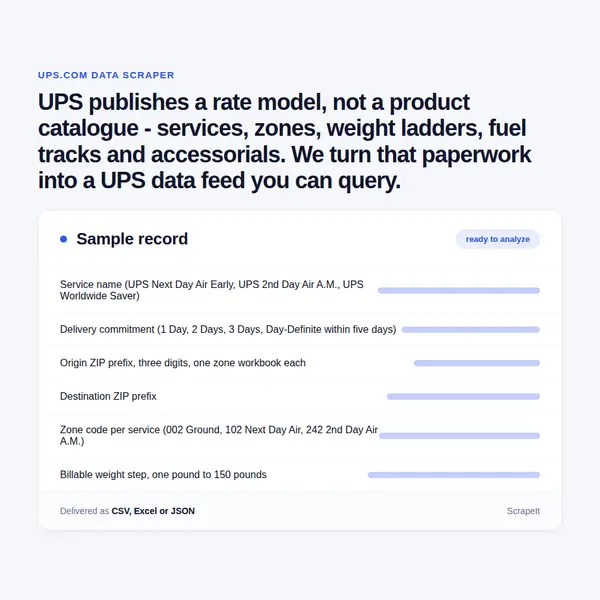
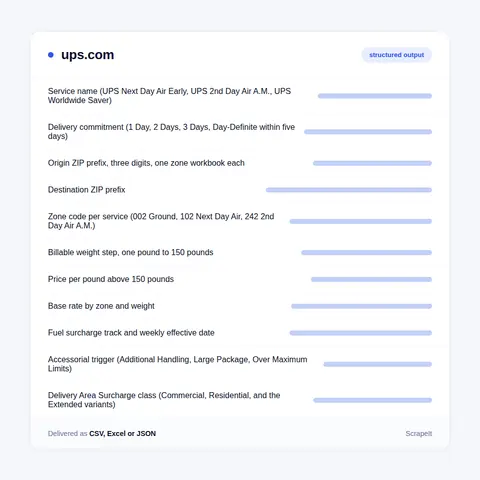
Zones are the field most projects get wrong. There is no single domestic zone table to extract. UPS keys the chart to the shipper, not to the lane: you hand it an origin postal code, it matches the first three digits against an index of 902 prefixes and returns one workbook for that prefix alone. Inside sits a single sheet that names the origin range it covers and lists destination ZIP prefix against six service columns - Ground, 3 Day Select, 2nd Day Air, 2nd Day Air A.M., Next Day Air Saver and Next Day Air - with a dash wherever the service is not offered. The zone values are service-prefixed, so one lane reads 002 for Ground, 102 for Next Day Air and 242 for 2nd Day Air A.M. International zones work differently again: the Worldwide Zone Chart keys each destination by country name and ISO code, gives a zone per service, leaves the cell empty where the service is not sold, and hands Canada and Mexico charts of their own. Worldwide Expedited even splits its zone by whether the origin state counts as West or East.
The rate itself is a weight ladder. Each page carries four side-by-side blocks stepping from one pound to 150 pounds against zone columns, then closes with a price per pound for anything heavier. Building a usable UPS price table means reconstructing that ladder per service, per origin group and per zone, then keeping the three of them aligned when the guide is reissued.