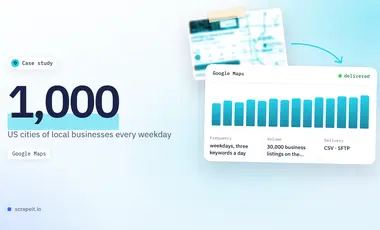
Google Maps Data: Local Businesses from 1,000 US Cities Every Weekday
A weekday feed of local businesses from Google Maps for a local-marketing company: 1,000 US cities, three keywords a day, files by 10:00 UTC.
Capterra scores every product four more times after the overall rating: ease of use, value for money, customer service and features. Our Capterra scraper keeps them all.
Plans from €169 a month · Free project assessment · Reply within 1 business day
CSV · Excel · JSON · XML · FTP · SFTP · Amazon S3 · Google Cloud
API, JSON feed or CSV, XLSX and JSON files
ScheduleOne-time, monthly, weekly, daily or 3 times a day
Capterra pages, filters, fields and a schedule
Built, monitored and repaired by our team
API, JSON feed or CSV, XLSX and JSON files
Capterra is a directory first and a review site second, so the natural unit of a project is a category - CRM, project management, accounting - and not a single product. You give us the categories or the product list, the country sites and the refresh rhythm; we write the crawlers, operate them and fix them when the pages change.
The site sits behind a web application firewall, so proxy rotation, pacing and browser rendering are included. Deliveries go out as CSV, Excel, JSON or JSONLines to Amazon S3, SFTP, Google Drive or your database, once or on a schedule. Plans start from EUR 169 a month, or EUR 199 for a one-time extract.
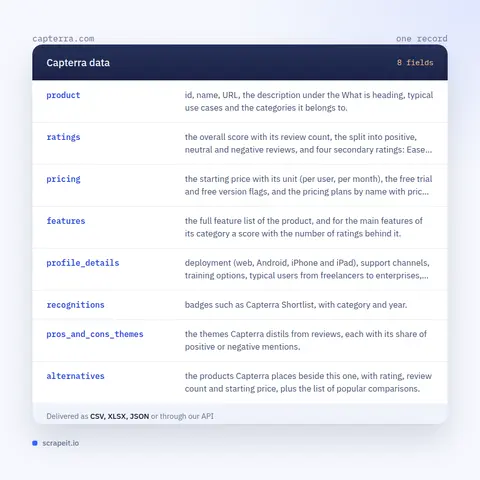
A Capterra product page reads like a spec sheet followed by reviews. Its address carries a numeric product id - capterra.com/p/135003/Slack/ - and the same id opens the product on the country sites, which makes it the join key of the whole dataset.
Category pages return a shorter card per product - name, rating, review count, description, key features and badges - so the software listings of a whole category can be collected first and deepened product by product.
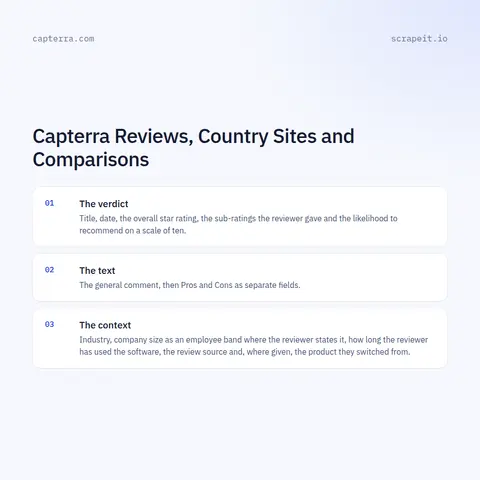
Reviews are the second layer. Each product has a reviews page that shows twenty-five reviews at a time and can be ordered by helpfulness, rating, company size, reviewer's role, length of use and frequency of use. From every review we take:
Capterra also runs country sites - capterra.co.uk, capterra.com.de, capterra.fr, capterra.es and others - with the interface, the category names and many reviews in the local language. We collect the sites you choose and add a site column, so German or French reviews can be read apart from the English ones.
Comparison pages put two products into one table: overall rating, starting price, free trial, free version, the secondary ratings, per-feature scores and the counts of positive, neutral and negative reviews. Repeated runs add what a single visit cannot show - how ratings, review counts and starting prices move over time.
Capterra is a software directory for business buyers: a catalogue of products sorted into more than nine hundred categories, each product with a profile, a price indication and user reviews. The site counts its verified reviews in the millions. Formerly a Gartner company, Capterra now belongs to G2; the two sites keep separate reviews, so one product carries a different score and a different review count on each.
The structure is category first. A category page such as CRM software lists a couple of thousand products over dozens of pages and can be narrowed by plan type (free trial, free version, monthly or annual subscription), by key feature and by deployment: cloud, desktop, on-premise or mobile. Capterra Shortlist marks the highest-rated and most popular products of a category, and a card may show the share of reviewers who recommend the product.
From a card the path leads to the product page, to its sub-pages for pricing, alternatives and reviews, and to comparison pages that pair two product ids in one address. Because every page type repeats the same labels, a category of any size collapses into two tables: products and reviews.
Delivery: CSV, JSON or XLSX files, our API or a JSON feed. MCP server on request.
Full plan detailsCapterra lays software out the way a buyer compares it, which is why its fields travel well into spreadsheets and models.
Collected from several country sites, the review texts also show what German, French or British users write in their own language.
Learn how to use web scraping to solve data problems for your organization
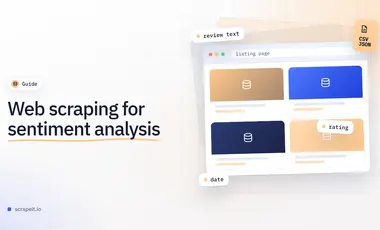
Where opinion text lives on the public web, what a review record contains on each kind of site, which fields a model needs besides the text, and what quietly breaks a sentiment dataset - with examples from our own projects.
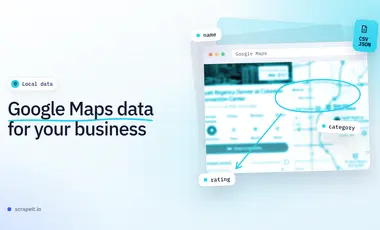
Using web scraping to extract Google Maps data will help you quickly and efficiently find businesses in any industry, city, state, or region. And the extracted contact information, such as phone or email address, social networks, or links to web pages, will help to contact them.
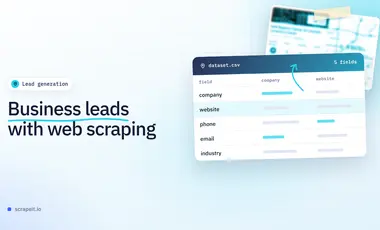
Lead scraping is a reliable way to get the right customer contacts to market your product, saves organizations time, and helps you better understand the audience you want to attract. Contacts include emails, phone numbers, or social media profiles.

ScrapeIt is a data collection agency. You describe the dataset; our team writes the crawlers, keeps them running and hands over the files with a description of every field. Software directories suit this way of working: thousands of near-identical profiles, prices that change quietly and reviews that keep arriving.
For Capterra we collect what any visitor sees and never log in. Personal data is handled under GDPR, and reviewer names and job titles stay out by default. An MCP server is available on request.
Still unsure? Write to info@scrapeit.io
Yes. The ScrapeIt Capterra API returns product id, name, overall rating, the four secondary ratings, starting price, free trial and free version flags and the review fields as JSON from an endpoint we host, refreshed on the schedule you set. If you prefer files, the same data arrives as CSV or XLSX, as a JSON feed or as a load into your database.
Yes. Product pages, prices, feature lists, ratings and review texts are published on capterra.com and its country sites for every visitor. We collect only publicly available data - everything a visitor can see on Capterra - and we collect it legally. Reviewer names and job titles are personal data and are not included by default.
It contains a product table with id, name, rating, review count, secondary ratings, starting price, plan type flags, deployment and feature list for every product in the category, and a review table joined to it by product id. Alternatives and comparison pairs can be added as a third table. Field documentation comes with the files.
Yes. Local sites such as capterra.co.uk, capterra.com.de and capterra.fr use the same numeric product id as capterra.com, so rows from different sites join without guesswork. Interface labels and many reviews there are in the local language, and we keep the original text next to a site column.
Reviews keep arriving on popular products, and the overall score and the four secondary ratings are recalculated with them. Starting prices and plan names change when a vendor reprices, which a monthly run catches. For review monitoring we re-read the review pages every week and add only the reviews not yet in your table.
You share your needs, expectations, and desired timeframe. We'll suggest the best solution based on your request and budget.
Our specialists configure the crawlers and extract a sample dataset for your review before proceeding with the full-scale extraction.
Once you approve the sample, we launch the project and start full data collection. We gather, filter, and structure the data for easy use, delivering it on time in your preferred format.
Our team manages ongoing processes, monitors website changes, and supports all data extraction cycles. We can also help integrate data into your systems or create dashboards to simplify analysis.
Tell us which sites, which fields and how often. A couple of lines is enough to start.
Capterra data from €169/month. Free project assessment, reply within 1 business day.