
G2 Scraper for Software Reviews, Ratings and Pricing

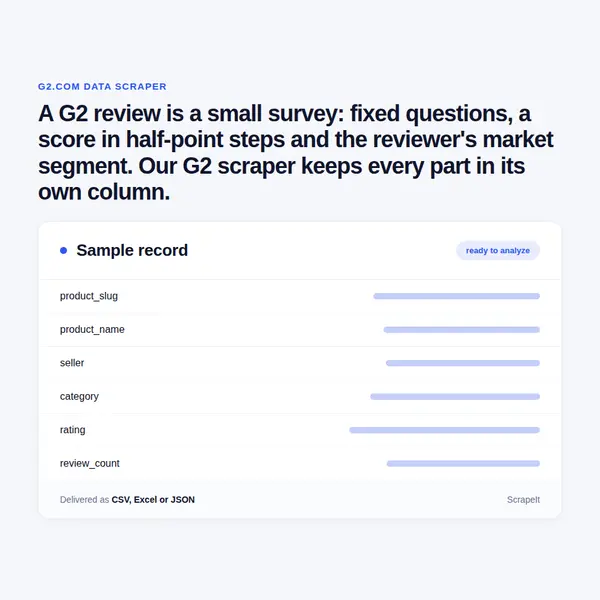
A G2 review is a small survey: fixed questions, a score in half-point steps and the reviewer's market segment. Our G2 scraper keeps every part in its own column.

Plans from €169/month · Free project assessment · Reply within 1 business day

G2 Scraper
Solutions

How G2 Scraping Works With ScrapeIt

You send a list of products, sellers or categories and tell us which parts you need: reviews, ratings, pricing editions, alternatives, comparisons. We build the G2 crawlers, run them on your schedule and repair them whenever the site changes.

G2 challenges traffic it does not recognise, so rendering, pacing, proxy rotation and CAPTCHA handling are part of the service, not something you set up. We read G2 as an anonymous visitor and never log in. What the site keeps for signed-in members stays outside the dataset, and we show you where that line runs before the project starts. The project assessment is free, and a sample can be ordered before you decide.

What Our G2 Review Scraper Collects

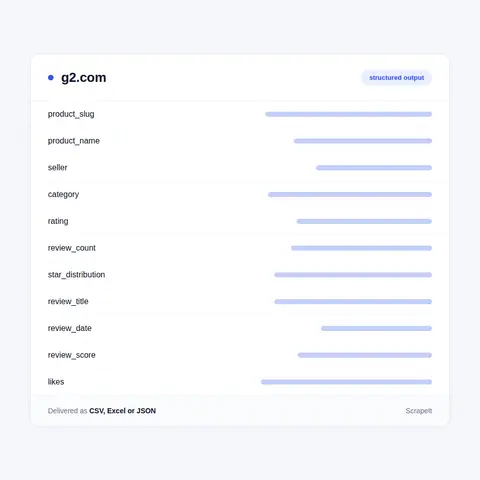
The product profile is where most G2 data lives. Its address is built from a product slug - g2.com/products/slack/reviews - and that slug is the key we keep on every row. From the profile we take:

  • Product - name, description, seller, languages supported, the categories the product is listed in and its integrations.
  • Rating summary - the average score on the five-point scale, the review count and the star distribution: a count for each of the five levels.
  • Pros and cons tags - the topics G2 extracts from review texts, each with the number of reviews that mention it, such as Notification Issues or Missing Features.
  • Review - title, date, the score in half-point steps, and the answers to G2's fixed questions as separate columns: what the reviewer likes best, what they dislike, and which problems the product solves for them.
  • Reviewer context - industry and market segment: Small-Business, Mid-Market or Enterprise, each defined by headcount.
  • Review labels - Validated Reviewer, Current User, Incentivized Review, Translated Using AI, and the review source line that tells an organic review from a G2 invite or a seller invite. Reviews from business partners and guest users, which G2 leaves out of its scores, carry labels of their own.
  • Pricing - edition names, price and billing unit, the features listed under each edition, the free trial flag and the date the pricing was last updated.
  • Features - the feature groups of the product and the features listed under each.

Reviewer names, job titles and photos are personal data, so they stay out of the files by default. Industry and segment remain, because they describe a company and not a person.

What Our G2 Review Scraper Collects
G2 Data Beyond the Product Profile

G2 Data Beyond the Product Profile

Around each profile G2 publishes pages that set products side by side, and these are often what a buyer of the data wants most.

  • Category pages. G2 listings in a category are sorted by G2 Score by default and can be re-sorted by popularity or satisfaction, with a separate list of free products and separate views for small business, mid-market and enterprise. A card shows the product with its rating and review count. Sponsored listings sit among the organic ones, and we flag them in a column of their own.
  • Comparisons. A compare page rates two products on Meets Requirements, Ease of Use, Ease of Setup, Ease of Admin and Quality of Support, each with the number of reviewers behind the score, and adds entry-level pricing, the free trial flag and the split of reviewers by company size.
  • Alternatives. The alternatives page ranks competitors and states how reviewers see each one against the product: more expensive, easier to admin, better at support.
  • Sellers. A seller page totals reviews, product profiles and categories for the whole vendor, with head office location, founding year and ownership.
  • Discussions. The questions buyers ask about a product and the comments posted under them.

Run on a schedule, the same pages give a history of review counts, ratings and category positions.

About G2 and How the Site Is Organised

G2 is a review marketplace for business software and services, founded in 2012, based in Chicago and still searched for under its former name, G2 Crowd. People who use a product at work rate it and answer a fixed set of questions; G2 turns the answers into scores and rankings. G2 states that it does not sell placement: advertising does not move a product's organic ranking.

Everything hangs on three kinds of page. A product profile holds the reviews, pricing editions, features and alternatives of one product. A category lists every product G2 files under one type of software - the CRM category alone holds over a thousand listings. A seller page collects all profiles of one vendor.

How much an anonymous visitor sees is the practical question. A profile shows its reviews a page at a time. Reviews can be ordered by most recent, most helpful, highest or lowest rated, and the filter panel splits them by company size, user role, industry and region. We plan the crawl around those sorts and filters, read only what is shown without signing in, and report the yield per product.

Get a Quote
dev_w
25

Developers

customers
500+

Customers worldwide

pages
1 500 000 000+

Pages extracted

stime
15000+

Hours saved for our clients

Plans

G2 Scraping Plans and Pricing

Airplane

€199 / one-time

setup fee - included

Data limits100,000
Frequencyone-time
Run timeup to 5 days
Data storing7 days

Helicopter

€169 / mo

setup fee €499

Data limits250,000
Frequencymonthly
Run timeup to 5 days
Data storing14 days

Glasses

€229 / mo

setup fee €499

Data limits1,000,000
Frequencyweekly
Run timeup to 5 days
Data storing30 days

DNA

€549 / mo

setup fee €799

Data limits3,000,000
Frequency3 times daily
Run timesame day
Data storing90 days

Delivery: CSV, JSON or XLSX files, our API or a JSON feed. MCP server on request.

Full plan details →

Why Scrape G2 Reviews

G2 reviews are written by people who use software at work, and each one says what kind of company is speaking. That makes the data useful well beyond a star average.

  • Competitive intelligence. Follow a rival's rating, review count and star distribution month by month, and read what its users dislike in their own words - a ready list of objections for sales and positioning.
  • Product research. Answers to the dislike question, grouped by pros and cons tag, show which gaps come up most often. Split by market segment, they show whether enterprise users and small businesses complain about the same things.
  • Pricing benchmarks. Edition names, prices and billing units across a category show where a product sits and when a competitor repackages its plans.
  • Category mapping. Listings ranked by G2 Score, with seller, rating and review volume, describe a software market for investors, analysts and partnership teams.
  • Win-loss context. Comparison and alternatives pages show which products buyers weigh against each other, and on which ratings one beats the other.

Our Blog

Reads Our Latest News & Blog

Learn how to use web scraping to solve data problems for your organization

Web Scraping for Sentiment Analysis: Sources, Fields and Data Traps

Web Scraping for Sentiment Analysis: Sources, Fields and Data Traps

Where opinion text lives on the public web, what a review record contains on each kind of site, which fields a model needs besides the text, and what quietly breaks a sentiment dataset - with examples from our own projects.

Empower Your Business with Google Maps Data

Empower Your Business with Google Maps Data

Using web scraping to extract Google Maps data will help you quickly and efficiently find businesses in any industry, city, state, or region. And the extracted contact information, such as phone or email address, social networks, or links to web pages, will help to contact them.

How to Generate Business Leads Using Web Scraping

How to Generate Business Leads Using Web Scraping

Lead scraping is a reliable way to get the right customer contacts to market your product, saves organizations time, and helps you better understand the audience you want to attract. Contacts include emails, phone numbers, or social media profiles.

scrapeit logo

About ScrapeIt

ScrapeIt builds and operates crawlers for companies that need data from the web but do not want to run scraping themselves. Review platforms are familiar ground for us: long paginated threads, scores recalculated as new reviews arrive, and a boundary between what is open and what sits behind an account.

On G2 we stay on the open side of that boundary. We handle personal data under GDPR and do not sell contact lists of reviewers or dossiers on people.

FAQ

Do you offer a G2 API for review and rating data?

Yes. The ScrapeIt G2 API returns product slug, rating, review count, star distribution, review title, date, score and the like and dislike answers as JSON from an endpoint we host, refreshed on the schedule you set. The same rows are also delivered as CSV or XLSX files, as a JSON feed or loaded into your database.

Is it legal to scrape G2?

Yes. Product profiles, ratings, review texts, pricing editions, category listings and comparison pages are open to any visitor of g2.com. We collect only publicly available data - everything a visitor can see on G2 without signing in - and we collect it legally. Reviewer names, job titles and photos are left out by default.

What does a G2 dataset look like?

It is a table of products with slug, seller, categories, rating, review count and star distribution, and a table of reviews joined to it by slug. Each review row carries the title, date, score, the three answers, industry, market segment and the labels G2 attaches, such as Validated Reviewer or Incentivized. Pricing editions, alternatives and comparisons come as separate tables when you need them.

How many G2 reviews can you collect per product?

As many as G2 shows to a visitor who is not signed in. On a product with tens of thousands of reviews that can be less than the full count, so we work through the sort orders and filters the page offers and report, product by product, how many reviews the open pages yielded. We never log in to reach the rest.

How often should G2 ratings and reviews be refreshed?

Popular products receive new reviews every week, and the average, the review count and the star distribution move with them. Monthly runs are enough for a category overview, while weekly runs suit competitor tracking; the most recent sort keeps each run short, because only new reviews are read. Pricing editions carry the date G2 last updated them; we compare them on each run and store what differs.

How does it Work?

Step 1 - Make a Request

You share your needs, expectations, and desired timeframe. We’ll suggest the best solution based on your request and budget.

Step 2 - Configuring Custom Web Crawlers

Our specialists configure the crawlers and extract a sample dataset for your review before proceeding with the full-scale extraction.

Step 3 - Collect and Deliver

Once you approve the sample, we launch the project and start full data collection. We gather, filter, and structure the data for easy use, delivering it on time in your preferred format.

Step 4 - Maintain and Support

Our team manages ongoing processes, monitors website changes, and supports all data extraction cycles. We can also help integrate data into your systems or create dashboards to simplify analysis.

Request a Quote

Tell us more about you and your project information.
Which sites, which fields, how often. A couple of lines is enough.

We reply within 1 business day. No obligation.

G2 data from €169/month. Free project assessment, reply within 1 business day.

scrapiet

Scrapeit Sp. z o.o.
10/208 Legionowa str., 15-099, Bialystok, Poland
NIP: 5423457175
REGON: 523384582