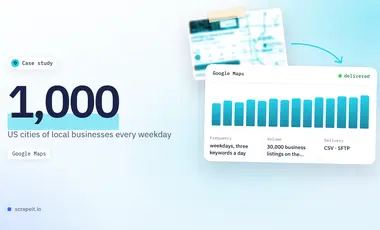
Google Maps Data: Local Businesses from 1,000 US Cities Every Weekday
A weekday feed of local businesses from Google Maps for a local-marketing company: 1,000 US cities, three keywords a day, files by 10:00 UTC.
Only diners who ate at a restaurant can review it on OpenTable, and each review scores food, service and ambience. Our OpenTable scraper delivers those scores per restaurant.
Plans from €169 a month · Free project assessment · Reply within 1 business day
CSV · Excel · JSON · XML · FTP · SFTP · Amazon S3 · Google Cloud
API, JSON feed or CSV, XLSX and JSON files
ScheduleOne-time, monthly, weekly, daily or 3 times a day
OpenTable pages, filters, fields and a schedule
Built, monitored and repaired by our team
API, JSON feed or CSV, XLSX and JSON files
You name the metros, neighborhoods or restaurant groups; we run the crawl and send the files. OpenTable addresses a restaurant in more than one way - a /r/ slug, a numbered restaurant profile and an older rest_profile link with a rid - and the same restaurant is served on country domains such as opentable.co.uk and opentable.com.au, so the first step is collapsing those into one row per restaurant id. The crawler then reads the profile, the ratings block, the menu and the reviews on the cadence you pick: daily for booking counts, weekly for scores, one-off for a market study. We take care of pacing, proxy rotation, CAPTCHA handling and rendering. A free project assessment comes first, and a sample from your city before the full run.
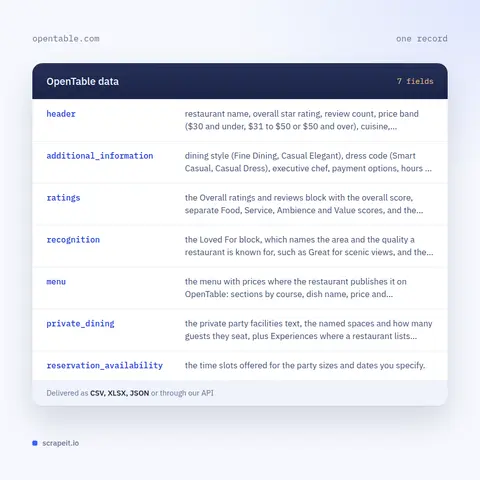
An OpenTable restaurant page has a short header and a long Additional information block, and most of the dataset comes from the second.
The About this restaurant text is the restaurant's own description, while the Review summary above the reviews is labelled by OpenTable as AI-generated from verified diner reviews, so the two go into separate columns. Fields a restaurant leaves blank stay empty instead of being guessed.
Restaurant pages are the end point; coverage starts from the pages that list restaurants. These follow the breadcrumb on every restaurant page - country, metro, area and neighborhood, as in United States, New York City, Manhattan, Union Square - plus the Restaurants Near Me and Restaurants Open Now pages and OpenTable's editorial lists such as the Top 100 Restaurants.
OpenTable is a restaurant reservation platform and part of Booking Holdings. Diners search by place, date, time and party size, and restaurants pay OpenTable for the booking system behind the button. For someone who needs data, the result is a directory of restaurants with price bands, cuisines and open tables, plus a review base closed to anyone who has not dined.
One catalogue sits behind many country domains. Besides opentable.com there are country sites such as opentable.co.uk, opentable.com.au, opentable.ca, opentable.ie and opentable.sg, and pages also take a language parameter such as lang=es. The domain changes the interface, not the restaurant, so the restaurant id is the key and the domain is only a source detail.
Restaurant pages share one template - header, Additional information, ratings, menu, reviews - but how much each restaurant fills in varies. Some publish a full priced menu with a last-updated date while others link out; some name an executive chef and describe parking, others leave both blank. Diners' Choice lists, the Loved For block and the editorial lists add a layer of recognition on top of the raw scores.
Delivery: CSV, JSON or XLSX files, our API or a JSON feed. MCP server on request.
Full plan detailsOpenTable data measures a restaurant's quality and demand from the diner side, in fields no menu or website states.
Learn how to use web scraping to solve data problems for your organization
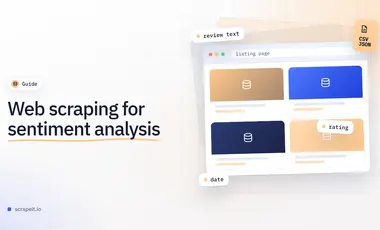
Where opinion text lives on the public web, what a review record contains on each kind of site, which fields a model needs besides the text, and what quietly breaks a sentiment dataset - with examples from our own projects.
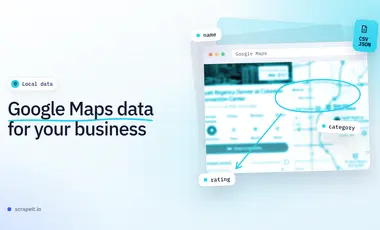
Using web scraping to extract Google Maps data will help you quickly and efficiently find businesses in any industry, city, state, or region. And the extracted contact information, such as phone or email address, social networks, or links to web pages, will help to contact them.
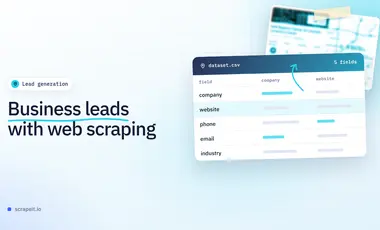
Lead scraping is a reliable way to get the right customer contacts to market your product, saves organizations time, and helps you better understand the audience you want to attract. Contacts include emails, phone numbers, or social media profiles.

ScrapeIt builds, runs and maintains crawlers for clients who want the data rather than the tooling. On OpenTable we merge restaurants served on several country domains, keep category scores and reviews linked to one restaurant id and document every field, including the ones a restaurant left empty. Deliveries go out as CSV, XLSX, JSON or JSONLines to Amazon S3, Google Cloud Storage or through our API, and an MCP server is available on request. Plans start from EUR 169 a month, or EUR 199 for a one-time extract.
Still unsure? Write to info@scrapeit.io
Yes. The ScrapeIt OpenTable API returns restaurant id, name, cuisine, price band, neighborhood, overall and category scores and the Booked times today counter as JSON from an endpoint we host, refreshed when your schedule says. Files work too: CSV, XLSX, a JSON feed or a direct load into your warehouse.
Yes. Restaurant profiles, menus, scores, reviews and open time slots are visible to any visitor without an account. We collect only publicly available data - everything a visitor can see on OpenTable - and we collect it legally. Reviewer names are dropped by default, and any personal data is handled under GDPR.
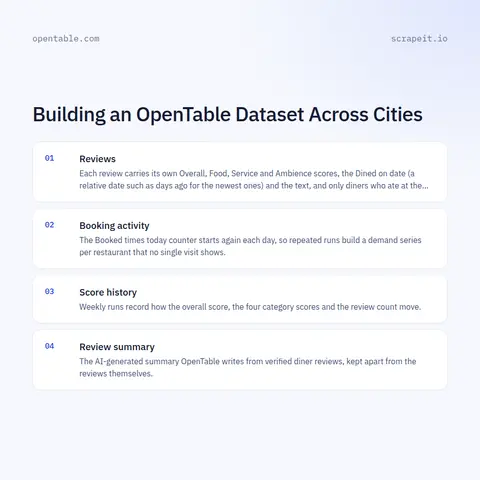
Each review row holds the overall score, the Food, Service and Ambience scores, the Dined on date, the review text and the restaurant id it belongs to. Because only diners who ate at the restaurant can review it, every row stands for a real visit. Reviewer names are not part of the default schema.
Yes, both. The price range is the three-step band OpenTable prints in the header next to the cuisine, and menu prices come dish by dish from restaurants that publish a menu on OpenTable, with course, description and the last-updated date. Where a restaurant only links to its own site, the row keeps the link and leaves the dish columns empty.
Yes. Open time slots depend on the date, the time and the party size, so we query the combinations you choose - for example tables for two and four over the next two weeks of evenings - and record what is offered on each run. Read together with Booked times today, this gives a daily measure of how full a restaurant is.
You share your needs, expectations, and desired timeframe. We'll suggest the best solution based on your request and budget.
Our specialists configure the crawlers and extract a sample dataset for your review before proceeding with the full-scale extraction.
Once you approve the sample, we launch the project and start full data collection. We gather, filter, and structure the data for easy use, delivering it on time in your preferred format.
Our team manages ongoing processes, monitors website changes, and supports all data extraction cycles. We can also help integrate data into your systems or create dashboards to simplify analysis.
Tell us which sites, which fields and how often. A couple of lines is enough to start.
OpenTable data from €169/month. Free project assessment, reply within 1 business day.