Euronews Scraper for Articles Across Language Editions

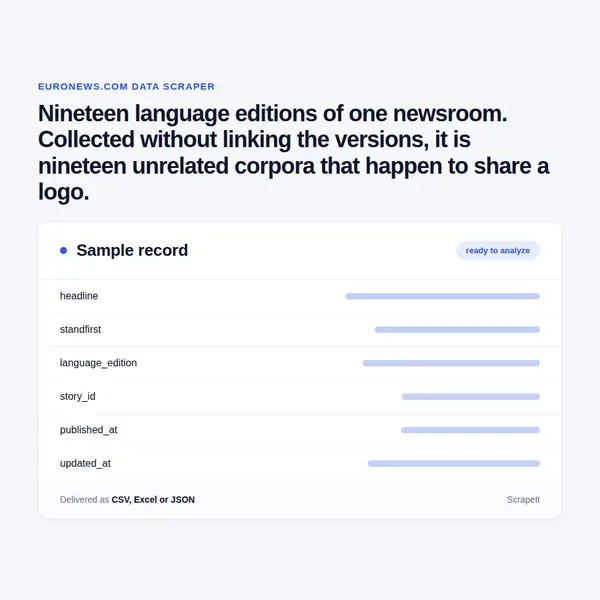
Nineteen language editions of one newsroom. Collected without linking the versions, it is nineteen unrelated corpora that happen to share a logo.

Euronews Scraper
Solutions

Managed multilingual news data, run end to end by us

ScrapeIt runs the collection as a managed service. You name the languages, sections or topics; we build the pipeline with story identifiers linking editions, language and timestamps as fields, and hand back CSV, JSON, Excel or a push into your warehouse.

News moves and gets updated, so we collect frequently and keep revisions rather than overwriting, which is also what makes translation lag measurable.

We collect published editorial content, honour the crawl rules and pace requests. Content is copyrighted: the dataset is for measurement and analysis rather than republication, and your counsel should see the use case before the project starts.

Euronews fields in every export

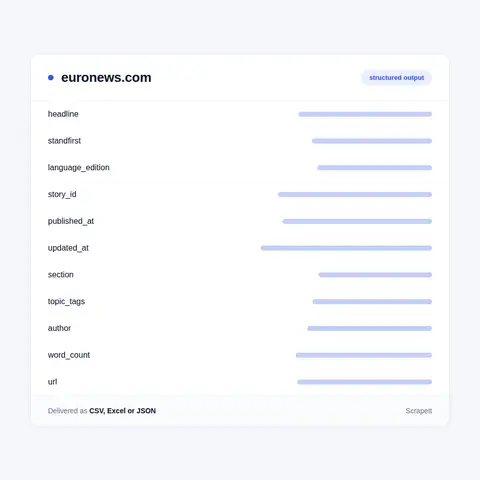
Article records carry the headline, standfirst, publication and update timestamps, language edition, section, topic tags, author where bylined, word count and the address.

A story identifier links the versions of one piece across editions. It is built from the declared alternate language relationships rather than from content similarity, which makes it a stated fact rather than an inference - and where a version exists in one edition and not another, that absence is itself a record.

Language edition is a first class field rather than something parsed from a URL later, because every question worth asking of this corpus is asked along that axis.

Publication and update times are both kept, since a story translated into a second language hours after the original is normal here and the lag between editions is one of the more interesting measurements available.

Every row carries the collection timestamp and, where re-collection shows the text changed, a revision count.

Euronews fields in every export
Translation lag, framing analysis and rights

Translation lag, framing analysis and rights

Translation lag analysis - how long a story takes to appear in each edition - is the most straightforward output once timestamps and story links exist, and it is a direct read on editorial priority per language.

Coverage gap analysis shows which stories never reach which editions, which for media research is often more informative than what does get published.

Framing comparison across languages is the richer analysis and needs care. Headlines differ between editions for reasons ranging from idiom to length limits to genuine editorial choice, and a difference is not automatically a finding. We deliver the linked text and are candid that separating translation from framing needs human reading rather than a similarity score.

On rights: the content is copyrighted. Structuring and measuring it is analysis; republication is not, and a product surfacing article text to end users is a licensing conversation with the broadcaster. We raise it at scoping.

One newsroom publishing in nineteen languages

Euronews is a pan-European news broadcaster based in Lyon, publishing in a large number of languages. Its own markup declares alternate language editions covering English, French, German, Italian, Spanish, Portuguese, Greek, Hungarian, Polish, Romanian, Turkish, Arabic, Persian, Russian, Serbian, Albanian, Bulgarian and Georgian.

That is the defining fact for a data project here, and it is an opportunity rather than an obstacle. Most multilingual news analysis is built from separate outlets in separate countries, which means every cross-language comparison is confounded by editorial differences. Here one newsroom covers the same events for many audiences, which turns the corpus into something close to a controlled comparison.

Realising that requires linking the versions of a story across editions, and the site helps: the alternate language declarations connect equivalent pages directly rather than leaving the matching to be inferred from content.

Section pages respond with substantial content. Crawl rules are published and disallow the API, module and plugin paths, leaving editorial content open.

Get a Quote
dev_w
25

Developers

customers
500+

Customers worldwide

pages
1 500 000 000+

Pages extracted

stime
15000+

Hours saved for our clients

Plans

Airplane

€199 / one-time

setup fee - included

Data limits100,000
Frequencyone-time
Run timeup to 5 days
Data storing7 days

Helicopter

€169 / mo

setup fee €499

Data limits250,000
Frequencymonthly
Run timeup to 5 days
Data storing14 days

Glasses

€229 / mo

setup fee €499

Data limits1,000,000
Frequencyweekly
Run timeup to 5 days
Data storing30 days

DNA

€549 / mo

setup fee €799

Data limits3,000,000
Frequency3 times daily
Run timesame day
Data storing90 days

Why linked editions are worth more than more articles

A multilingual corpus is easy to assemble and hard to make useful, and the difference is whether the versions are linked.

Unlinked, nineteen editions are nineteen separate piles of text. You can count articles per language and little else, because you cannot tell whether a topic is covered more in Greek than in Polish or whether you are just looking at two different sets of stories.

Linked, the same corpus answers questions nobody else can ask cheaply: which stories are published in every edition and which stay local, how long a story takes to appear in each language, whether headlines are framed differently for different audiences, and which topics one language audience gets that another does not. Those are real editorial and research questions and they need the story identifier to exist.

The second reason is the controlled comparison. Because one newsroom is responsible for all of it, differences between editions reflect editorial and translation decisions rather than the differences between separate news organisations. That is rare and it is what makes this source academically interesting as well as commercially useful.

The third is coverage of languages that are otherwise thin. Georgian, Albanian and Persian editions of a major European outlet are unusual, and for anyone studying media in those language markets this is one of the few consistent sources.

Our Blog

Reads Our Latest News & Blog

Learn how to use web scraping to solve data problems for your organization

How Artificial Intelligence Is Used In Web Scraping

How Artificial Intelligence Is Used In Web Scraping

Leveraging advances in technology, the AI-powered web scraper has skyrocketed in demand and is helping to expand capabilities by automating tedious daily tasks and speeding up data collection from thousands of websites several times over.

What is Web Scraping and What is it Used For?

What is Web Scraping and What is it Used For?

Web scraping is a method of obtaining web data by extracting it from pages of web resources with the help of a program, that is, in automatic mode. It is used to syntactically convert web pages into more usable forms.

Web Scraping for Machine Learning

Web Scraping for Machine Learning

If you specialize in machine learning, you need to feed large amounts of data to the algorithms. Web scraping is the easiest and the most efficient method of collecting the data from all over the Internet.

scrapeit logo

Who builds and keeps your multilingual feed

ScrapeIt is a managed extraction company, not a tool you have to learn. Our team builds the pipeline, maintains the cross-edition linking as the site's markup changes, and repairs the collector before a language edition quietly drops out of your corpus.

You see a sample first, in your format, over the languages you actually work in, with versions linked so you can judge on real stories whether the matching holds.

FAQ

How do you link the same story across languages?

From the alternate language relationships the site declares in its own markup, not from content similarity. That makes the link a stated fact rather than an inference, and where a version exists in one edition and not another, the absence is recorded too.

What can I do with linked editions that I could not otherwise?

Ask which stories reach every edition and which stay local, how long a story takes to appear per language, and whether headlines are framed differently for different audiences. Unlinked, you can count articles per language and very little else.

Is this really a controlled comparison?

Closer to one than most multilingual corpora. Because a single newsroom produces all editions, differences reflect editorial and translation decisions rather than differences between separate organisations - which is what usually confounds cross-language media research.

Can you tell me if a headline was reframed?

We give you the linked text; separating translation from framing needs human reading. Headlines differ for idiom and length as well as editorial choice, so a difference is not automatically a finding and we will not pretend a similarity score settles it.

Which languages are covered?

The site declares alternate editions across nineteen languages including Georgian, Albanian and Persian. For research into media in those smaller language markets this is one of the few consistent sources available.

How does it Work?

Step 1 - Make a Request

You share your needs, expectations, and desired timeframe. We’ll suggest the best solution based on your request and budget.

Step 2 - Configuring Custom Web Crawlers

Our specialists configure the crawlers and extract a sample dataset for your review before proceeding with the full-scale extraction.

Step 3 - Collect and Deliver

Once you approve the sample, we launch the project and start full data collection. We gather, filter, and structure the data for easy use, delivering it on time in your preferred format.

Step 4 - Maintain and Support

Our team manages ongoing processes, monitors website changes, and supports all data extraction cycles. We can also help integrate data into your systems or create dashboards to simplify analysis.

Request a Quote

Tell us more about you and your project information.
Which sites, which fields, how often. A couple of lines is enough.

We reply within 1 business day. No obligation.

scrapiet

Scrapeit Sp. z o.o.
10/208 Legionowa str., 15-099, Bialystok, Poland
NIP: 5423457175
REGON: 523384582