Le Monde Scraper for French News Monitoring

France is a market where the reputational conversation happens in French, in a paper of record, behind a meter. All three facts shape what a collector can honestly deliver.

Le Monde Scraper
Solutions

Managed Le Monde scraping, run end to end by us

ScrapeIt runs the Le Monde collector as a managed service. You name the sections, subjects and editions; we build the crawl, run it on your cadence and hand back CSV, JSON, Excel or a push into your warehouse. French language matching, including accent and elision variants of your brand and product names, is part of the setup.

Cadence is per source. The front page feed and section fronts justify frequent passes during an active story; archive work runs slower. Requests are paced deliberately rather than bursted.

We collect what the site renders publicly to an ordinary visitor and flag subscriber restricted articles rather than working around the meter. We do not use subscriber credentials. Le Monde journalism is copyrighted and their terms restrict automated collection and reuse, so the dataset is built for analysis rather than republication. Bring the use case to your own counsel before the project starts.

Le Monde fields in every export

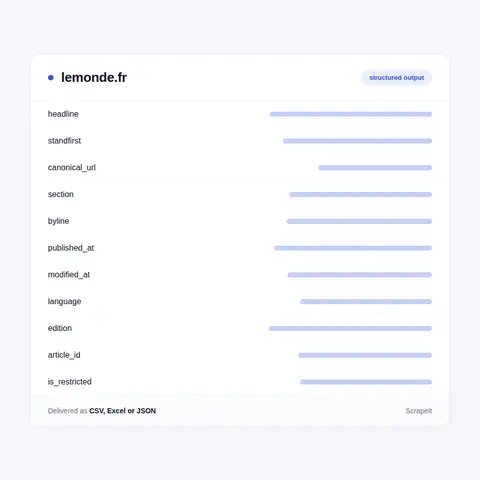
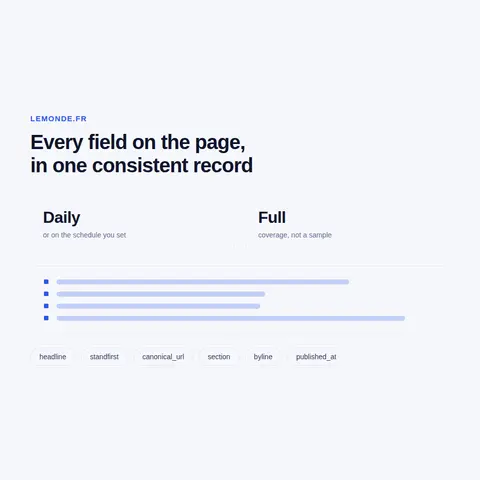
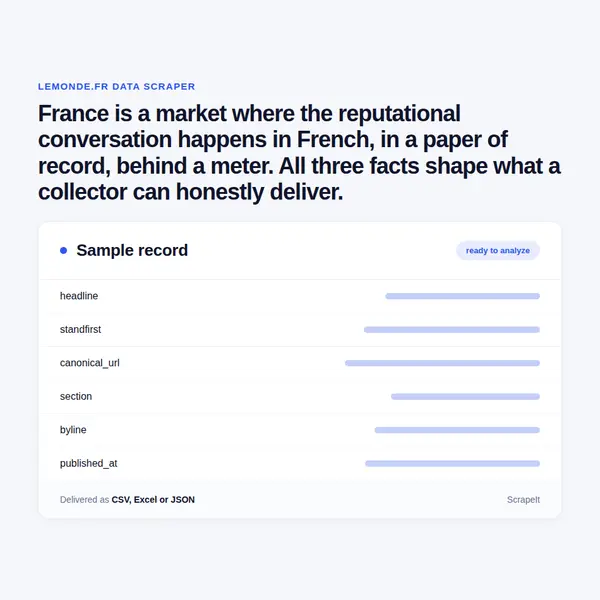
The article record covers canonical URL, headline, standfirst, section and subsection, byline, publication timestamp, last modified timestamp, language, edition, item type and the article identifier used in Le Monde URLs.

The access flag is a first class field. Each row records whether the article was subscriber restricted at the time of collection and how much text rendered publicly. Without it, an opening paragraph looks exactly like a short article, and every word count and sentiment score built on the dataset inherits the mistake.

Both timestamps are kept separately. French dailies update stories in place as events develop, and the gap between first publication and last modification is often the most informative number on the row.

Front observations run alongside: which stories were on the front or a section front, in what order and at what time. On a paper of record, prominence carries more signal than volume, and it is only obtainable by looking repeatedly.

Then the context fields: topic tags where published, lead image URL and caption, word count of the publicly rendered portion, outbound links, live page entry counts where relevant, and the collection timestamp on every row.

Le Monde fields in every export
The English edition, live coverage and the archive

The English edition, live coverage and the archive

The English edition is a useful secondary collection and a poor primary one. Treated as a selection signal it tells you what the paper chose to put before an international readership; treated as coverage it will understate French reporting by a wide margin. Rows carry language and edition so both readings are available from one dataset.

Live coverage needs its own structure. A live page runs for hours under a single URL with a stream of timestamped entries, and collapsing it into one article loses the entries, their times and their attributions. We collect entries individually, keyed to a parent record that carries an entry count and the time of the most recent entry.

Historical work is practical for recent years: article URLs are stable and section and topic pages paginate. A retrospective on a company, a person or a policy area runs as a one time job separate from the ongoing feed, with the access flag applied to historical rows exactly as to current ones.

Translation is delivered as a separate labelled field when a client wants it. The French source text is never overwritten, because any later verification has to be done against the original rather than against our rendering of it.

How Le Monde is arranged, and what renders before the meter

Le Monde is the French paper of record and it operates a subscription model over a substantial part of its output. On a restricted article the headline, the standfirst, the byline and an opening portion render publicly; the rest does not. That line is where a collector has to stop, and stopping there still leaves enough for the questions monitoring actually asks.

There is also an English edition at a separate path, which is a curated selection rather than a mirror of the French site. It is useful for understanding what the paper wants an international audience to see, and useless as a substitute for the French output, which is many times larger.

Discovery is straightforward. The paper publishes RSS for its front page and a news sitemap covering recently published items, both of which are cheap and reliable ways to know what is new. Section fronts carry an ordered selection and are where prominence becomes observable; article pages carry structured markup with the headline, publisher and dates.

Editorially the site splits into the usual desks plus a substantial run of live coverage and long form. Live pages behave differently enough from articles that collecting them as a single item throws away most of what is in them, so they are typed and handled separately.

Get a Quote
dev_w
25

Developers

customers
500+

Customers worldwide

pages
1 500 000 000+

Pages extracted

stime
15000+

Hours saved for our clients

Plans

Airplane

€199 / one-time

setup fee - included

Data limits100,000
Frequencyone-time
Run timeup to 5 days
Data storing7 days

Helicopter

€169 / mo

setup fee €499

Data limits250,000
Frequencymonthly
Run timeup to 5 days
Data storing14 days

Glasses

€229 / mo

setup fee €499

Data limits1,000,000
Frequencyweekly
Run timeup to 5 days
Data storing30 days

DNA

€549 / mo

setup fee €799

Data limits3,000,000
Frequency3 times daily
Run timesame day
Data storing90 days

Why French coverage needs French collection

A monitoring setup built on English sources reports confidently and misses the French conversation entirely. For a company with French operations, customers or regulatory exposure, that is not a gap at the margin; it is most of the story.

French text also needs handling as French rather than as English with accents. Accented characters appear stripped in URLs and slugs but present in body text, elision joins words in ways that break naive tokenisation, and a brand name inside a French sentence is often preceded by a contracted article. Matching that reliably is a setup decision, not a filter you switch on afterwards.

The meter is the second thing that shapes the work. A collector that ignores the subscriber boundary either fails or, worse, silently delivers openings as complete articles. We flag the boundary and report what rendered, which keeps the dataset usable in a commercial product and keeps the analysis honest.

The third is prominence over volume. Le Monde publishes less than a tabloid and each item carries more weight, so counting mentions is a particularly bad proxy here. A story that led the front for a morning is a different event from one that appeared in a section listing, and only repeated observation separates them.

Where full article text genuinely is the requirement, the honest route is a licence from the publisher. We will say so rather than hand over a thin dataset and let it look complete.

Our Blog

Reads Our Latest News & Blog

Learn how to use web scraping to solve data problems for your organization

How Artificial Intelligence Is Used In Web Scraping

How Artificial Intelligence Is Used In Web Scraping

Leveraging advances in technology, the AI-powered web scraper has skyrocketed in demand and is helping to expand capabilities by automating tedious daily tasks and speeding up data collection from thousands of websites several times over.

What is Web Scraping and What is it Used For?

What is Web Scraping and What is it Used For?

Web scraping is a method of obtaining web data by extracting it from pages of web resources with the help of a program, that is, in automatic mode. It is used to syntactically convert web pages into more usable forms.

Web Scraping for Machine Learning

Web Scraping for Machine Learning

If you specialize in machine learning, you need to feed large amounts of data to the algorithms. Web scraping is the easiest and the most efficient method of collecting the data from all over the Internet.

scrapeit logo

Who builds and keeps your Le Monde feed

ScrapeIt is a managed extraction company, not a tool you have to learn. Our team builds the pipeline, watches it as the site changes, and repairs it before your dashboard goes quiet.

You see a sample first, in your format, over the sections and editions you actually track, with the access flag visible so you can judge the real coverage before committing.

FAQ

Can you collect subscriber only articles in full?

No. We do not use subscriber accounts and we do not work around the meter. We collect what an ordinary visitor sees: headline, standfirst, byline, section, both timestamps, front position and the opening text that renders publicly, with the article marked as restricted. If full bodies are the requirement, the route is a licence from the publisher.

Is the English edition enough for monitoring France?

No. It is a curated selection for an international audience, and the French output is many times larger. Using it as your only French source will understate coverage substantially and will do so silently. We collect both and tag every row with its language and edition.

How do you handle accents and French word forms?

As a setup decision rather than a filter. Accented characters are stripped in URLs and slugs but present in body text, and elision attaches contracted articles directly to the following word, which breaks naive matching. We build the match rules around your specific brand and product names with those variants included.

Can you collect live coverage entry by entry?

Yes. A live page is collected as a parent record plus a stream of entries, each with its own text, timestamp and author where credited. The parent carries an entry count and the time of the latest entry, so a page that has gone quiet is distinguishable from one still running.

Is scraping Le Monde legal?

Le Monde journalism is copyrighted and their terms restrict automated collection and reuse, so this dataset is for analysis rather than republication. We work only on public pages, never with subscriber credentials, we honour the crawl rules the site publishes and we pace requests. Media monitoring on published metadata and publicly rendered text is common practice, but the use case is yours: have your own counsel approve it before the project starts.

How does it Work?

Step 1 - Make a Request

You share your needs, expectations, and desired timeframe. We’ll suggest the best solution based on your request and budget.

Step 2 - Configuring Custom Web Crawlers

Our specialists configure the crawlers and extract a sample dataset for your review before proceeding with the full-scale extraction.

Step 3 - Collect and Deliver

Once you approve the sample, we launch the project and start full data collection. We gather, filter, and structure the data for easy use, delivering it on time in your preferred format.

Step 4 - Maintain and Support

Our team manages ongoing processes, monitors website changes, and supports all data extraction cycles. We can also help integrate data into your systems or create dashboards to simplify analysis.

Request a Quote

Tell us more about you and your project information.
Which sites, which fields, how often. A couple of lines is enough.

We reply within 1 business day. No obligation.

scrapiet

Scrapeit Sp. z o.o.
10/208 Legionowa str., 15-099, Bialystok, Poland
NIP: 5423457175
REGON: 523384582