Why Polish morphology decides whether the data works
Media monitoring in Polish fails in a specific and predictable way, and it fails silently.
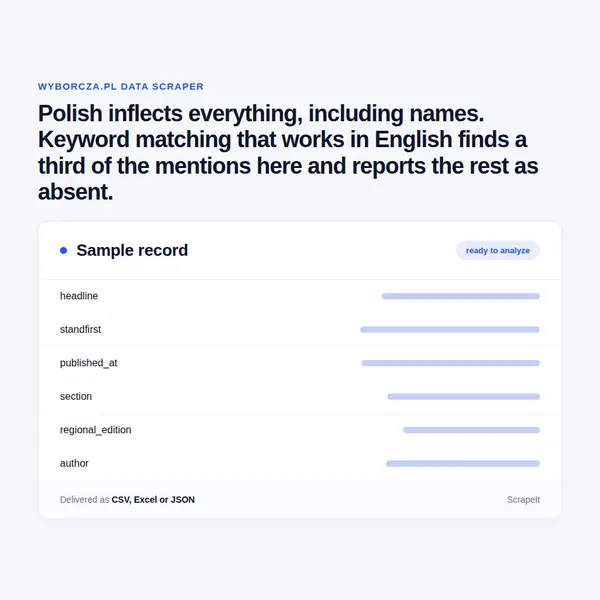
Polish is heavily inflected. A surname changes form depending on its grammatical role in the sentence, and so do the names of parties, institutions and cities. A keyword matcher built for English looks for one string and finds the subset of mentions that happen to use it, then reports the rest as absent. The output looks like data and understates coverage by a large and unknowable margin.
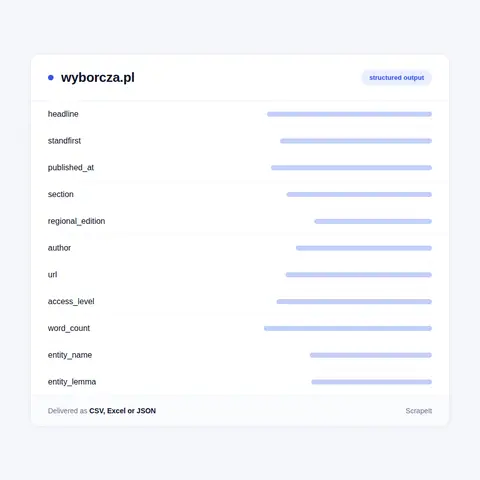
Doing it properly means lemmatising Polish text and matching on the base form, which is well-established work but has to be built in rather than bolted on. We build it in, and where a client is comparing Polish coverage against another language we say plainly that the two pipelines are not equivalent unless both do this.
The second reason is the subscription boundary. A dataset here is mostly headlines and metadata, which is entirely sufficient for coverage measurement, topic tracking and timing analysis, and insufficient for anything needing full text. Knowing which of those a client needs is a scoping conversation, not a delivery surprise.
The third is editorial context. This outlet has a declared political position, which is a fact about the source rather than a criticism of it, and a Polish media dataset that does not record outlet stance produces aggregate sentiment that is really a measure of which outlets were sampled.