Times of India Scraper for National and City Editions

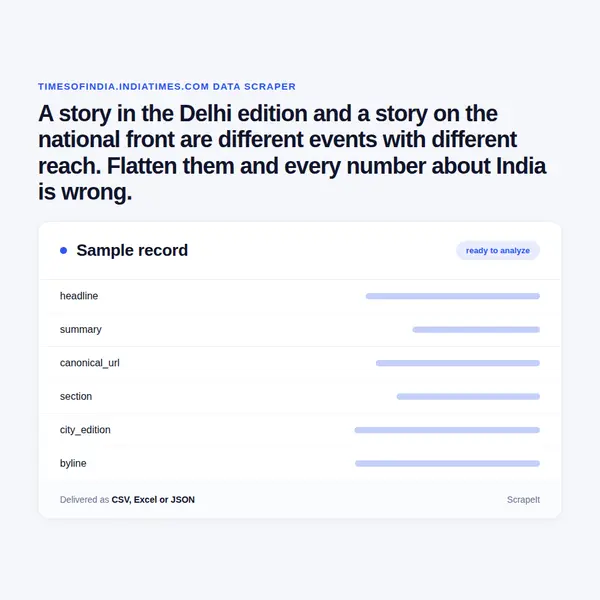
A story in the Delhi edition and a story on the national front are different events with different reach. Flatten them and every number about India is wrong.

Times of India Scraper
Solutions

Managed Indian news collection, run end to end by us

ScrapeIt runs the collector as a managed service. You name the cities, sections and subjects; we build the crawl, run it on your cadence and hand back CSV, JSON, Excel or a push into your warehouse, with the city edition on every row and sections scoped deliberately.

Scoping happens before collection, not after. On a source this large an undefined crawl is expensive and produces a dataset nobody can use, so we agree the city and section list first and price against it.

We collect what the site renders publicly, honour the crawl rules it publishes and pace requests. The journalism is copyrighted and the terms restrict reuse, so the dataset is metadata and publicly rendered text for analysis rather than material for republication. Bring the use case to your own counsel before the project starts.

Times of India fields in every export

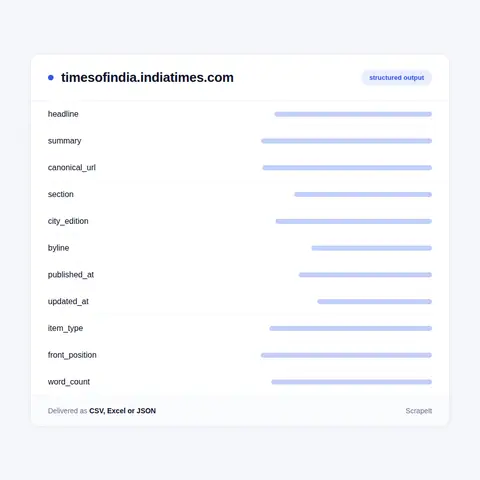
The article record covers canonical URL, headline, summary, section and subsection, city edition where applicable, byline, publication timestamp, last updated timestamp, item type and the article identifier.

The city edition field is the one that makes an Indian market analysis honest. Without it a story in one city edition reads as national coverage, which overstates reach, and national coverage of a local issue reads as local, which understates it. Every row carries the edition it was collected from.

Both timestamps are kept separately, as everywhere, and matter here because the site updates stories in place through the day.

Front observations run on the national front and on whichever city fronts a client cares about, recording which stories appeared, in what order and when. Given the volume, promotion is a far better proxy for reach than a count.

Then the context fields: topic tags where published, publicly rendered body text and word count, lead image URL, outbound links, and the collection timestamp on every row.

Times of India fields in every export
City editions, sections and the archive

City editions, sections and the archive

City editions are configured as their own scheduled collections, each tagged on every row. That lets a client compare markets directly, ask where coverage of an issue started, and separate local reach from national reach without recollecting anything.

Section scoping is worth doing deliberately too. Entertainment and sport carry enormous volume on this source and will dominate any chart built across the whole site, so most projects either exclude them or analyse them separately. That is a decision, not an accident, and we put it in front of the client at the start.

Historical backfill is practical because article URLs are stable and section and city pagination reaches back. It runs as a one time job separate from the ongoing feed, and on a source this large it is worth bounding by date and section rather than running open ended.

Combining with other Indian outlets is the usual extension. One publication is a large sample of the Indian conversation, not the whole of it, and we say that rather than letting a single source stand in for a market.

National sections plus a city edition for every major market

The Times of India is among the largest English language news operations anywhere by volume, and the volume is the first thing a project here has to plan around. The front alone renders tens of thousands of words, and the daily output across sections and editions is far larger than most collectors are scoped for.

The structure that matters is the city edition. Alongside national sections the site runs editions for individual cities, each with its own front and its own local reporting. For any company with operations in specific Indian markets, the city editions are where its coverage actually appears, and they are the part a national-only collector misses entirely.

Discovery is well served: RSS feeds exist per section and respond, section and city fronts carry ordered selections, and article pages carry structured markup with headline, publisher and timestamps.

English is the publication language, which removes the script handling that complicates other large non-Western sources. What it does not remove is the need to handle Indian English conventions, local institution names and city specific terminology when matching brands and topics.

Get a Quote
dev_w
25

Developers

customers
500+

Customers worldwide

pages
1 500 000 000+

Pages extracted

stime
15000+

Hours saved for our clients

Plans

Airplane

€199 / one-time

setup fee - included

Data limits100,000
Frequencyone-time
Run timeup to 5 days
Data storing7 days

Helicopter

€169 / mo

setup fee €499

Data limits250,000
Frequencymonthly
Run timeup to 5 days
Data storing14 days

Glasses

€229 / mo

setup fee €499

Data limits1,000,000
Frequencyweekly
Run timeup to 5 days
Data storing30 days

DNA

€549 / mo

setup fee €799

Data limits3,000,000
Frequency3 times daily
Run timesame day
Data storing90 days

Why volume makes scoping the whole project

On most sources you decide what to collect after you see the data. Here you decide first, or the cost decides for you. The output is large enough that an undefined crawl becomes expensive within days and produces a dataset nobody can use, because the signal a client wanted is buried under everything else.

So the scoping conversation is the work. Which cities, which sections, which subjects. A company with plants in three states needs those three city editions properly rather than all of them badly, and the difference in cost between those two designs is substantial.

The second reason is the local and national distinction. Indian coverage is geographically distributed in a way that a national front does not represent. A dispute, a plant opening or a regulatory issue often generates steady coverage in one city edition and none nationally, and a monitoring setup pointed only at the national front reports quiet while the local conversation is loud. The reverse error, reading one city edition as national reach, is equally common and equally wrong.

The third is pace. This source publishes continuously and updates in place, so the interval between observations determines how much of the picture you get. We set it per front rather than uniformly.

The fourth is that English publication makes this the most accessible entry point into Indian media data, which is why it is usually the first source in an India project rather than the only one.

Our Blog

Reads Our Latest News & Blog

Learn how to use web scraping to solve data problems for your organization

How Artificial Intelligence Is Used In Web Scraping

How Artificial Intelligence Is Used In Web Scraping

Leveraging advances in technology, the AI-powered web scraper has skyrocketed in demand and is helping to expand capabilities by automating tedious daily tasks and speeding up data collection from thousands of websites several times over.

What is Web Scraping and What is it Used For?

What is Web Scraping and What is it Used For?

Web scraping is a method of obtaining web data by extracting it from pages of web resources with the help of a program, that is, in automatic mode. It is used to syntactically convert web pages into more usable forms.

Web Scraping for Machine Learning

Web Scraping for Machine Learning

If you specialize in machine learning, you need to feed large amounts of data to the algorithms. Web scraping is the easiest and the most efficient method of collecting the data from all over the Internet.

scrapeit logo

Who builds and keeps your Indian news feed

ScrapeIt is a managed extraction company, not a tool you have to learn. Our team builds the pipeline, watches it as fronts and editions change, and repairs it before a city quietly drops out of your reporting.

You see a sample first, in your format, across the cities and sections you actually cover, so you can see the volume you are committing to before you commit to it.

FAQ

Why do city editions matter so much here?

Because Indian coverage is geographically distributed in a way the national front does not represent. A company issue often generates steady coverage in one city edition and none nationally, so a national-only setup reports quiet while the local conversation is loud. Reading one city edition as national reach is the mirror error and equally wrong. Every row carries its edition.

The site is enormous. How do you keep this affordable?

By scoping before collecting. Which cities, which sections, which subjects, agreed up front and priced against. A company with plants in three states needs those three city editions properly rather than all of them badly, and the cost difference between those designs is substantial.

Should entertainment and sport be included?

Usually not in the same chart. They carry enormous volume and will dominate any series built across the whole site. We separate them by section so they can be excluded or analysed on their own, and we raise the decision at the start rather than letting it surprise somebody later.

Is one publication enough to monitor India?

No, and we say so rather than letting a single source stand in for a market. It is a large and accessible sample of the English language conversation, which makes it the natural first source in an India project. A full picture normally combines it with other outlets, including language press where the brief needs it.

How often can the feed refresh, and in what formats?

From a daily digest up to frequent passes on the fronts you care about, set per front rather than uniformly, since the site publishes continuously and updates in place. Delivery is CSV, Excel, JSON, JSONLines or XML over FTP, SFTP, Amazon S3, Google Cloud Storage, Dropbox, Google Drive or email, or written straight into your database.

How does it Work?

Step 1 - Make a Request

You share your needs, expectations, and desired timeframe. We’ll suggest the best solution based on your request and budget.

Step 2 - Configuring Custom Web Crawlers

Our specialists configure the crawlers and extract a sample dataset for your review before proceeding with the full-scale extraction.

Step 3 - Collect and Deliver

Once you approve the sample, we launch the project and start full data collection. We gather, filter, and structure the data for easy use, delivering it on time in your preferred format.

Step 4 - Maintain and Support

Our team manages ongoing processes, monitors website changes, and supports all data extraction cycles. We can also help integrate data into your systems or create dashboards to simplify analysis.

Request a Quote

Tell us more about you and your project information.
Which sites, which fields, how often. A couple of lines is enough.

We reply within 1 business day. No obligation.

scrapiet

Scrapeit Sp. z o.o.
10/208 Legionowa str., 15-099, Bialystok, Poland
NIP: 5423457175
REGON: 523384582