Straits Times Scraper for Singapore and Regional Coverage

The site asks for ten seconds between requests. Honour it and the collector runs for years; ignore it and the project ends in a week.

The Straits Times Scraper
Solutions

Managed Southeast Asian media data, run end to end by us

ScrapeIt runs the collection as a managed service. You name the sections, markets or topics; we build the pipeline pacing to the ten-second interval the site requests, with story country and access level as fields, and hand back CSV, JSON, Excel or a push into your warehouse.

Forward monitoring fits this source comfortably; archive backfill is slow by arithmetic and we quote the real duration rather than a hopeful one.

We collect published content only, honour the stated crawl delay and do not circumvent subscriptions. Content is copyrighted, so the dataset is for measurement and analysis rather than republication, and your counsel should see the use case before the project starts.

Straits Times fields in every export

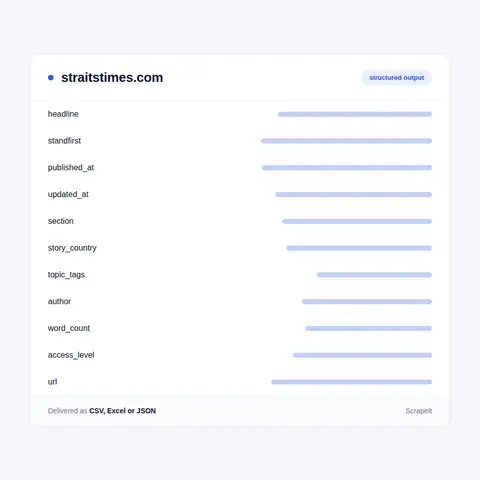
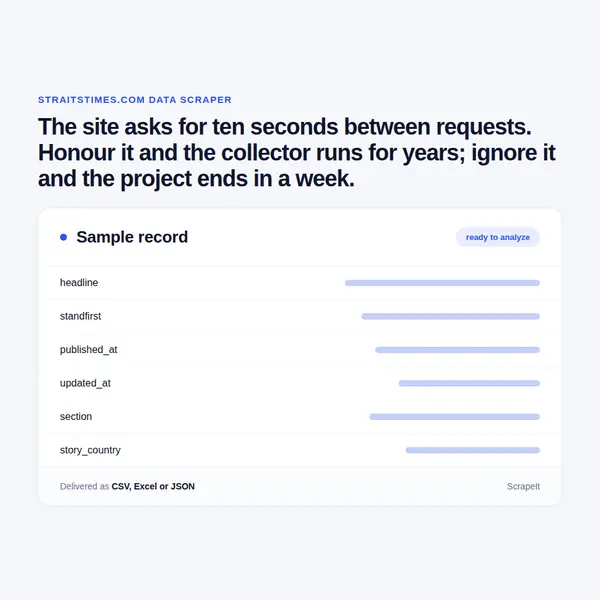
Article records carry the headline, standfirst, publication and update timestamps, section, the country or countries the story concerns, topic tags, author where bylined, word count, access level and the address.

Story country is a separate field from section, because a Singapore newsroom reporting on Indonesia produces an article whose subject and whose origin are different places. Media analysis that conflates them attributes regional coverage to the wrong market.

Access level is recorded, since subscription and open articles both appear and a corpus that mixes them without saying so produces word counts and text analysis that cannot be interpreted.

Entities mentioned are extracted where a client needs them, with the transliteration issue handled: names across Southeast Asian languages appear in several romanised forms and matching has to allow for that.

Every row carries the collection timestamp and a revision count where re-collection shows the article changed.

Straits Times fields in every export
Regional comparison, archive depth and limits

Regional comparison, archive depth and limits

Cross-market comparison is the strongest use: how much attention each Southeast Asian market receives, how that shifts around events, and which topics travel across borders. It works because one newsroom applies one standard, which separate national outlets do not.

Archive backfill is possible and slow, and we price it honestly against the crawl delay rather than quoting a number that assumes we will ignore the delay.

Ongoing monitoring is the better-fitting product here: a forward feed collected politely within the stated interval, which stays comfortably inside the pace limit because daily publication volume is far below what ten-second pacing allows.

Limits: subscription content stays behind its subscription and we record access level rather than circumventing. Content is copyrighted, so the dataset is for measurement rather than republication. And one outlet is one perspective on a region, which matters more when the outlet is a paper of record.

Singapore's paper of record, reporting on a region

The Straits Times is Singapore's main English-language daily, covering national news, business and a significant amount of reporting on the wider Southeast Asian region from a single well-resourced newsroom.

The regional coverage is the reason it appears in most Southeast Asia media briefs. Consistent English-language reporting on Malaysia, Indonesia, Thailand, Vietnam and the Philippines from one editorial standard is hard to assemble otherwise, and it gives a comparable baseline across markets whose domestic media are in different languages.

The crawl rules are the other defining fact and they are unusually explicit: a crawl delay of ten seconds. That is a long interval, it is stated plainly, and it determines the shape of every project here.

Beyond that the rules disallow the usual platform directories and leave editorial content open. Section pages respond directly with substantial content.

Get a Quote
dev_w
25

Developers

customers
500+

Customers worldwide

pages
1 500 000 000+

Pages extracted

stime
15000+

Hours saved for our clients

Plans

Airplane

€199 / one-time

setup fee - included

Data limits100,000
Frequencyone-time
Run timeup to 5 days
Data storing7 days

Helicopter

€169 / mo

setup fee €499

Data limits250,000
Frequencymonthly
Run timeup to 5 days
Data storing14 days

Glasses

€229 / mo

setup fee €499

Data limits1,000,000
Frequencyweekly
Run timeup to 5 days
Data storing30 days

DNA

€549 / mo

setup fee €799

Data limits3,000,000
Frequency3 times daily
Run timesame day
Data storing90 days

Why a ten second delay changes the whole plan

Most crawl delays are short enough to ignore in planning. Ten seconds is not, and pretending otherwise is how a project promises a timeline it cannot meet.

At one request every ten seconds a collector manages roughly eight and a half thousand pages a day at absolute best. A backfill of a large archive is therefore measured in weeks, and that has to be in the quote rather than discovered halfway through. We calculate it up front and say the real number.

The corollary is that scope discipline matters more here than on a fast source. Collecting only the sections a client actually needs is not a cost saving, it is the difference between a project that finishes and one that does not, and we push back on all-of-it briefs on this source specifically.

The second reason to use it despite that is the regional baseline. English-language reporting on several Southeast Asian markets from one editorial standard is genuinely hard to replace, and for cross-market comparison it removes a confound that separate domestic outlets introduce.

The third is that a paper of record has a particular relationship with official information in its market, and anyone reading its coverage analytically should record that as context rather than treat all outlets as interchangeable observers.

Our Blog

Reads Our Latest News & Blog

Learn how to use web scraping to solve data problems for your organization

How Artificial Intelligence Is Used In Web Scraping

How Artificial Intelligence Is Used In Web Scraping

Leveraging advances in technology, the AI-powered web scraper has skyrocketed in demand and is helping to expand capabilities by automating tedious daily tasks and speeding up data collection from thousands of websites several times over.

What is Web Scraping and What is it Used For?

What is Web Scraping and What is it Used For?

Web scraping is a method of obtaining web data by extracting it from pages of web resources with the help of a program, that is, in automatic mode. It is used to syntactically convert web pages into more usable forms.

Web Scraping for Machine Learning

Web Scraping for Machine Learning

If you specialize in machine learning, you need to feed large amounts of data to the algorithms. Web scraping is the easiest and the most efficient method of collecting the data from all over the Internet.

scrapeit logo

Who builds and keeps your regional media feed

ScrapeIt is a managed extraction company, not a tool you have to learn. Our team builds the pipeline, keeps it inside the stated pace, and repairs it before a monitoring series loses the week an event happened.

You see a sample first, in your format, over the markets you actually follow, with story country separated from section so you can check the attribution on real articles.

FAQ

Why does the crawl delay matter so much?

Because ten seconds per request caps a collector at roughly eight and a half thousand pages a day at best. A large archive backfill is therefore measured in weeks, and that belongs in the quote rather than being discovered halfway through.

Can you just go faster?

No. The interval is stated plainly by the site, and honouring it is both correct and practical - a collector that respects it runs for years, one that does not ends the project in a week. We scope to the pace instead.

Why separate story country from section?

Because a Singapore newsroom reporting on Indonesia produces an article whose subject and origin are different places. Conflating them attributes regional coverage to the wrong market, which is exactly the error a regional comparison cannot survive.

What makes this useful for Southeast Asia?

One editorial standard across several markets. English-language reporting on Malaysia, Indonesia, Thailand, Vietnam and the Philippines from a single newsroom removes the confound that separate domestic outlets in different languages introduce.

Do you collect subscription articles?

Only what is served publicly, with access level recorded on every row. A corpus that mixes open and truncated articles without saying which produces word counts and text analysis nobody downstream can interpret.

How does it Work?

Step 1 - Make a Request

You share your needs, expectations, and desired timeframe. We’ll suggest the best solution based on your request and budget.

Step 2 - Configuring Custom Web Crawlers

Our specialists configure the crawlers and extract a sample dataset for your review before proceeding with the full-scale extraction.

Step 3 - Collect and Deliver

Once you approve the sample, we launch the project and start full data collection. We gather, filter, and structure the data for easy use, delivering it on time in your preferred format.

Step 4 - Maintain and Support

Our team manages ongoing processes, monitors website changes, and supports all data extraction cycles. We can also help integrate data into your systems or create dashboards to simplify analysis.

Request a Quote

Tell us more about you and your project information.
Which sites, which fields, how often. A couple of lines is enough.

We reply within 1 business day. No obligation.

scrapiet

Scrapeit Sp. z o.o.
10/208 Legionowa str., 15-099, Bialystok, Poland
NIP: 5423457175
REGON: 523384582