Homegate Data: A Daily Snapshot of Two Cantons with 46K Photos
Every day, a full snapshot of all active Homegate listings in one Swiss region, with photos and PDFs, for a company's own listing-history database.
Learn More
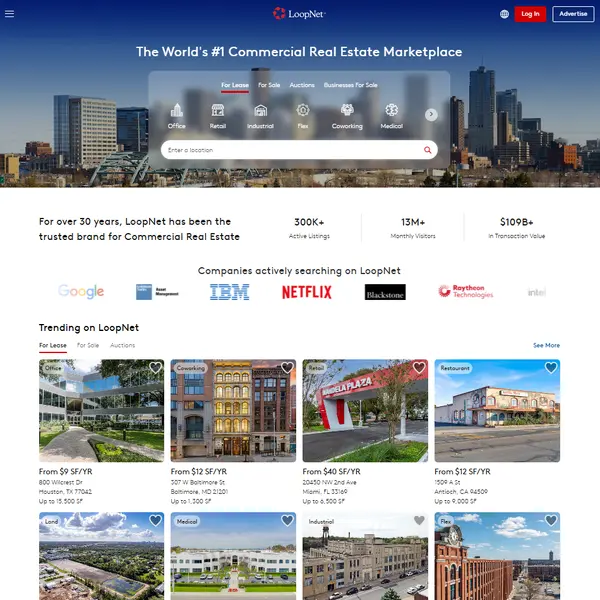
LoopNet is the public marketplace for United States commercial property. We extract what an anonymous visitor sees, building by building and space by space.
Plans from €169/month · Free project assessment · Reply within 1 business day
We run the whole job. You name the markets, property types and cadence; we build the crawler, extract and validate the fields, and deliver on schedule as CSV, JSON, XLSX, a database load or an API endpoint your systems can poll. The scraping, the retries, the proxying and the monitoring are ours to operate.
Common shapes: a one-off market snapshot for a feasibility study; a weekly refresh of availabilities across a set of submarkets; a nightly delta of new, changed and removed listings; or a backfill plus ongoing runs so you hold a history rather than a moment. Two-table output is the usual choice, one row per building listing and one row per available space, joined on listing ID.
When the markup moves, we fix the parser. That is not your maintenance problem.
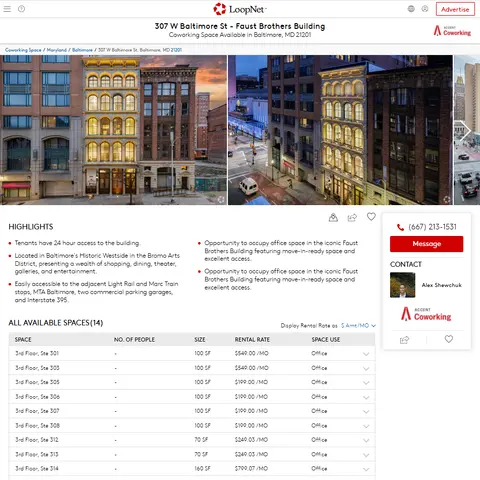
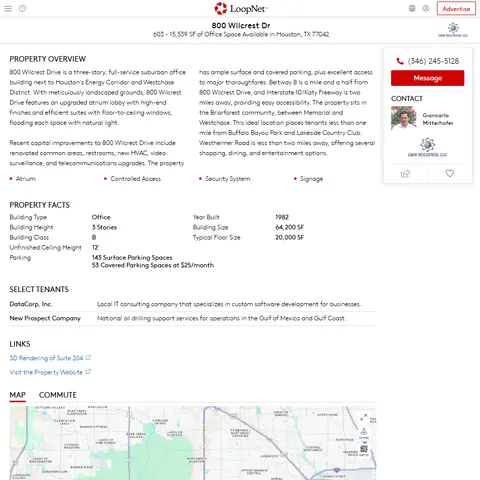
A commercial record is not a house record with bigger numbers. The unit of interest is often a space inside a building rather than the building itself, and the money is quoted per square foot rather than as a single figure. Our LoopNet scraper keeps both levels and joins them on the listing ID.
At the building level we take:
At the space level each availability gets its own row: floor and suite label, size in SF, lease term, rental rate, space use, build-out condition and the date the space becomes available. The rate is stored with its unit, because the same space can be displayed as $/SF/YR, $/SF/MO, $ Amt/YR or $ Amt/MO, and a rent without its unit is worthless. Where the rate reads Upon Request or the term reads Negotiable, we record that text rather than inventing a figure. Lease type, where the listing names one, is carried through as written: NNN, modified gross or full service.
Akamai fronts the domain and turns away unrendered requests, so the practical starting point is a rendered page fetched at a measured rate. Anti-bot handling, proxy rotation and CAPTCHA handling are part of the service, and we do not register or log in. Everything we collect is what an anonymous visitor sees.
Search paths follow /search/property-type/market/for-lease/ or /for-sale/, where the market segment accepts a state, a city or a submarket such as downtown-los-angeles-los-angeles-ca. Pagination is a numeric path segment appended to that path. On the search pages we read, the counter stopped at 500 results, 25 per page across 20 pages, in markets the site itself described as holding thousands of properties. So we never run one query per city. Each market is split by property type, submarket, size band and price band, and the results are de-duplicated on listing ID.
Detail pages sit at /Listing/street-city-state/numeric-id/. That numeric ID is the stable join key between runs, so a suite whose rent moves can be matched to the same building next week. Output is limited to listing and commercial property data; broker and brokerage names appear on the public listing, and broker contact fields can be excluded from the delivery on request.
LoopNet is a public marketplace for commercial property in the United States. Brokers, owners and leasing agents advertise buildings, suites, land and investment offerings there, and anyone can browse the result without signing in. The site is operated by CoStar Group, which also runs the CoStar subscription research service, Apartments.com, Homes.com, Ten-X and Land.com.
That ownership matters for anyone planning to scrape LoopNet. CoStar sells commercial property research as a paid product. The marketplace is a separate thing: an advertising surface where the listing broker decides what to publish. The two are not interchangeable. Public pages carry the advertised record, not the subscription research database, and we make no attempt to reach the latter.
LoopNet also runs its own advertising tiers. Listings are sold in named ad packages, so how prominently a property appears is partly a paid decision. A public crawl therefore reflects the public marketplace view on the day it ran. Every listing, available space, asking rent, cap rate and broker name in that view is LoopNet data we can deliver.
Get a Quote
Developers

Customers worldwide

Pages extracted

Hours saved for our clients
€199 / one-time
setup fee - included
€169 / mo
setup fee €499
€229 / mo
setup fee €499
€349 / mo
setup fee €499
€549 / mo
setup fee €799
Delivery: CSV, JSON or XLSX files, our API or a JSON feed. MCP server on request.
Full plan details →Availability ages fast. A suite leases, a rent gets cut, an owner pulls a building, and the marketplace reflects it within days. Reading that on a schedule is what turns a page into a dataset.
Acquisition and investment teams screen for-sale inventory by market, property type, price band and cap rate, then push a shortlist into their own model. Landlords and asset managers watch competing availabilities in a submarket to see what nearby buildings quote per square foot and how long a suite has sat. Tenant representatives build option lists from the space table rather than the building headline, because a 3,000 SF requirement cares about suites, not about the tower they sit in.
Appraisers, lenders and market research groups use repeated snapshots to measure direction: availabilities appearing, asking rents moving, listings leaving the market. Site selection and franchise development teams filter retail and industrial LoopNet listings by size, zoning and trade area. Proptech products use the feed to keep a market map current between vendor deliveries.
In every case the value sits in the repeat. A single run is a list. A year of runs is a time series.
Every day, a full snapshot of all active Homegate listings in one Swiss region, with photos and PDFs, for a company's own listing-history database.
Learn More
A real-estate analytics company got two portals archived listing by listing: the saved page, a JSON file and every photo, 420K+ listings in all.
Learn More
US real-estate investors get agent lists for their markets from MLS portals under their own 2FA logins, plus realtor.com and Zillow directories.
Learn MoreLearn how to use web scraping to solve data problems for your organization

Real estate teams work in a fragmented data landscape. The sites that drive demand in Boston look nothing like the ones that matter in Berlin, São Paulo, Dubai, or Mumbai.

Real estate teams are operating in a data environment that is bigger, faster, and more fragmented than ever. Listings go live and disappear in hours, price cuts happen quietly, and the portals that matter most in each country are rarely the same global “top 5.”

Six jobs that scraped property data does, each backed by a ScrapeIt project: seller leads, listing monitoring, image datasets, weekly market supply, sold records and unit-level rentals. For every use case - the fields it needs and how often to refresh them.
ScrapeIt is a managed web scraping agency. We are not selling a library, a plugin or a browser extension. We build the crawler, run it on our own infrastructure, watch it, repair it when the source changes, and hand over clean data in the format and on the schedule you asked for.
We collect only publicly available data - everything a visitor can see on LoopNet - and we collect it legally. If a requirement cannot be met honestly, we say so before the project starts.
Yes. The ScrapeIt LoopNet API returns asking rent per square foot, available spaces, cap rate, price per SF, broker and brokerage as JSON from an endpoint we host, refreshed on the schedule you set. The same data also comes as CSV or XLSX files or straight into your database.
No. Both belong to CoStar Group, but they are different products. CoStar sells a paid research and analytics service. LoopNet is the public marketplace where brokers advertise space and buildings. We collect only public marketplace pages. What you get is the advertised record: listings, available spaces, asking rents, cap rates and broker names as the public pages show them.
As two linked tables. One row describes the building: address, size, class, year built, property type, broker and brokerage. Then one row per available space: floor and suite, size in SF, term, rental rate with its unit, space use, condition and availability date. One office listing we read carried twelve available spaces under a single listing ID, each with its own size and its own rate. Flattening that into one row per building throws away the part tenant reps and analysts actually work with.
We record what is shown and nothing more. Many records display Upon Request instead of a rental rate and Negotiable instead of a term, and some listings put documents and further detail behind a registration prompt. We do not create accounts, do not log in, and do not collect anything behind that prompt. Fields that are not public come back empty, with the on-page wording preserved so you can see why they are empty.
Daily, weekly or monthly, depending on how many markets you cover and how fast they move. Because the numeric listing ID is stable, consecutive runs can be compared: new availabilities, asking rent changes, spaces disappearing, and listings that flip to the state where the page says the property is no longer advertised on LoopNet.com. Listing pages also print a date on market and a last updated date, which we keep as recorded. Any count we quote is dated to the run that measured it.
Step 1 - Make a Request
You share your needs, expectations, and desired timeframe. We’ll suggest the best solution based on your request and budget.
Step 2 - Configuring Custom Web Crawlers
Our specialists configure the crawlers and extract a sample dataset for your review before proceeding with the full-scale extraction.
Step 3 - Collect and Deliver
Once you approve the sample, we launch the project and start full data collection. We gather, filter, and structure the data for easy use, delivering it on time in your preferred format.
Step 4 - Maintain and Support
Our team manages ongoing processes, monitors website changes, and supports all data extraction cycles. We can also help integrate data into your systems or create dashboards to simplify analysis.
LoopNet data from €169/month. Free project assessment, reply within 1 business day.

Scrapeit Sp. z o.o.
10/208 Legionowa str., 15-099, Bialystok, Poland
NIP: 5423457175
REGON: 523384582