230,000 Daily Rows Standardized Across 5 EU Property Sites
Monitoring of real estate listings on funda.nl, pararius.com, rentberry.com, rentola.com, and zimmo.be to support the growth of a European property portal.
Learn More
You name the states, cities and statuses. We build the crawlers, run them on your schedule, repair them when the markup moves, and hand back clean rows keyed on the property code.
Plans from €169/month · Free project assessment · Reply within 1 business day
This is a managed service. We design the URL matrix, build and run the crawler, and keep it working when slugs or markup change. Output ships as CSV, JSON, XLSX or a JSON API, or lands in your database, an S3 bucket or an SFTP drop. Schedules run daily, weekly or monthly, with change-only files if you prefer them to full snapshots.
Output is limited to listing and commercial data. Listings name agents and brokerages, and sometimes owners, so personal contact details can be excluded from your files on request. Several US states now have their own consumer privacy statutes, and we set field scope with that in mind. MLS-sourced records also carry the MLS of record and the MLS number, so every row can be traced to its source. We agree fields, geography and intended use with you before a build starts.
A Homes.com scraper is normally specified as one row per property per crawl date, keyed on the thirteen-character code that closes the detail URL. The same code appears in the page as data-entity-key, so rows harvested from search pages and rows harvested from detail pages join without guesswork.
Fields we extract:
The hard constraint is the search cap, and it is worth stating with numbers. On 2025-12-17 the Washington, DC for-sale page reported 2,691 homes for sale and still ended at "Page 1 of 18" with forty results to a page. Chicago reported 5,299 the day before and stopped at the same eighteen pages. The site's own "Full Inventory Search" at /all-inventory/ reported 199,287 nearby homes on 2025-05-17 and also ended at eighteen. No single search view returns more than that, so covering a metro means splitting it into slices that each fall under the ceiling, by neighborhood, ZIP, property type and price band, then de-duplicating on the property code. The published sitemaps are the second route: the active-property index pointed at 67 shard files covering the fifty states plus DC and Puerto Rico, and its DC shard alone listed 4,625 property URLs.
We plan crawls around the canonical path-based geography - city, neighborhood and ZIP paths - rather than filtered query strings.
A single pull ages quickly. Homes.com price cuts, status flips into pending, relists and new inventory only exist as differences between runs, so we keep the snapshot history and ship the deltas already computed: what appeared, what changed, what disappeared.
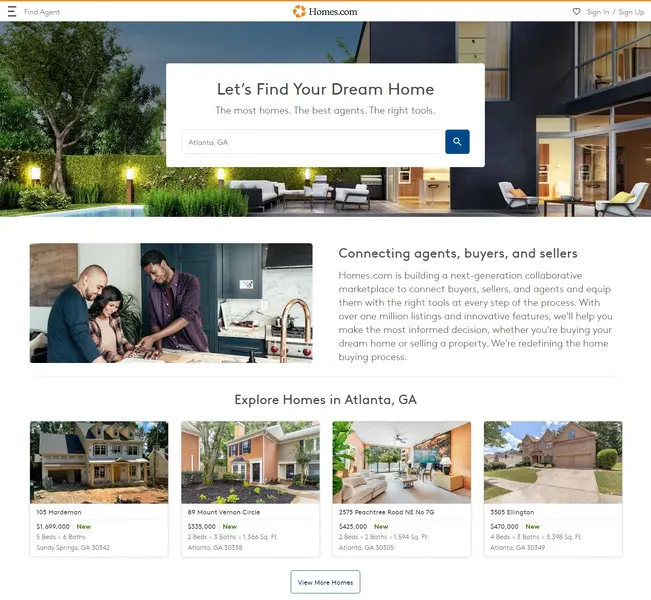
Homes.com is a United States residential portal owned by CoStar Group, which bought it from Dominion Enterprises in 2021. Inventory reaches the site from MLSs and brokerages rather than from private sellers. Coverage therefore follows whichever MLSs and brokerages list on the portal today, and freshness follows how often those sources update, not how often a seller edits a page.
The commercial model is what separates it from the other US portals. Homes.com puts the listing agent on the property instead of routing the enquiry to a buyer agent who paid for the slot, and the property page states it in as many words: "Only Homes.com connects you to the Listing Agent." That decision is visible in the markup rather than only in marketing. Every result card renders an agent block carrying agent name, brokerage and a phone number, and the embedded record types the agent as "jobTitle": "Listing Agent" while the brokerage is held separately as "seller". Each listing also links to that agent's own profile page on the site.
Provenance is printed as well. A detail page names the MLS of record and the listing number under labels such as "Source:" and "MLS Number:", and a section headed "See All MLS Data" passes the originating field names through unchanged, which is why a single property can carry keys that mean nothing outside the MLS that produced them. Valuation follows the same habit. Instead of one house estimate, the page prints several named third-party models beside each other with an "Average Value" underneath.
Get a Quote
Developers

Customers worldwide

Pages extracted

Hours saved for our clients
€199 / one-time
setup fee - included
€169 / mo
setup fee €499
€229 / mo
setup fee €499
€349 / mo
setup fee €499
€549 / mo
setup fee €799
Delivery: CSV, JSON or XLSX files, our API or a JSON feed. MCP server on request.
Full plan details →Most buyers do not come to us for another copy of the for-sale grid. They come for the agent side of it. Because the listing agent is the named party on every property rather than a rotating advertiser, a crawl of a market resolves into a book of business per agent and per brokerage, and the site publishes the aggregates on top: the agent directory prints a "Total Sales" count, a market-scoped count beside it, and a "Price Range" band. Brokerages use that to measure share by city and to build recruiting lists. Vendors selling into brokerages use it to size and rank territories.
The second reason is provenance. When a row names the MLS it came from and the MLS number beside it, a national dataset stops being one flat table and becomes a set of clearly labelled regional sets you can reconcile, audit or exclude. Teams that already cover one or two markets use the portal to see the shape of the markets they do not hold.
The third is straightforward comparables work. Sold pages are addressable by city and by ZIP, so an appraiser, a lender or an underwriter can pull a defensible comparable set for a defined area and hold it as history. Teams scrape Homes.com alongside a valuation model because the page carries more than one third-party estimate, which makes disagreement between models measurable rather than invisible.

Monitoring of real estate listings on funda.nl, pararius.com, rentberry.com, rentola.com, and zimmo.be to support the growth of a European property portal.
Learn More
Daily detection of new private property listings in Switzerland on Homegate.ch and ImmoScout24.ch, giving the agency first access to high-value leads.
Learn More
Scraping residential listings from Immobilienscout24.de in Germany and Mallorca, including complete data and resized images.
Learn MoreLearn how to use web scraping to solve data problems for your organization

Real estate teams work in a fragmented data landscape. The sites that drive demand in Boston look nothing like the ones that matter in Berlin, São Paulo, Dubai, or Mumbai.

Real estate teams are operating in a data environment that is bigger, faster, and more fragmented than ever. Listings go live and disappear in hours, price cuts happen quietly, and the portals that matter most in each country are rarely the same global “top 5.”

Six jobs that scraped property data does, each backed by a ScrapeIt project: seller leads, listing monitoring, image datasets, weekly market supply, sold records and unit-level rentals. For every use case - the fields it needs and how often to refresh them.
ScrapeIt is a managed web scraping agency. We do not sell a tool or a library. We take the specification, build the crawlers, run them on the schedule you set, monitor them, and repair them when a site changes. You receive data in the format you asked for and run no infrastructure.
We work with publicly visible pages only, at a rate and scope agreed in writing beforehand. Send us the markets and the fields and we will return a sample before anything larger is committed.
Yes. The ScrapeIt Homes.com API returns asking price, status and dates, the listing agent and brokerage, the MLS of record with the MLS number, and the Property History rows as JSON from an endpoint we host, refreshed on the schedule you set. The same data also comes as CSV or XLSX files or straight into your database.
Both. Sold inventory has its own addressable paths, at city level as /city-state/sold/ and at ZIP level as /washington-dc/20001/sold/, and the site submits both sets in its sitemaps. Sold pages give you the comparable set for an area; the Property History table on a detail page gives you the events behind one address, including the "List to Sale" column. What sold history reaches a public page still varies by originating MLS, so we test your markets on a sample before quoting a full build.
It depends on what you are measuring. New listings, Homes.com price cuts and status changes into pending are day-scale events, so lead generation and pricing work usually runs daily. Market share, agent production and comparable sets move slowly and are fine weekly or monthly. Because inventory arrives from MLSs and brokerages rather than from sellers typing into a form, a page updates when its source does, which is why we record a crawl timestamp on every row and never present a snapshot as if it were live.
That is the strongest part of this source. The agent is a first-class field rather than an advertising slot, so agent name, brokerage, the agent profile URL and the office attribution come back on the listing row itself, and the agent profile can be crawled separately for the published sales aggregates. Phone numbers are on the page too, and the agent-level number and the office number are often different, so we keep them in separate columns. If you would rather not hold personal contact details at all, we drop those columns before delivery.
By slicing the geography until every slice fits under the ceiling. A metro breaks into neighborhoods and ZIPs, and each of those breaks further by property type and price band, using the canonical path-based URLs the site publishes rather than filtered query strings. The sitemaps give a second, independent enumeration of property URLs by state, which is usually broader than what the capped search view exposes, and we reconcile the two on the property code. The result is one de-duplicated set per market rather than the first 720 rows a search happens to show.
Step 1 - Make a Request
You share your needs, expectations, and desired timeframe. We’ll suggest the best solution based on your request and budget.
Step 2 - Configuring Custom Web Crawlers
Our specialists configure the crawlers and extract a sample dataset for your review before proceeding with the full-scale extraction.
Step 3 - Collect and Deliver
Once you approve the sample, we launch the project and start full data collection. We gather, filter, and structure the data for easy use, delivering it on time in your preferred format.
Step 4 - Maintain and Support
Our team manages ongoing processes, monitors website changes, and supports all data extraction cycles. We can also help integrate data into your systems or create dashboards to simplify analysis.
Homes.com data from €169/month. Free project assessment, reply within 1 business day.

Scrapeit Sp. z o.o.
10/208 Legionowa str., 15-099, Bialystok, Poland
NIP: 5423457175
REGON: 523384582