Funda Data: Two Years of Monthly Home Sales by Franchise Territory
Every month a marketing agency gets the homes sold on Funda in the previous month, split by the postcodes of each franchise branch.
A Funda listing pairs the asking price with cadastral data, the energy label and, once sold, the date of sale. Our Funda scraper delivers it per Funda ID.
Plans from €169 a month · Free project assessment · Reply within 1 business day
CSV · Excel · JSON · XML · FTP · SFTP · Amazon S3 · Google Cloud
API, JSON feed or CSV, XLSX and JSON files
ScheduleOne-time, monthly, weekly, daily or 3 times a day
Funda pages, filters, fields and a schedule
Built, monitored and repaired by our team
API, JSON feed or CSV, XLSX and JSON files
You tell us which part of the Dutch market you need: municipalities, neighbourhoods, postcodes or a radius around a town; koop, huur or nieuwbouw; available homes, sold homes or both; and the fields. We build the Funda crawler, run it once or on your schedule, and keep it working. When Funda changes its page structure, the repair is ours to make, not yours.
Funda sometimes stops a visitor at a check page before it shows a listing, so request pacing, proxy rotation, page rendering and CAPTCHA handling are part of the service. Each project starts with a free assessment, you can order a sample first, and the dataset comes with documentation that maps every Dutch label to its column.
Our Funda data scraper reads the full Kenmerken (Features) block of each listing, not only the summary line under the photos. A row is one Funda ID on one run date; cadastral parcels and photos go to child tables, because one home can sit on several parcels.
Labels come as Funda prints them in Dutch or English and are mapped to one column set, so a Utrecht rental and an Enkhuizen sale share a schema.
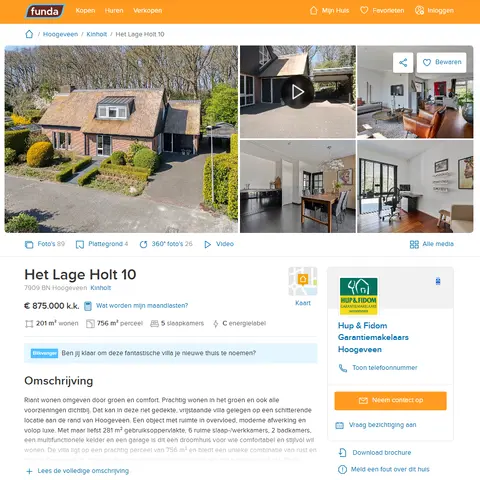
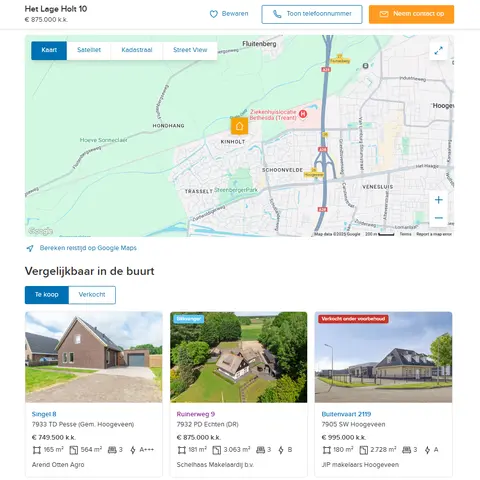
Three layers sit outside the Kenmerken block, and each changes what a dataset can answer.
Repeated runs add the time dimension. Daily or weekly snapshots record each asking price, the step from available to sold under reservation to sold, and the run on which a listing left search, which together give a price series and days on market per Funda ID.
We collect Funda listings for sale, for rent, newly built and sold, one row per listing keyed on the numeric Funda ID that ends every listing URL, on a daily, weekly or monthly schedule. Files arrive as CSV, XLSX or JSON, or through our API, a JSON feed, SFTP or Amazon S3. Plans start from EUR 169 a month, or EUR 199 for a one-time extract. Our case study Funda Data: Monthly Sold Homes by Territory shows one such schedule: a monthly file of sold homes.
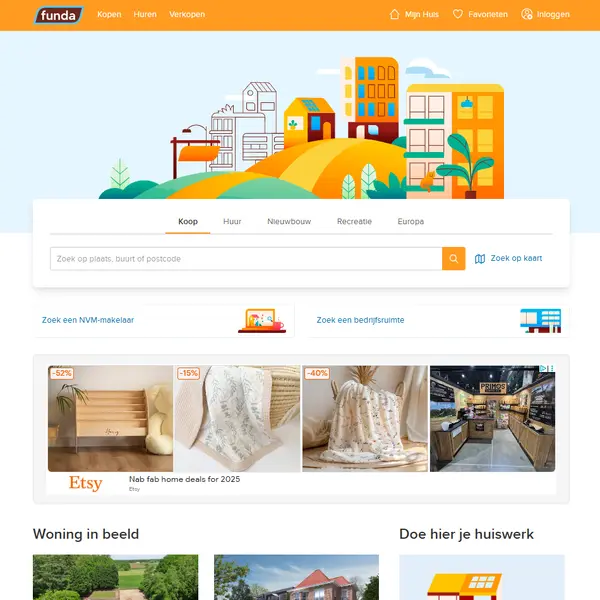
Funda (funda.nl) is a housing portal for the Netherlands on which estate agents publish homes for sale and for rent. It has been online since 2001 and runs in Dutch, with an English version under /en/. The top menu splits it into Kopen (buy), Huren (rent), Nieuwbouw (newly built) and Verkopen (sell), and a listing URL spells out the same logic: offer type, town, property type with the street, then the ID. Search starts from a place - town, neighbourhood or postcode - with a radius, filters for price, property type, Days on Funda and floor area, and a running count of homes found.
Each listing names the agent office behind it, and Funda's menu points buyers and sellers to NVM agents. A listing does not vanish when the home sells: it moves from available to Verkocht onder voorbehoud and then to Verkocht, keeping its features, cadastral data and agent. That is why one site serves both current supply and recent sales.
Delivery: CSV, JSON or XLSX files, our API or a JSON feed. MCP server on request.
Full plan detailsFunda puts a price, a surface and a legal status on the same page, so its data answers questions that need all three at once.
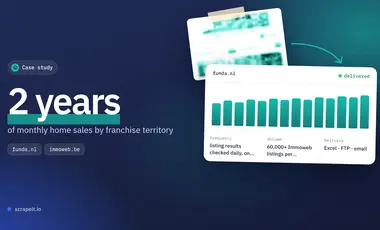
Every month a marketing agency gets the homes sold on Funda in the previous month, split by the postcodes of each franchise branch.

Monitoring of real estate listings on funda.nl, pararius.com, rentberry.com, rentola.com, and zimmo.be to support the growth of a European property portal.
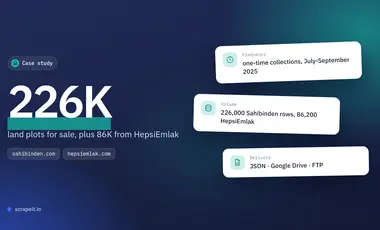
Land for sale across Turkey from Sahibinden and HepsiEmlak for a land investor: 226,000 plots in the first file and 86,200 HepsiEmlak rows.
Learn how to use web scraping to solve data problems for your organization
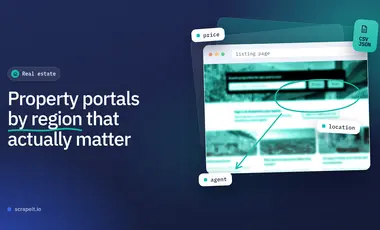
Real estate teams work in a fragmented data landscape. The sites that drive demand in Boston look nothing like the ones that matter in Berlin, São Paulo, Dubai, or Mumbai.
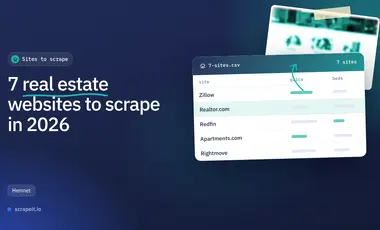
Real estate teams are operating in a data environment that is bigger, faster, and more fragmented than ever. Listings go live and disappear in hours, price cuts happen quietly, and the portals that matter most in each country are rarely the same global “top 5.”

Six jobs that scraped property data does, each backed by a ScrapeIt project: seller leads, listing monitoring, image datasets, weekly market supply, sold records and unit-level rentals. For every use case - the fields it needs and how often to refresh them.

ScrapeIt is a managed web scraping agency: we design, run and repair the crawlers and deliver the data. Since 2024 we have sent a marketing agency the homes sold on Funda in the previous month, split by the postcodes of each branch of a real estate franchise network - street, house number, postcode, town and price, with new builds and duplicates removed, one Excel tab per branch sorted by price, by FTP and e-mail on the first Monday. Funda had more than 70,000 for-sale listings when it joined that project. Personal data is handled under GDPR.
Still unsure? Write to info@scrapeit.io
Yes. The ScrapeIt Funda API returns the Funda ID, address, asking price, energy label, status and date of sale as JSON from an endpoint we host, refreshed on the schedule you set. The same rows also come as CSV or XLSX files, a JSON feed or a load into your database.
Yes. Search pages, listing pages with their features and cadastral data, and sold listings with their sales history are open to any visitor of funda.nl. We collect only publicly available data - everything a visitor can see on Funda - and we collect it legally. Agent offices are named; private persons are left out by default.
Yes, as Funda shows them. A sold listing keeps its last asking price, the listed-since date, the date of sale and the term in days, so you get the time to sell per home. The figure is the last asking price, not the price in the deed, and the column is labelled that way.
A listing shows its current asking price, so the dated series comes from our runs. With daily or weekly runs we record each asking price, every move from available to sold under reservation to sold, and the date a listing leaves search. The first run is your baseline, so start before the period you want to analyse.
One row per Funda ID with the fields above, plus child tables for cadastral parcels and photos. A city run can cover koop, huur and newly built, split by neighbourhood or postcode, and arrives as XLSX, CSV or JSON by SFTP, Amazon S3 or e-mail.
You share your needs, expectations, and desired timeframe. We'll suggest the best solution based on your request and budget.
Our specialists configure the crawlers and extract a sample dataset for your review before proceeding with the full-scale extraction.
Once you approve the sample, we launch the project and start full data collection. We gather, filter, and structure the data for easy use, delivering it on time in your preferred format.
Our team manages ongoing processes, monitors website changes, and supports all data extraction cycles. We can also help integrate data into your systems or create dashboards to simplify analysis.
Tell us which sites, which fields and how often. A couple of lines is enough to start.
Funda data from €169/month. Free project assessment, reply within 1 business day.