230,000 Daily Rows Standardized Across 5 EU Property Sites
Monitoring of real estate listings on funda.nl, pararius.com, rentberry.com, rentola.com, and zimmo.be to support the growth of a European property portal.
Learn More
Zimmo prints a dated price history under an advert: every asking price and the percentage change. Our Zimmo scraper collects that table with the listing and its agency.
Plans from €169/month · Free project assessment · Reply within 1 business day
You describe the scope in the portal's own vocabulary: te koop or te huur, the property types, and the provinces, municipalities or postcodes that matter to you. We build the crawlers, run them and repair them when Zimmo changes its pages, so there is no tool to install or maintain. Anti-bot handling - pacing, proxy rotation and page rendering - is part of the service.
Runs are one-off or scheduled: daily, weekly or on demand. Each run is compared with the one before, so a delivery marks new adverts, changed asking prices and adverts that have left the site. Files arrive as CSV, Excel (XLSX) or JSON, through an endpoint we host, by SFTP, in Amazon S3 or as a load into your database, with field documentation attached. A free project assessment comes first, and a sample can be ordered before you commit.
Every advert carries a short Zimmo-code, printed under its title and closing its web address after the municipality with its postcode, the transaction and the property type. That code is our row key: it stays put when the price changes, and the Dutch and French pages of one advert share it. Around it we collect what the advert shows a visitor:
Rental adverts add the date the home becomes free and a furnished flag. Where an advertiser left a field out, Zimmo often prints 'op aanvraag' (on request); we keep that marker and do not guess a value.
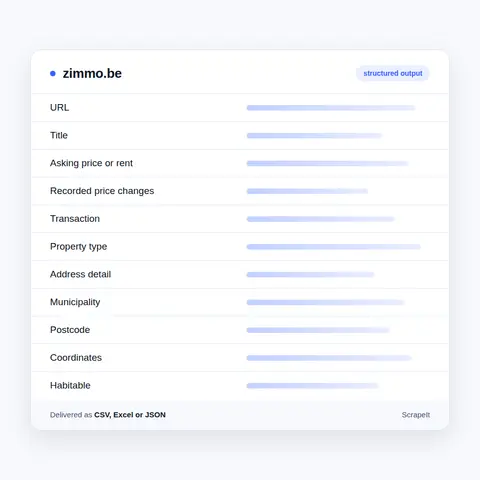
Open the Prijshistoriek block and Zimmo lists each asking price the advert has had: the date, the amount, the change in percent, the price per square metre of living area and of plot, and a total difference on top. We take the whole table, so the first delivery already holds a price history per listing, not one figure.
Two counters on the same advert - days on Zimmo and time since the last change - are shown to signed-in members only. We never log in, so time on market is calculated from the dates in the price table and from the first and last run in which a Zimmo-code appeared. Repeated runs add what no single page states: price drops per week, adverts withdrawn, adverts that come back.
Agency pages form a second dataset. Each office shows its address, enterprise and BIV registration numbers, opening hours, website, a review score out of ten with the number of reviews, and its newest stock for sale and for rent. Review texts come with their date, their source and the verified mark; reviewer names are personal data and are left out by default.
New-build projects are built differently from single adverts. A project page gives the price range, the surface range and a link to its units, and its search card states the share still available. Project and units arrive as linked rows. Search pages per province, municipality, postcode and property type each print a result counter, which we use to check coverage against Zimmo's own totals.
Zimmo is a Belgian property portal, wholly owned by the media group Mediahuis, and calls itself the second-largest property platform in the country. Two other sites were folded into it over the years: Hebbes, a sister classifieds site inside Mediahuis, and Logic-Immo.be, whose web address now leads to zimmo.be. Logic-Immo belonged to the IPM group, whose newspapers - La Libre Belgique and l'Avenir among them - carried its adverts.
The site runs in Dutch and French over a single stock: the home page counts properties in Flanders, Wallonia and Brussels together. Everything is either te koop (for sale) or te huur (for rent), then split by type - house, apartment, land, garage, commercial property, student room and new-build project - with finer types such as villa, penthouse, loft, studio or farmhouse. Geography runs from province through municipality to postcode, and a draw-on-map search cuts across those borders. A foreign-property section is kept apart from the Belgian listings.
Adverts come from estate agencies, notaries and developers, and private owners can place their own. The filters show what the portal records for each advert: energy label and EPC value, building condition, type of construction, furnished homes, investment property and notarial sales. Around the listings Zimmo runs an agency directory with reviews, each marked verified or not, and a valuation tool called Prijswijzer.
Get a Quote
Developers

Customers worldwide

Pages extracted

Hours saved for our clients
€199 / one-time
setup fee - included
€169 / mo
setup fee €499
€229 / mo
setup fee €499
€349 / mo
setup fee €499
€549 / mo
setup fee €799
Delivery: CSV, JSON or XLSX files, our API or a JSON feed. MCP server on request.
Full plan details →Zimmo data answers questions a single asking price cannot, because the portal leaves the earlier prices on the page.
Since both language versions show the same adverts under the same code, one crawl covers the three regions without counting a home twice.

Monitoring of real estate listings on funda.nl, pararius.com, rentberry.com, rentola.com, and zimmo.be to support the growth of a European property portal.
Learn More
Daily detection of new private property listings in Switzerland on Homegate.ch and ImmoScout24.ch, giving the agency first access to high-value leads.
Learn More
Scraping residential listings from Immobilienscout24.de in Germany and Mallorca, including complete data and resized images.
Learn MoreLearn how to use web scraping to solve data problems for your organization

Real estate teams work in a fragmented data landscape. The sites that drive demand in Boston look nothing like the ones that matter in Berlin, São Paulo, Dubai, or Mumbai.

Real estate teams are operating in a data environment that is bigger, faster, and more fragmented than ever. Listings go live and disappear in hours, price cuts happen quietly, and the portals that matter most in each country are rarely the same global “top 5.”

Six jobs that scraped property data does, each backed by a ScrapeIt project: seller leads, listing monitoring, image datasets, weekly market supply, sold records and unit-level rentals. For every use case - the fields it needs and how often to refresh them.
ScrapeIt is a managed web scraping service: we build, run and repair the crawlers and hand over the data, so your team works with rows and not with scrapers. On property portals the work is in the detail, and Belgian ones have their own - two languages over one stock, postcodes shared by several part-municipalities, energy and flood fields that are not filled in on every advert. We map all of it into one documented schema. Plans start from EUR 169 a month, or EUR 199 for a one-time extract.
Zimmo.be was one of five property sites in a monitoring project for a European real estate portal, next to funda.nl, pararius.com, rentberry.com and rentola.com. The system went live three weeks after the order and returns about 230,000 rows a day, with all five sources reconciled into one structure the portal's analytics reads without adapters.
Yes. The ScrapeIt Zimmo API returns the Zimmo-code, asking price, price history, living area, energy label and agency name as JSON from an endpoint we host, refreshed on the schedule you set. The same data also comes as CSV or XLSX files, a JSON feed or straight into your database.
Yes. Adverts, prices, price history tables and agency pages are shown on Zimmo to every visitor without an account. We collect only publicly available data - everything a visitor can see on Zimmo - and we collect it legally. Counters reserved for signed-in members stay out of the dataset, and personal details such as reviewer names are left out by default.
Yes, wherever Zimmo shows the table. Each entry carries the date, the asking price, the percentage change and the price per square metre, keyed to the Zimmo-code. An advert that never changed price has no earlier entries, and from the first run onward we add our own dated observations.
As often as the use requires: daily for price-cut alerts and new-listing feeds, weekly for market reports, or once for a valuation model. Search cards flag fresh adverts as 'Nieuw', and every run reports new, changed and removed Zimmo-codes against the previous one.
Yes. Zimmo keeps one stock of adverts for the three regions and shows it in Dutch and French, so each advert is crawled once and its labels can be delivered in either language. The scope can be narrowed to provinces, municipalities or single postcodes, and the foreign-property section is available as a separate extract.
Step 1 - Make a Request
You share your needs, expectations, and desired timeframe. We’ll suggest the best solution based on your request and budget.
Step 2 - Configuring Custom Web Crawlers
Our specialists configure the crawlers and extract a sample dataset for your review before proceeding with the full-scale extraction.
Step 3 - Collect and Deliver
Once you approve the sample, we launch the project and start full data collection. We gather, filter, and structure the data for easy use, delivering it on time in your preferred format.
Step 4 - Maintain and Support
Our team manages ongoing processes, monitors website changes, and supports all data extraction cycles. We can also help integrate data into your systems or create dashboards to simplify analysis.
Zimmo.be data from €169/month. Free project assessment, reply within 1 business day.

Scrapeit Sp. z o.o.
10/208 Legionowa str., 15-099, Bialystok, Poland
NIP: 5423457175
REGON: 523384582