230,000 Daily Rows Standardized Across 5 EU Property Sites
Monitoring of real estate listings on funda.nl, pararius.com, rentberry.com, rentola.com, and zimmo.be to support the growth of a European property portal.
Learn More
Immobilier Le Figaro carries agency stock that arrives by feed rather than direct postings. We extract the listing record and deliver it on your schedule.
Plans from €169/month · Free project assessment · Reply within 1 business day
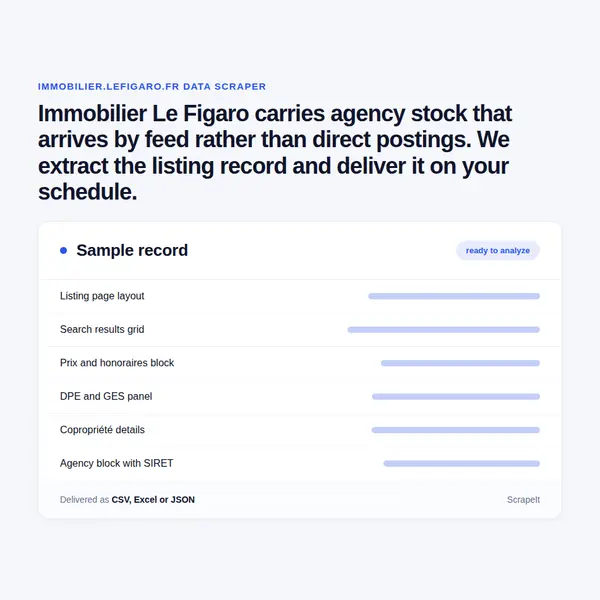
Le Figaro Immobilier data lands as CSV, JSON, XLSX or a REST endpoint on our side, at whatever cadence you set: once for a snapshot, nightly, or every few hours where prices are the point. The schema is agreed before the first run, so columns stay fixed and your downstream jobs keep working.
We watch the site for markup and field changes and repair the crawler when something moves, as part of the service. Files can be pushed to S3, Google Cloud Storage, an SFTP drop, Google Sheets or a webhook. Where a repeated crawl supports it, we also emit a change log of new, updated and removed listings alongside the full set, so you can load deltas instead of re-reading everything.
Listing pages are server-rendered and ship the underlying record as structured data inside the page. We read that record rather than the rendered text, so field names hold steady across houses, apartments and new build. A typical extraction set:
Where the source record has no value we return the column empty. We do not infer a surface or a DPE letter the agency did not supply.
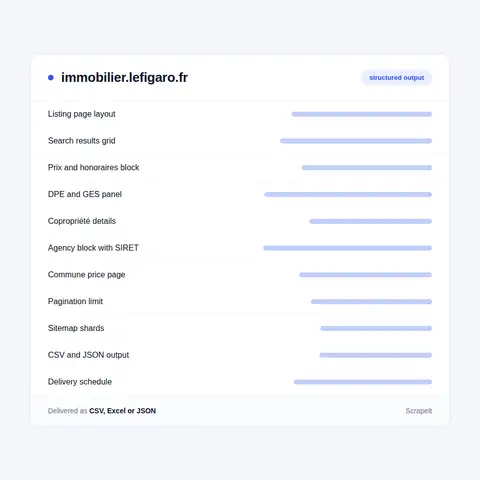
Search pages sit under /annonces/ and encode the query in the path itself. A département search looks like immobilier-vente-appartement-paris+(75).html; an arrondissement search looks like immobilier-vente-appartement-marseille+9eme+13009.html. Facets ride along as query parameters, for example ?option=terrasse, ?option=piscine or ?option=particulier. Location hubs use a different shape, /immobilier/{region}/{departement}/{commune}, and each commune has a price page at /prix-immobilier/{commune}/ville-{INSEE code} that the listing record links to directly.
Pagination is ?page=N and it stops hard. The last page any search will serve is page 100. The portal publishes the result total alongside the query, 11,483 for apartments for sale in Paris on that date, so a broad search plainly holds more rows than the reachable window. Any such query has to be partitioned by commune, price band, room count or property type before the crawl runs. We build that partition automatically and reconcile the parts on the listing id.
We crawl at a modest rate and seed from the site's own sitemaps: the classifieds set was published in twelve shards on 2026-08-28, the first holding exactly 50,000 listing URLs.
Immobilier Le Figaro, branded Figaro Immobilier, is the property portal of Figaro Classifieds inside the Groupe Figaro media business. It grew out of Explorimmo, renamed in 2018 after the group took the brand over. That history shapes the data. This is not a marketplace where sellers post one by one. Most inventory is pushed in rather than typed in: an agency enters a property into its logiciel de transaction (transaction software) or a multidiffusion gateway, and the record reaches Le Figaro through a feed.
The feed origin is visible in the page data. Every record carries an originSite value, and a single result set mixes them. On a Paris apartments-for-sale query, the first page held records marked figimmo for the general portal, figimmoneuf for new build, and plf, the code used by the group's prestige title. Each record also carries a transmitter block whose idClassified is prefixed with the code of the feed that delivered it. IMBX and IBPB both appeared on that page, followed by the agency's own reference.
Three consequences follow. Coverage tracks which agencies and networks push a feed to the group, not what exists in a given commune. Freshness tracks the feed cycle, not the minute an agent edited a prix. And the upper end of the market is over-represented next to a pure classifieds site, because a media brand pulls prestige stock in from a sister product.
Get a Quote
Developers

Customers worldwide

Pages extracted

Hours saved for our clients
€199 / one-time
setup fee - included
€169 / mo
setup fee €499
€229 / mo
setup fee €499
€349 / mo
setup fee €499
€549 / mo
setup fee €799
Delivery: CSV, JSON or XLSX files, our API or a JSON feed. MCP server on request.
Full plan details →Most buyers of this feed already hold data from the volume portals. They come here for what those sources cover thinly.
Premium and second-home stock. Records from the group's prestige title surface inside ordinary searches rather than sitting behind a separate site. The portal also publishes 106 named-area searches built on geography instead of administrative boundaries, among them Côte d'Azur, Bassin d'Arcachon, Balagne and the 3 Vallées ski domain. For holiday and high-end pricing work, that geography is the reason to use this source at all.
Agency mapping. Every professional record links to an agency page carrying a SIRET, a postal address and a website. The agency sitemap listed 11,293 such pages on 2026-08-28. The SIRET is a clean join key against French company registers and a practical way to size a network's live stock.
Price movement. Records expose creationDate and updatedAt next to a computed price-drop percentage, so a repeated crawl yields time on market and reductions without any separate history source.
Cross-portal matching. A property usually appears on several French sites under different ids. Here the agency's own reference travels with the record, which makes de-duplication against SeLoger or Leboncoin sets far more reliable than matching on address strings.

Monitoring of real estate listings on funda.nl, pararius.com, rentberry.com, rentola.com, and zimmo.be to support the growth of a European property portal.
Learn More
Daily detection of new private property listings in Switzerland on Homegate.ch and ImmoScout24.ch, giving the agency first access to high-value leads.
Learn More
Scraping residential listings from Immobilienscout24.de in Germany and Mallorca, including complete data and resized images.
Learn MoreLearn how to use web scraping to solve data problems for your organization

Real estate teams work in a fragmented data landscape. The sites that drive demand in Boston look nothing like the ones that matter in Berlin, São Paulo, Dubai, or Mumbai.

Real estate teams are operating in a data environment that is bigger, faster, and more fragmented than ever. Listings go live and disappear in hours, price cuts happen quietly, and the portals that matter most in each country are rarely the same global “top 5.”

Six jobs that scraped property data does, each backed by a ScrapeIt project: seller leads, listing monitoring, image datasets, weekly market supply, sold records and unit-level rentals. For every use case - the fields it needs and how often to refresh them.
ScrapeIt is a managed web scraping agency. We design the crawler, run it on our own infrastructure, monitor it, and hand over clean data. You maintain no code, no proxies and no parsers.
We already deliver French property feeds from other portals, so the département codes, the DPE letters and the honoraires conventions are familiar ground. Tell us the regions, property types and refresh interval you need, and we will confirm the field list, the sample output and the schedule before any work begins.
Yes. The ScrapeIt Immobilier Le Figaro API returns asking price and prix au m2, honoraires, surface, room count, the DPE and GES letters and the agency SIRET as JSON from an endpoint we host, refreshed on the schedule you set. The same data also comes as CSV or XLSX files or straight into your database.
Both appear, but the balance is heavily professional. Each record carries an origin field valued professionnel or particulier, and the portal exposes a ?option=particulier filter. Apartments for sale in Paris returned 11,483 results in total, and 34 with that filter applied. Private-seller rows also look different in the data: they name an individual and carry no SIRET, while professional rows carry a company name, a SIRET and an agency page. If private inventory is your main requirement, a private-only portal fits better. This source is for agency and network coverage.
Yes. Output is limited to listing and commercial data by default. Named contacts, direct phone numbers and any other personal detail can be dropped from the schema on request, and we confirm the exclusion list with you before the first run. Private-seller records are the ones that carry personal data in the sense of the GDPR, since they identify an individual rather than a company. We collect only publicly available data - everything a visitor can see on Le Figaro Immobilier - and we collect it legally. You decide which fields ever leave our side.
Freshness is measurable per listing rather than assumed, because each record carries creationDate, firstPublicationDate and updatedAt. Since inventory reaches the portal from agency software and multidiffusion gateways, those timestamps reflect when the feed was processed, not the moment the agency edited the property. A daily crawl catches new listings, price changes and removals. An hourly crawl narrows your own window but cannot remove the upstream processing lag. Before you commit to a schedule we report the observed spread of updatedAt across your target geography, so the cadence matches how often the data actually moves.
Yes, by splitting the query. Pagination stops after page 100, so a wide search cannot simply be walked to its end. We partition it by commune first, then by price band, room count and property type, until each partition fits inside the reachable window, and we cross-check the seed list against the site's sitemaps. Results are then merged and de-duplicated on the listing id, so the delivered set carries no repeats. We also report the published result total per partition next to the rows we actually retrieved, so any shortfall is visible to you instead of hidden.
Step 1 - Make a Request
You share your needs, expectations, and desired timeframe. We’ll suggest the best solution based on your request and budget.
Step 2 - Configuring Custom Web Crawlers
Our specialists configure the crawlers and extract a sample dataset for your review before proceeding with the full-scale extraction.
Step 3 - Collect and Deliver
Once you approve the sample, we launch the project and start full data collection. We gather, filter, and structure the data for easy use, delivering it on time in your preferred format.
Step 4 - Maintain and Support
Our team manages ongoing processes, monitors website changes, and supports all data extraction cycles. We can also help integrate data into your systems or create dashboards to simplify analysis.
Immobilier Le Figaro data from €169/month. Free project assessment, reply within 1 business day.

Scrapeit Sp. z o.o.
10/208 Legionowa str., 15-099, Bialystok, Poland
NIP: 5423457175
REGON: 523384582