Sahibinden Land Listings: 226K Plots for Sale, Plus 86K from HepsiEmlak
Land for sale across Turkey from Sahibinden and HepsiEmlak for a land investor: 226,000 plots in the first file and 86,200 HepsiEmlak rows.
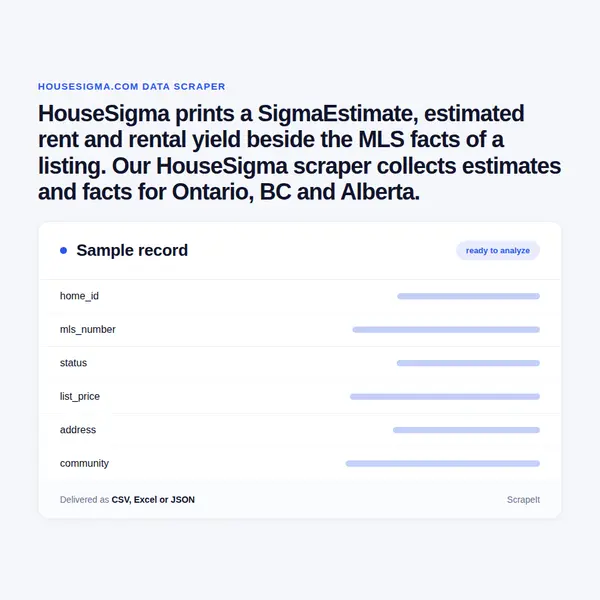
HouseSigma prints a SigmaEstimate, estimated rent and rental yield beside the MLS facts of a listing. Our HouseSigma scraper collects estimates and facts for Ontario, BC and Alberta.
Plans from €169 a month · Free project assessment · Reply within 1 business day
CSV · Excel · JSON · XML · FTP · SFTP · Amazon S3 · Google Cloud
API, JSON feed or CSV, XLSX and JSON files
ScheduleOne-time, monthly, weekly, daily or 3 times a day
HouseSigma pages, filters, fields and a schedule
Built, monitored and repaired by our team
API, JSON feed or CSV, XLSX and JSON files
You tell us which provinces, cities or communities matter, which listing states you need - active, sold, de-listed, for lease - and how often to look. We build the HouseSigma crawlers, run them on your schedule and repair them whenever the single-page app changes its layout. Page rendering, request pacing, proxy rotation and CAPTCHA handling are our side of the job.
Some HouseSigma data opens only after a free sign-in: sold prices, earlier prices in Listing History, the date a home was first listed, most Market Trends charts and the full details of listings marked Login Required. When a project needs them, it runs on an account registered through HouseSigma's own sign-up form or on your own account, and we say up front which columns depend on that. Field documentation comes with every delivery, and a sample can be ordered before the first scheduled run.
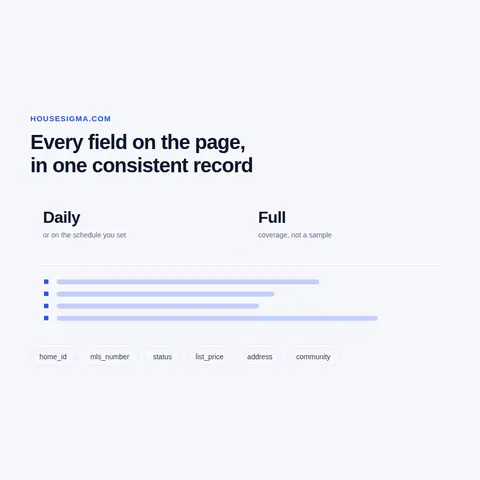
Every HouseSigma listing lives at an address built from the province code (/on/, /bc/ or /ab/), the city, the street address and a 16-character home id. That id, together with the MLS number the page prints as Listing #, keys each row, so one home can be followed from run to run and joined to your own MLS records.
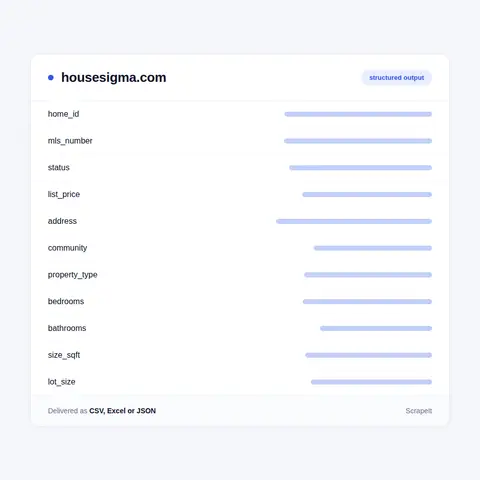
Search and city pages return the card version of the same record - status, list price, address with community, property type, beds, baths, garage and size range, plus the MLS number and brokerage on open cards, while other cards hide the address and price behind a sign-in prompt. A crawl can start from a city, a community or a property type filter and open full pages only where needed.
Beyond the single listing, HouseSigma publishes a page for each city and community with filters for active, sold and de-listed homes, property type, price and lot size. Every city page carries a written monthly summary: median sold price with month-over-month, year-over-year and five-year change, average days on market, counts of sold, active and new listings, the median rental price and the split of sold homes by property type. Captured each month, those paragraphs become a time series per city.
Sold listings are the layer to plan around. Without a sign-in, a sold card in a city such as Kitchener shows the address, how long ago it sold and sometimes an Estimated Sold Price; in Toronto even the address is masked, and the sold price, its date and the full details open after logging in. Market Trends works the same way: median price, new listings and the one-, five- and ten-year value change are public, while absorption rate, rent ratio and the sold price distribution need an account. Projects that need sold prices run that part of the crawl on an account opened through HouseSigma's own sign-up form, or on the client's account.
Repeated runs fill the gap from the other side. A home recorded as For Sale on Monday and gone on Friday keeps every price change in between, and the Listing History rows show whether the same address was listed and expired before.
HouseSigma is a Toronto company founded in 2018 that runs a listings portal, a home-value tool and a real estate brokerage under one roof; its listing pages state that HouseSigma Inc. is a registered brokerage in Ontario. It began with Toronto and the GTA, spread across Ontario to Ottawa, London and Hamilton, and now covers British Columbia and Alberta as well. Each province has its own branch of the site with its own city and community pages.
The listings come from regional real estate boards, and each page names the MLS source in its Data Source field. HouseSigma adds its own layer on top: the SigmaEstimate and rent estimate, the Market Demand gauge, an area Popularity Score built from online activity such as listing views, a Listing Popularity score for each home and AI summaries of listing remarks. Under a listing sit three sets of comparables - Sold Comparables, Similar for Sale and Rent Comparables - plus catchment schools and community statistics.
An anonymous visitor sees a lot but not everything. Many active listings open in full, with Key Facts, room tables and community figures; others carry a Login Required notice that masks the address, price and Key Facts, and sold prices and most trend charts are for logged-in users. A dataset built from HouseSigma follows that split, and our field list marks which columns depend on an account.
Delivery: CSV, JSON or XLSX files, our API or a JSON feed. MCP server on request.
Full plan detailsHouseSigma was built to show Canadian buyers more about a price than the listing alone does. Collected in bulk, the same fields answer questions for the businesses around those buyers.
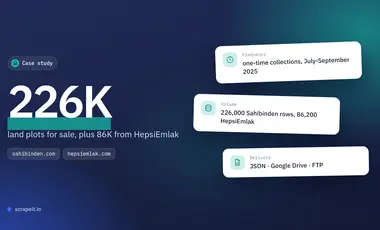
Land for sale across Turkey from Sahibinden and HepsiEmlak for a land investor: 226,000 plots in the first file and 86,200 HepsiEmlak rows.
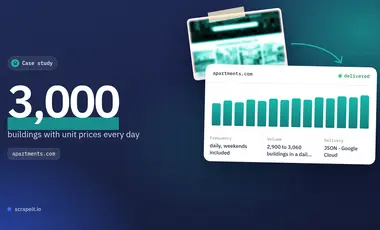
A daily apartments.com feed for a US apartment locator: about 3,000 buildings from the client's own list, down to each unit's rent and floor plan.

A one-time Housing.com collection for a real-estate company in India: project cards plus every photo and floor plan, uploaded straight to its cloud drive.
Learn how to use web scraping to solve data problems for your organization
Real estate teams work in a fragmented data landscape. The sites that drive demand in Boston look nothing like the ones that matter in Berlin, São Paulo, Dubai, or Mumbai.
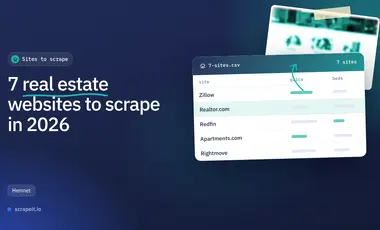
Real estate teams are operating in a data environment that is bigger, faster, and more fragmented than ever. Listings go live and disappear in hours, price cuts happen quietly, and the portals that matter most in each country are rarely the same global “top 5.”
Six jobs that scraped property data does, each backed by a ScrapeIt project: seller leads, listing monitoring, image datasets, weekly market supply, sold records and unit-level rentals. For every use case - the fields it needs and how often to refresh them.

ScrapeIt builds and runs crawlers for property portals, including analytics-heavy sites like HouseSigma where much of the value sits in the estimates layered over each listing. We keep the board's identifiers intact, so a HouseSigma row joins your MLS or CRM records, and we handle personal data under GDPR: brokerages appear by name, private individuals do not. You choose the provinces and the cadence; we deliver CSV, Excel, JSON or a load into your database.
Still unsure? Write to info@scrapeit.io
Yes. The ScrapeIt HouseSigma API returns the home id, MLS number, status, list price, Listing History events and SigmaEstimate for each home as JSON from an endpoint we host, updated on the schedule you choose. The same records can also arrive as CSV or Excel files, through a JSON feed or loaded into your database.
Yes. Many active listings with their Key Facts and room tables, the community statistics and the monthly city summaries load for every visitor, signed in or not. We collect only publicly available data - what any visitor can open on HouseSigma - and we collect it legally.
Sold prices and sold dates, earlier prices in Listing History, the date a home was first listed, most Market Trends charts and the address, price and Key Facts of listings marked Login Required sit behind HouseSigma's sign-in. When a project needs them, it runs on an account registered through the site's own sign-up form or on the client's account. Everything else described on this page is visible to an anonymous visitor.
Yes, from two directions. Each listing page shows a dated Price Changes table and the Listing History of the same address, whose earlier rows, such as Expired listings, show their prices only after sign-in, so that part runs on an account registered through HouseSigma's own form or on yours. Our repeated runs then record every status change and price cut from the day we start, giving a price history per home id that outlasts the listing itself.
Ontario, British Columbia and Alberta - the three provinces HouseSigma publishes. Within them you can scope by city or community, for example Toronto, Ottawa, Hamilton, Brampton or Burlington in Ontario, Vancouver or Surrey in BC, Calgary or Edmonton in Alberta, and narrow further by property type or listing status.
You share your needs, expectations, and desired timeframe. We'll suggest the best solution based on your request and budget.
Our specialists configure the crawlers and extract a sample dataset for your review before proceeding with the full-scale extraction.
Once you approve the sample, we launch the project and start full data collection. We gather, filter, and structure the data for easy use, delivering it on time in your preferred format.
Our team manages ongoing processes, monitors website changes, and supports all data extraction cycles. We can also help integrate data into your systems or create dashboards to simplify analysis.
Tell us which sites, which fields and how often. A couple of lines is enough to start.
HouseSigma data from €169/month. Free project assessment, reply within 1 business day.