Beauty Price Monitoring on Notino and Douglas in 15+ Countries, in English
A cosmetics company got monthly prices and promotions from 40+ beauty stores in 15+ countries, translated to English and fed into its existing import.
Learn More
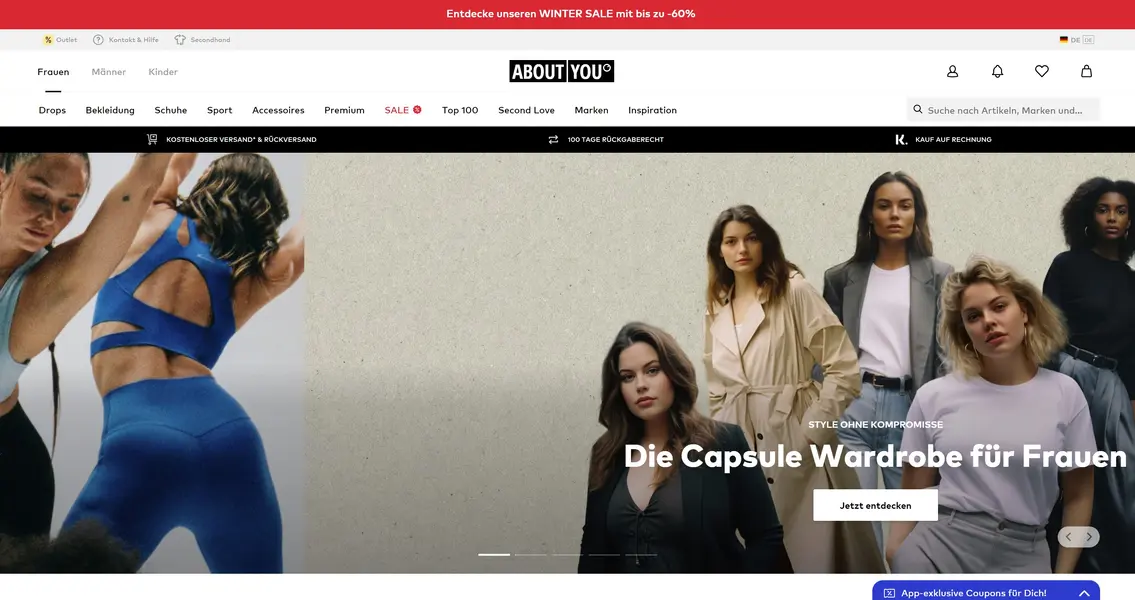
AboutYou opens on a feed built for each visitor, so there is no fixed catalogue to walk. We assemble it from the category tree, brand pages and sitemaps, market by market.
Plans from €169/month · Free project assessment · Reply within 1 business day
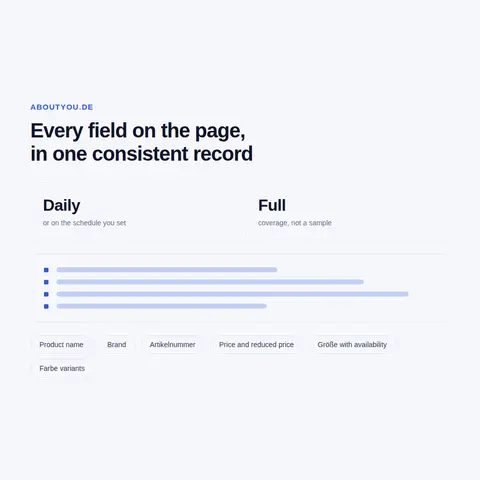
We run the crawler and you receive the data. Deliveries come as CSV, JSON, XLSX or Parquet, through an API, or as a scheduled push to S3, Google Cloud Storage, SFTP or a warehouse table you name. Schedules run hourly, daily or weekly depending on how fast the fields you care about move; a weekly full assortment refresh with daily price and size availability passes is a common shape.
Scope is yours to set: one brand catalogue across every market, a single category tree in one country, the sale paths only, or the whole German storefront. Column names are fixed to your schema so the feed lands in an existing pipeline without a mapping step, and we watch for layout changes and repair the parsers before a scheduled run breaks.
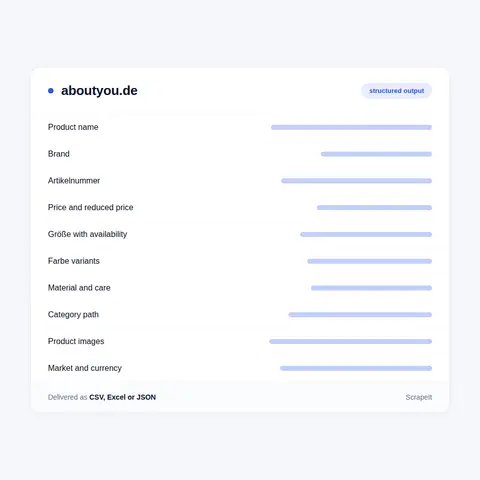
A product record carries the merchandising detail a fashion team actually works with, labelled in German on the German storefront and in the local language elsewhere. A standard AboutYou extract covers:
Collection covers public product and pricing data only. We do not collect customer data, account data or order data.
Three things decide the shape of the crawl, and all three are ours to handle.
Personalisation. Because every market opens on a per-visitor feed, coverage cannot come from following the front page. We drive collection from the category tree, brand indexes and the published sitemaps, which are split by type into product, category, brand, brand-category, filtered-category and outfit files. In September 2026 the German product sitemap listed 1,000,072 product URLs across 21 shards, alongside 2,016 category URLs. Working from that spine gives a repeatable frame instead of whatever a session happened to be shown.
Rendering. A plain request to a product URL returns the application shell rather than the record; name, price and size availability are assembled in the browser. Our crawlers take the rendered state, so the row you receive matches what a shopper sees on that storefront.
Access. The site sits behind a CDN that filters automated traffic. Proxy rotation, CAPTCHA solving and adaptive request pacing are part of the managed service, so you never build or maintain that layer. We work only on pages a visitor can open without signing in.
AboutYou is a Hamburg fashion platform launched in 2014 inside the Otto Group and now controlled by Zalando, which took the majority of its shares in 2025. It sells clothing, shoes and accessories through separate country storefronts across 26 European markets, each on its own domain: aboutyou.de, aboutyou.at, aboutyou.ch, aboutyou.pl, aboutyou.fr, aboutyou.it and the rest. The company puts the catalogue at around a million items from roughly 5,000 brands, shopped by more than 15 million active customers, mostly in the app.
The first thing that shapes any AboutYou scraper is that the storefront is personalised. Open the root of any market and you land on a per-visitor feed: /dein-shop in Germany, Austria and Switzerland, /jouw-shop in the Netherlands, /twoj-sklep in Poland, /votre-boutique in France, /tuo-negozio in Italy. There is no fixed front-page grid to walk, and the recommendation rails below it differ from one session to the next. A complete assortment has to be assembled from the stable paths instead: the category tree under /c/, brand pages, sale paths and the sitemaps the site publishes.
Those stable paths are well formed and worth knowing. Category URLs end in a numeric id, as in /c/frauen/accessoires/guertel-20218, and product URLs pair a brand slug with a numeric product id, as in /p/0039-italy/kleid-jakarta-9428645. That id is the join key that makes a price series line up week after week, even when a title or a category path is edited.
Get a Quote
Developers

Customers worldwide

Pages extracted

Hours saved for our clients
€199 / one-time
setup fee - included
€169 / mo
setup fee €499
€229 / mo
setup fee €499
€349 / mo
setup fee €499
€549 / mo
setup fee €799
Delivery: CSV, JSON or XLSX files, our API or a JSON feed. MCP server on request.
Full plan details →Most of the catalogue is third-party brands, so the same garment sits on shelves at other retailers too. For a brand's own commercial team that makes this a channel to watch: whether an agreed price is being held across 26 markets, how far the shelf price for the same article moves between Poland and France, which colourways a partner actually stocked and in which sizes. MAP and pricing policy checks run off the same feed. Retail competitors read it the other way, as a standing view of a rival assortment and its competitor pricing.
The own labels are a different exercise. EDITED, the ABOUT YOU label, RÆRE by Lorena Rae, ÉVOIR by Alena Gerber and the rest of the exclusive roster of more than twenty labels sell nowhere else, so there is no shared product code to match on. Lining those up against your own range runs on attributes instead: category, material, colour family, cut and price band. That is the work behind a private label comparison set.
Beyond price monitoring, buyers use the feed for assortment and gap analysis, brand catalogue completeness, size curve and stock level reads, new-arrival tracking by category, and sourcing images and copy for their own merchandising.
A cosmetics company got monthly prices and promotions from 40+ beauty stores in 15+ countries, translated to English and fed into its existing import.
Learn More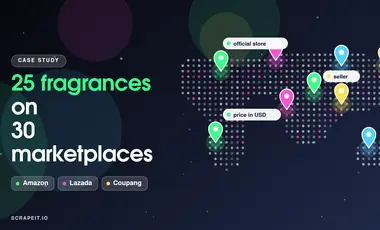
A consultancy working for a fragrance brand owner got sellers, official-store flags and USD prices for 25 fragrances on about 30 marketplaces in 12 countries.
Learn More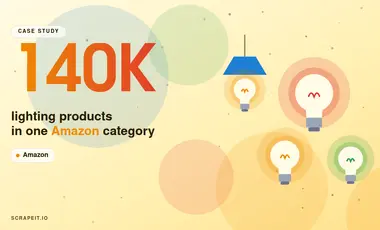
Three Amazon US lighting categories collected in full for a lighting manufacturer, with description text and images from brand content blocks.
Learn MoreLearn how to use web scraping to solve data problems for your organization
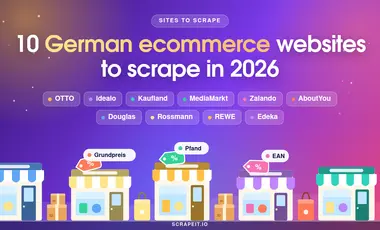
Ten German ecommerce websites worth scraping in 2026, from OTTO and idealo to REWE and Edeka: what each site shows, which fields matter to a data buyer, what is specific to German retail data and how to combine the sites into one dataset.
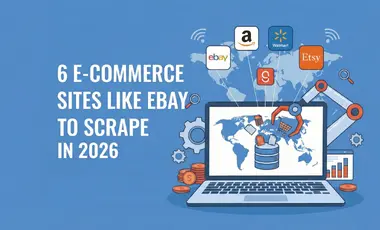
If you sell online, run a marketplace, or advise e-commerce clients, you already know why eBay matters: it’s one of the few places where big retailers compete side by side with thousands of small merchants and private sellers.

E-commerce teams do not just need “some” competitor data anymore. They need a continuous stream of real prices, discounts, stock levels, reviews, and seller behavior from the platforms that actually shape their markets.
ScrapeIt is a managed web scraping agency. We build the crawler, run it on your schedule, monitor it and fix it when the site changes. There is no library to install and no proxy pool to rent. You describe the fields and the cadence, we send a sample file within a few days, and once the schema is signed off the feed arrives on its own. Pricing is per project and scales with volume and frequency. Tell us the markets and categories you need and we will scope it.
Yes. The ScrapeIt AboutYou API returns product name, brand, Artikelnummer, current and reference price, per-size availability and colour variants as JSON from an endpoint we host, refreshed on the schedule you set. The same data also comes as CSV, XLSX or Parquet files or straight into your database.
Yes. What we collect is the same public catalogue any visitor can open without signing in: product names, brands, prices, per-size availability, colour variants and product attributes. We collect only publicly available data - everything a visitor can see on AboutYou - and we collect it legally.
As often as the project needs. Price and per-size availability are the fields that move, so most feeds run a daily pass over the tracked set and a fuller assortment sweep weekly. Hourly is workable on a narrow watchlist, for example the sale paths of one brand in three markets. Wider scopes take longer per cycle simply because there are more pages to visit, and we size the crawl to the cadence you ask for rather than the other way round.
Yes, and that is a common request. Each market runs on its own domain with its own assortment, currency and pricing, so aboutyou.de, aboutyou.pl and aboutyou.fr are collected as separate passes and merged on the product id. The result is one table with a market column, which is what you need to see the same article priced differently in two countries, or stocked in one and absent from another. Local field labels are normalised to your English column names on the way in.
CSV, JSON, XLSX or Parquet, plus an API endpoint if you prefer to pull. Scheduled deliveries can land in Amazon S3, Google Cloud Storage, an SFTP drop or straight into a warehouse table. Images can come as URLs or as downloaded files. The schema is agreed before the first full run, so column names, currency handling and the way size availability is flattened are all set to match the system that will read the file.
Step 1 - Make a Request
You share your needs, expectations, and desired timeframe. We’ll suggest the best solution based on your request and budget.
Step 2 - Configuring Custom Web Crawlers
Our specialists configure the crawlers and extract a sample dataset for your review before proceeding with the full-scale extraction.
Step 3 - Collect and Deliver
Once you approve the sample, we launch the project and start full data collection. We gather, filter, and structure the data for easy use, delivering it on time in your preferred format.
Step 4 - Maintain and Support
Our team manages ongoing processes, monitors website changes, and supports all data extraction cycles. We can also help integrate data into your systems or create dashboards to simplify analysis.
AboutYou data from €169/month. Free project assessment, reply within 1 business day.

Scrapeit Sp. z o.o.
10/208 Legionowa str., 15-099, Bialystok, Poland
NIP: 5423457175
REGON: 523384582