German ecommerce websites publish more per product than most data buyers expect: a unit price beside the shelf price, a deposit on drinks, a seller line that says whose stock it is, and in grocery a price that exists only once a store is chosen. A crawl designed for another country returns numbers nobody can compare.
Below are ten German sites we scrape, from a general marketplace to supermarkets, each with the fields that matter, what only that site adds and what its data is best used for.
Around the list: what the sites share, how several become one dataset, and three of our retail projects. For other markets, see the worldwide list of ecommerce websites to scrape.
Who this list of German online shops is for
It is written for people who buy data instead of building crawlers: pricing and category managers at retailers, brand teams watching how their products are listed, marketplace sellers, and analysts who need a German panel next to other countries.
The order is by breadth: sites that cover the most categories and sellers in one crawl come first, sites that answer a narrower question in more depth come later. It is not a ranking of the shops.
What German retail data has in common
Six things recur and shape the schema before any page is collected.
- Grundpreis. German price indication rules (Preisangabenverordnung) make sellers print a unit price beside the selling price, normally per kilogram or litre. Kept as value, reference amount and unit, it compares pack sizes without parsing titles, and a shrinking pack shows as a Grundpreis move while the shelf price stands still.
- Pfand. Drinks carry the deposit as a separate amount, with a single-use or reusable badge. Folded into the price, it breaks every beverage comparison.
- Store and region. At REWE and Edeka a price belongs to a market, not to a product page, so every row needs the market it was read in.
- Whose stock. OTTO, Kaufland, MediaMarkt and Douglas show third-party offers next to their own. A series that mixes own stock with a marketplace seller is not a price series.
- VAT and reference prices. Consumer prices include VAT. An advertised reduction has to reference the lowest price of the previous 30 days; that figure deserves its own column, apart from a recommended retail price.
- Identifiers and format. An EAN or GTIN where the page carries one, plus each retailer's own Artikelnummer. Labels are German and decimals use a comma.
Ten sites, from German marketplaces to supermarket shelves
Each entry links to our page for that site.
OTTO
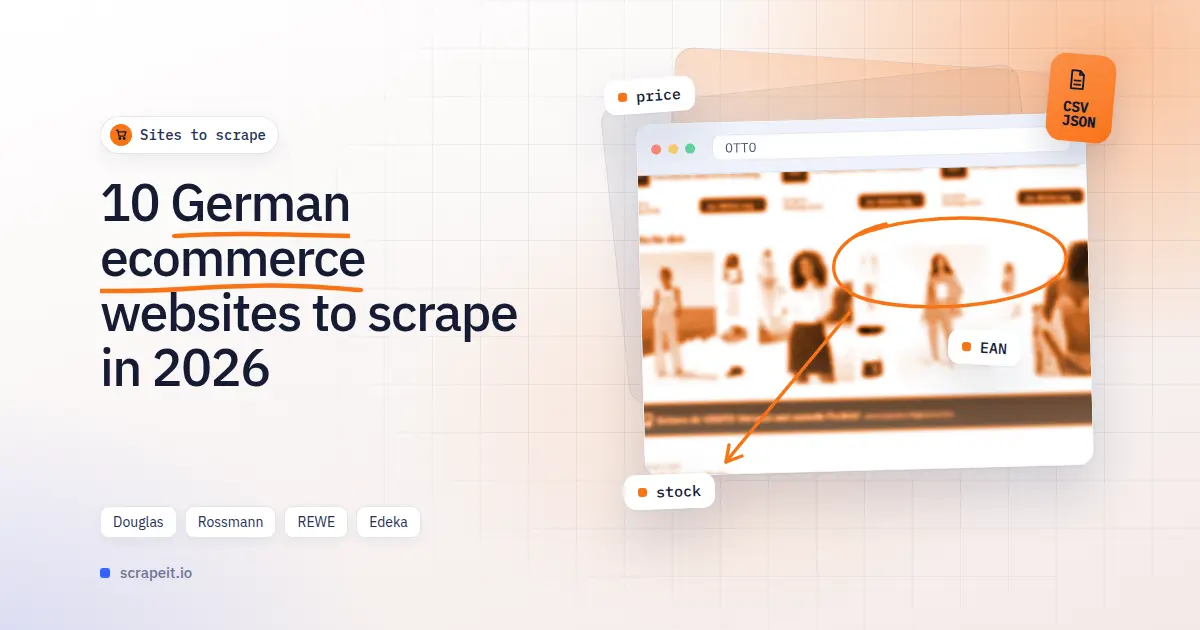
OTTO is a German general retailer and marketplace in one: its own stock and third-party sellers share one catalogue across fashion, electronics, furniture and home goods. A record holds base and discounted price with the recommended retail price, stock, delivery estimate and shipping options, a product's ranking position in the lists, promotion tags, sustainability labels and the seller type - OTTO itself or a marketplace seller. Two fields stand out on OTTO: review summaries that condense what buyers say about fit, size and quality, and sponsored placements labelled in the lists, which show who pays for visibility. Best for price and assortment positioning across several categories. See our OTTO scraper page.
idealo
idealo sells nothing itself: it groups merchant offers under one product page, so a page is not a price but a small market of shops, marketplace sellers and refurbishers quoting the same item. Each offer row carries the merchant's title, the price, the total including shipping, the delivery date, the shop with its rating and, for a marketplace offer, the label Marktplatz with the seller named. Used goods and B-Ware have a separate tab. No other site here shows every merchant's rank for one product, and the product id is identical on all six idealo country sites. Best for repricing, recommended price checks and price history per merchant. See our idealo scraper page.
Kaufland
Kaufland is a hypermarket chain whose online side is also a marketplace. One name covers weekly store offers, own labels such as K-Classic and K-Bio, and a non-food catalogue in which independent sellers list next to Kaufland's own offers. A record holds brand and category, the current and the old price, stock, the seller type - official store or marketplace vendor - and tags such as Bestseller, Deal or Organic. What Kaufland adds is grocery and general merchandise under one brand, local stock by the postcode a visitor selects, and sister sites in Czechia, Slovakia, Croatia and Romania. Best for sellers benchmarking marketplace offers and for private label comparisons. See our Kaufland scraper page.
MediaMarkt
MediaMarkt sells consumer electronics and appliances online and in stores. The product page gives Preis with any struck-through reference figure, Verfügbarkeit, the Artikelnummer that also closes the product URL, Technische Daten, ratings and the Energieeffizienzklasse with the energy label behind it. The line Verkauf und Versand durch names a marketplace seller when the item is not MediaMarkt's own stock. Note for buyers: the site publishes one online price plus per-store availability, not a shelf price per store, so every comparison should be labelled online price. The sister banner Saturn is a separate domain and a separate job. Best for brand price watching and specification data. See our MediaMarkt scraper page.
Zalando
Zalando is the largest fashion platform in Europe, and zalando.de is one of its country sites, each with its own language, currency and sometimes its own assortment. A record carries title and brand, price and discount, size availability with labels such as low stock or online only, material composition, care instructions, ratings, sustainability labels and the filter values a shopper sees: colour, material, fit, season and country of origin. What Zalando adds is the country comparison: the same article can be priced and stocked differently per country site, and limited collections are tested in selected regions. Best for fashion price monitoring across several European markets. See our Zalando scraper page.
AboutYou
AboutYou is a Hamburg fashion platform, now majority-owned by Zalando. Its front page is built for each visitor, so there is no fixed catalogue to walk: the assortment is assembled from the category tree, brand pages and sale paths. A record holds the Artikelnummer, the current price with the struck-through reference price, colour variants as linked rows, material and fit. Per-size availability is the reason to use it: a row says a style is live but sold out in two sizes, not one in-stock flag. The exclusive own labels have no shared product code and are matched on attributes. Best for size curves and brand price checks. See our AboutYou scraper page.
Douglas
Douglas is a beauty retailer: fragrance, skincare and further beauty lines, much of it from prestige brands, plus partner boutiques that bring niche brands next to Douglas's own stock. A record carries brand and category, price and discount, promotions such as 2-for-1, stock, ratings with review counts, and tags like limited, exclusive or online only. Here the variant, not the product, is the unit of comparison: one fragrance is sold in several bottle sizes, each with its own price, so every row needs the variant and its volume. Sponsored brand placements and pick-up stock by store are visible too. Best for beauty brands tracking price discipline and launch timing. See our Douglas scraper page.
Rossmann
Rossmann is a Drogeriemarkt, a drugstore chain with an online shop: cosmetics, body care, household goods, baby articles and food. Every product URL closes on a thirteen-digit GTIN, the stable key. A row carries Preis, Grundpreis as value, reference amount and unit, Inhalt as number and unit, Marke with an own-brand flag and Verfügbarkeit. The own brands are the point. ISANA, Alterra, domol and babydream are sold nowhere else and carry GTINs under Rossmann's own prefix, so an EAN join lines up the branded rows and drops the own-brand ones. Those are matched on brand, content and unit basis. Best for like-for-like drugstore pricing per unit. See our Rossmann scraper page.
REWE
REWE runs supermarkets and an online shop on the same domain. A REWE record has two halves. The national half: Artikelnummer, EAN, brand, category path, properties such as Bio, Regional or Vegan, nutrition values, ingredients, allergens and origin. The other half - price, Grundpreis, promotion state, Pfand - exists only once a market is attached, and it can differ between delivery and pickup. An unscoped crawl returns a complete catalogue with no money in it. What REWE adds is the full grocery range priced by market and service type, with market ID and postcode on every row. Best for listing checks, regional promotion tracking and label audits. See our REWE scraper page.
Edeka
Edeka is a cooperative of independent merchants, so no single national Edeka price exists. Its data comes as three record types with different keys. The catalogue is a reference shelf of own-label articles addressed by barcode, with nutrition and allergens but no price. Weekly offers belong to one market and one calendar week and carry Grundpreis, Pfand and the lowest price of the last 30 days. The per-market online shops add regular shop prices. What Edeka adds is the spread between merchants: our page describes the same Artikelnummer priced differently in two Edeka shops in the same week. Best for store-level prices on a fixed panel of markets. See our Edeka scraper page.
Other German sites worth adding
The discount segment is covered by our Lidl scraper page: a short, mostly private-label assortment with weekly store offers. Mueller adds toys and perfume to drugstore goods. Both are on the list of German sites we scrape. Amazon.de and eBay.de, the German storefronts of the global marketplaces, belong to our Amazon and eBay pages, found among the ecommerce and retail sites we scrape.
Get your Business Back on Track
Boost the growth and productivity of your retail or manufacturing business with e-commerce data
- Free Sample Data Sets
- Regular Data Delivery
- Legal and GDPR compliance
Get a Quote
Scraping German ecommerce websites into one dataset
The same product sits on several of these sites, so a combined dataset is only as good as its matching. Three of our projects on other marketplaces show how.
Match on a shared code first. For a client on Allegro.pl in Poland we resolve around 150,000 EANs from the client's list every day and return the lowest price for each, to be set against supplier prices: the lowest Allegro prices for 150,000 EANs. The hard part was completing the full run every day, not reading a price. The same lookup works on German sites wherever a page carries an EAN or GTIN; own brands need product matching on attributes.
Keep storefronts apart, then merge. Ralph Lauren monitoring on eight Amazon storefronts, amazon.de among them, delivered 41,000 rows: every colour and size as its own identifier, sellers per item, unrelated brands filtered out. Zalando or AboutYou country sites follow the same pattern with a market column.
Never collapse variants. In a full-category run on iHerb - 250,000 rows, launched in 3 working days - each packaging size stayed a separate row. In German data that rule keeps the Grundpreis meaningful.
One schema then holds every site: EAN or GTIN beside the site's own Artikelnummer, seller type, market ID, price, reference price, Grundpreis in three columns, Pfand, availability and a timestamp. Duplicates collapse onto the shared code; rows without one stay visible.
How ScrapeIt runs web scraping in Germany
ScrapeIt is a managed service: we build, run and repair the crawlers. Anti-bot handling - pacing, proxy rotation, CAPTCHA handling and rendering - is part of the service. A free project assessment comes first, a sample can be ordered, and field documentation comes with the dataset. Runs are one-off or on the schedule you set.
Formats are CSV, Excel (XLSX), JSON, JSONLines and XML, delivered through our API (an endpoint we host), a JSON feed, FTP, SFTP, Amazon S3, Google Cloud Storage, Dropbox, Google Drive, e-mail or a load into your database; an MCP server on request. Plans start from EUR 169 a month, or EUR 199 for a one-time extract. Retail scope is on our ecommerce data scraping page.
FAQ
Is it legal to scrape German ecommerce websites?
Yes. We collect only publicly available data - everything a visitor can see on the site - and we collect it legally. Names of reviewers and private sellers are personal data: we handle personal data under GDPR, leave such fields out by default, never log in and never go behind paywalls.
Which German retailers show different prices by store?
REWE and Edeka: the price appears only after a market is chosen, and at REWE it can also differ between delivery and pickup. MediaMarkt publishes one online price plus store availability. Agree a panel of markets and keep it fixed.
Can you match products across German retailers by EAN?
Yes, wherever the page carries the code, as REWE, Edeka and Rossmann pages do. Own brands such as ISANA or K-Classic exist at one retailer only and are matched on brand, content and unit basis.
How often should German retail prices be collected?
Daily suits price monitoring and availability. Grocery offers change weekly, so one run per calendar week covers them, while idealo offers move through the day. Full catalogue sweeps run weekly or monthly.