The Entire Iherb Supplements Catalog, Captured End-to-End in 3 Days
Scraping supplement products from iHerb.com with full details, including descriptions and packaging variations.
Learn More
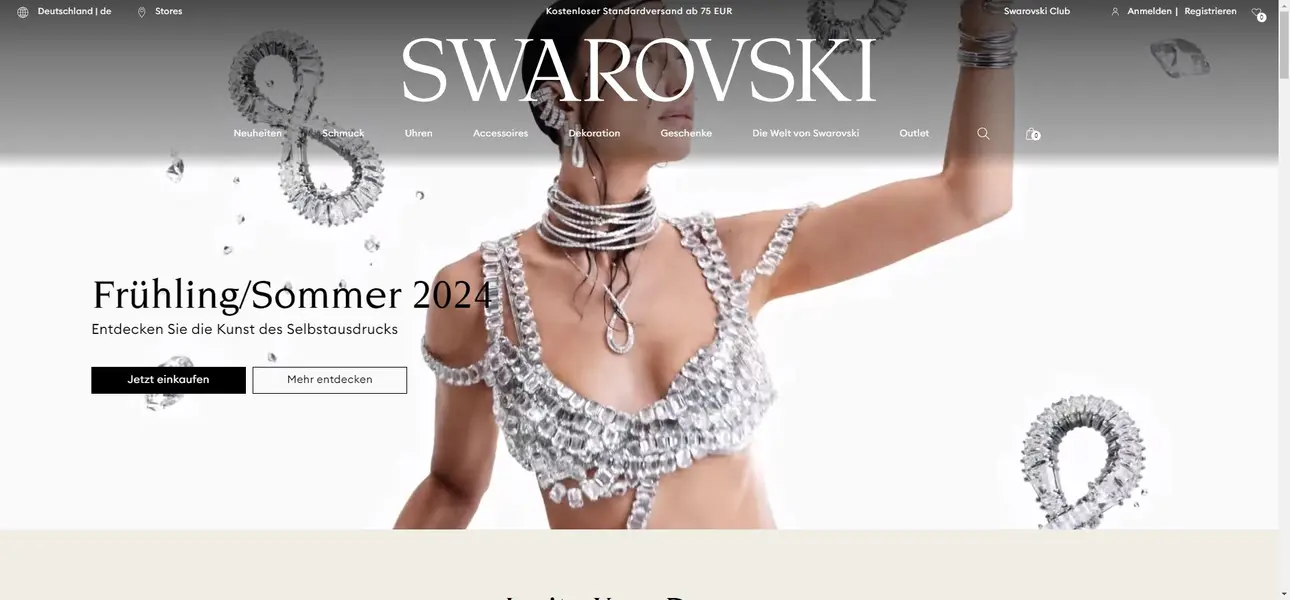
One Swarovski catalogue, many storefronts: the sitemap index listed 78 of them when we read it on 1 August 2025. We scrape them into a single dataset keyed on the article number.
Plans from €169/month · Free project assessment · Reply within 1 business day
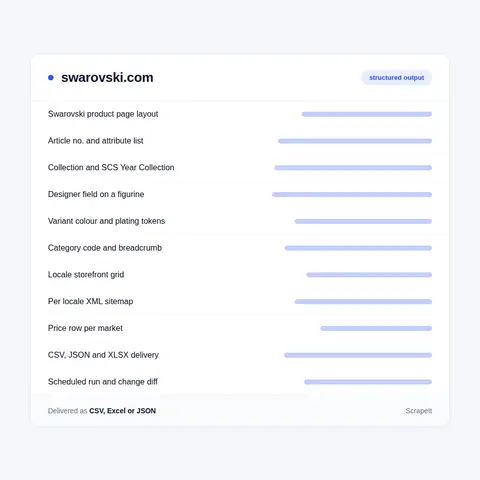
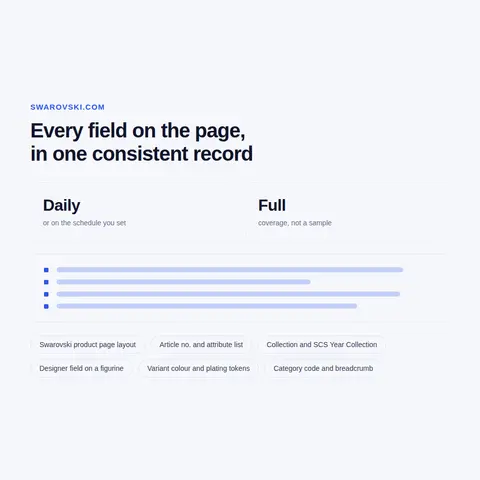
We build the crawler, run it, watch it and repair it. Swarovski data arrives as CSV, JSON, XLSX or an API endpoint your systems poll, on whatever cadence the job needs: daily for pricing, weekly for assortment, tighter around a launch or a sale period.
A job is scoped by locale set and category branch. Choose the storefronts you trade in, choose the branches under c-01 Jewelry or c-04 Decorations, and you get one row per article number per locale with a run timestamp. Runs are diffed, so what lands is new numbers, dropped numbers and price moves rather than an undated dump you have to compare yourself. If the markup changes, fixing it is our job.
Each product page carries three JSON-LD blocks: BreadcrumbList, Product and NewsArticle. The Product block gives sku, price, priceCurrency and availability. We reconcile it against the rendered page rather than trusting either source alone, then add the attribute list Swarovski prints under the description.
Colour and plating arrive fused into one token, so color-white-rhodium-plating and color-white-rose-gold-plating are separate rows. We split that token into a colour column and a plating column, because buyers filter on plating and the site does not offer it as its own field.
The locale codes do not follow one rule. Most are lowercase language plus uppercase country, such as de-AT or ja-JP, but eight carry an underscored language tag: en_GB-GB, en_GB-CA, en_GB-AU, en_GB-IE, en_GB-ZA, en_GB-NZ, zh_TW-HK and zh_TW-TW. A pattern written as two letters, hyphen, two letters quietly loses the United Kingdom, Canada, Australia, Ireland, South Africa, New Zealand, Hong Kong and Taiwan. There is also an AA storefront in four languages, and AA is not a country code at all.
Slugs drift while numbers hold. Archived Czech URLs show article 5171991 moving from "Swarovski Symbolic" to "Symbolica", article 5142721 gaining "Una" in front of "Angelic", and article 5128809 changing from "Solitaire" to "Stilla". Match on the number and treat the slug as a label, and the rename becomes a column in your history instead of a broken join.
The site sits behind an Akamai edge that turns ordinary automated clients away, so access handling comes before any collection: pacing, proxy rotation and rendering are part of the service. We crawl from the published per locale sitemaps and category pages, and we never log in to an account area.
Swarovski is an Austrian crystal house based in Wattens. The public shop at swarovski.com sells cut crystal jewellery, watches, bag charms, home decoration and the crystal figurines the brand is collected for. Every item carries a seven digit article number. The product page prints it as Article no.: and repeats it in a data-article-number attribute on the same list item, so it is readable without guessing at the URL.
Product URLs take two shapes. A single product sits at /{locale}/p-{article}/{slug}/. A product with variants sits at /{locale}/p-M{article}/{slug}/ and carries the chosen variant in the query string, either ?variantID={article} or ?color={token}. The M form borrows the number of one member variant: p-M5661957 is the Birthstone stud earring group whose April piece is article 5661957. A crawler that drops query strings collapses twelve birthstone months into one row.
Category pages use a numeric code that grows by two digits per level. In the en-US storefront c-01 is Jewelry, c-0101 is Necklaces-and-pendants, c-010102 is Necklaces, c-04 is Decorations and c-0408 is "SCS exclusive products". Facets attach as extra path segments, for example /f/product_material/material-crystals/. The code is the durable part. The words after it have been reworded more than once, and the older wording now answers with a redirect.
Get a Quote
Developers

Customers worldwide

Pages extracted

Hours saved for our clients
€199 / one-time
setup fee - included
€169 / mo
setup fee €499
€229 / mo
setup fee €499
€349 / mo
setup fee €499
€549 / mo
setup fee €799
Delivery: CSV, JSON or XLSX files, our API or a JSON feed. MCP server on request.
Full plan details →The seven digit article number is why Swarovski data joins cleanly to anything else. Resale listings, auction lots and grey market offers quote it verbatim, so a Swarovski price read off the official storefront becomes the reference line for everything trading elsewhere under that number.
Cross market work is the second reason. One article resolves in every storefront that stocks it, and the sitemap states the mapping through an hreflang block, so a single crawl yields one price row per market with no guessing about which page is which product. Teams use that to check parity, find markets where a piece was never launched, and see which currency moved and when.
Third is the collectable side, which behaves unlike ordinary fashion jewellery. Swarovski retires figurines and closes each Swarovski Crystal Society year, and a retired piece drops out of the category listings. If nobody recorded its price, description and designer while it was live, that record is no longer on the public site. Dealers in secondary market crystal ask us to keep a dated history for precisely that reason.

Scraping supplement products from iHerb.com with full details, including descriptions and packaging variations.
Learn More
Daily scraping of lowest prices for 150K products on Allegro.pl to support marketplace pricing and margin optimization.
Learn More
Regular monitoring of Ralph Lauren clothing, footwear, and accessories sold across Amazon subdomains: AE, DE, ES, FR, IT, NL, PL, UK.
Learn MoreLearn how to use web scraping to solve data problems for your organization
If you sell online, run a marketplace, or advise e-commerce clients, you already know why eBay matters: it’s one of the few places where big retailers compete side by side with thousands of small merchants and private sellers.

E-commerce teams do not just need “some” competitor data anymore. They need a continuous stream of real prices, discounts, stock levels, reviews, and seller behavior from the platforms that actually shape their markets.
Amazon provides valuable information gathered in one place: products, reviews, ratings, exclusive offers, news, etc. So scraping data from Amazon will help solve the problems of the time-consuming process of extracting data from e-commerce.
ScrapeIt is a managed web scraping agency. There is no library to install and nothing for your team to operate. You describe the fields and the schedule, we write the crawler, host it, monitor it and repair it when a site changes, and you receive clean data in a format your systems already read.
We collect only publicly available data - everything a visitor can see on Swarovski - and we collect it legally. We are not affiliated with Swarovski or with any brand whose pages we read.
Yes. The ScrapeIt Swarovski API returns the article number, collection, price and currency per storefront, availability and the split colour and plating values as JSON from an endpoint we host, refreshed on the schedule you set. The same data also comes as CSV or XLSX files or straight into your database. Our Swarovski scraper works from the per locale XML sitemap set and the schema.org Product markup on every product page.
Yes, and it is the usual request. The article number is the same everywhere, only the slug is translated, and the sitemap carries an hreflang alternate for every storefront that stocks the piece. The sitemap index listed 78 locale storefronts, including four languages for Switzerland and three each for Belgium and Luxembourg. Currency and language follow the storefront, not a cookie, so we crawl the locale paths directly and return one price row per market per run.
A retired figurine stops appearing in the category listings, and once it is out of the sitemap there is no public route back to its price and description. That matters more here than in most catalogues, because each Swarovski Crystal Society year closes and the Annual Edition, Jubilee and event pieces for that year become fixed sets. The members area that lists retirements sits behind a login, and we never log in. What we can do is snapshot the public pages on a schedule so you hold a dated record of what was listed, at what price, in which market, before it went.
Colour and plating are not suffixes. Each combination is its own seven digit article number: the Solitaire round cut white stud is 5128808 rhodium plated and 5128809 gold-tone plated. On the site those variants hang off a master URL and are selected in the query string. In the en-US product sitemap the only two variant parameters present were ?variantID= and ?color=, with no size parameter, and the colour token fuses both attributes, as in color-white-rose-gold-plating. We keep the master, the variant number and the split colour and plating values as separate columns.
It depends on what you track. Prices move per market and independently between markets, so pricing jobs usually run daily. Assortment moves more slowly and a weekly pass is enough. Two things need timing rather than frequency: seasonal drops around the festive ornament and Annual Edition cycle, and sale periods, when a piece can change price in one storefront and not in the next. The sitemap sets changefreq to weekly and carries a lastmod date per URL, which we use as a hint, not as the truth, and verify against the page.
Step 1 - Make a Request
You share your needs, expectations, and desired timeframe. We’ll suggest the best solution based on your request and budget.
Step 2 - Configuring Custom Web Crawlers
Our specialists configure the crawlers and extract a sample dataset for your review before proceeding with the full-scale extraction.
Step 3 - Collect and Deliver
Once you approve the sample, we launch the project and start full data collection. We gather, filter, and structure the data for easy use, delivering it on time in your preferred format.
Step 4 - Maintain and Support
Our team manages ongoing processes, monitors website changes, and supports all data extraction cycles. We can also help integrate data into your systems or create dashboards to simplify analysis.
Swarovski data from €169/month. Free project assessment, reply within 1 business day.

Scrapeit Sp. z o.o.
10/208 Legionowa str., 15-099, Bialystok, Poland
NIP: 5423457175
REGON: 523384582