eBay Data: 1.9M Auto Parts Listings from eBay.de, Specs Translated
About 1.9 million auto parts listings from eBay.de with brand, OEM, EAN and fitment, plus titles and specs machine-translated for the client's team.
Learn More
Edeka is a cooperative of independent merchants, so a single national Edeka price does not exist. We resolve the market first, then extract its catalogue, Angebote and labelling.
Plans from €169/month · Free project assessment · Reply within 1 business day
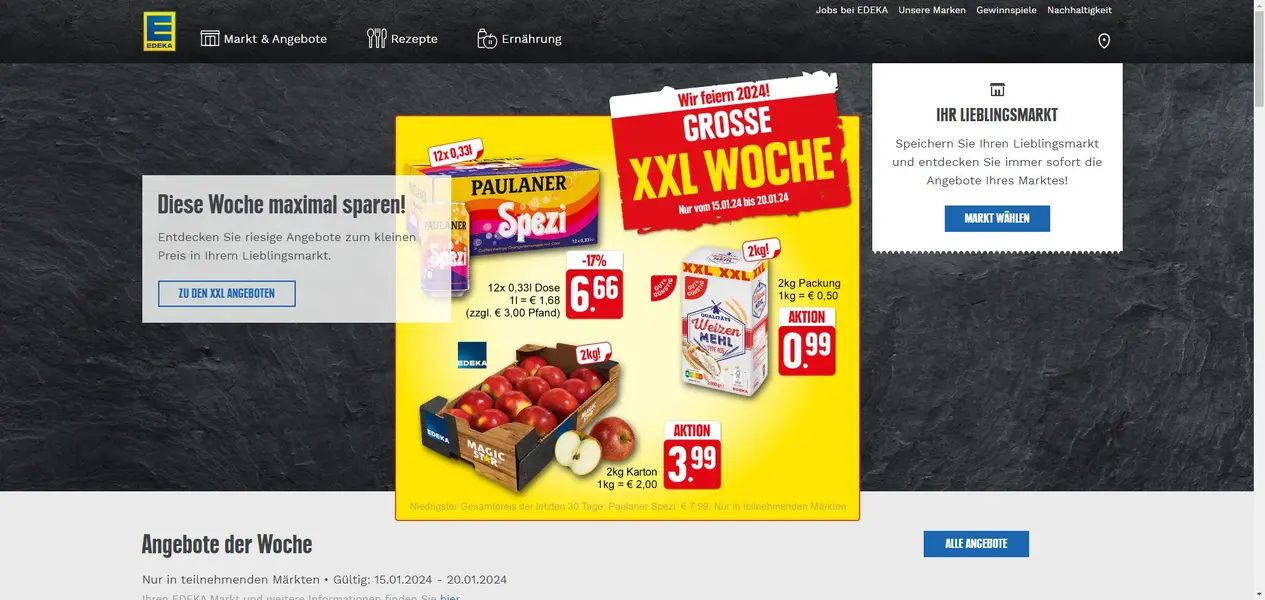
An Edeka scraping project starts with the market list, because that list decides what the numbers mean. Send postcodes, a region, or six-digit market IDs; we resolve each one, record whether it runs Lieferservice, Selbstabholung or Expresslieferung, and stamp the market onto every row.
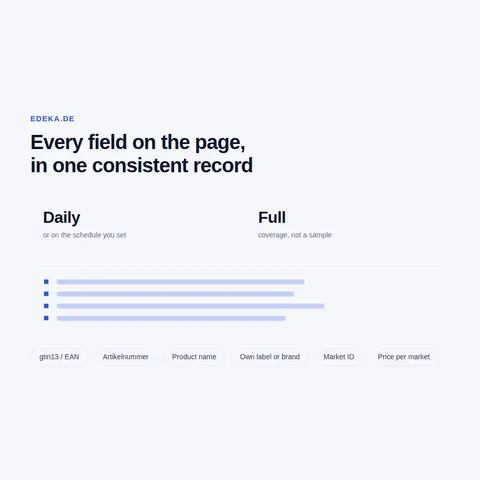
Scope comes next: the full own-label catalogue, a set of categories, a watchlist of barcodes, or weekly Angebote only. Cadence follows the question - weekly for promotions, daily for shop prices, monthly for range and label audits. Edeka answers plain automated clients with a block, so anti-bot handling, proxy rotation and CAPTCHA solving are part of the service rather than an extra line. Delivery is CSV, JSON, XLSX or an API, with a fixed schema, a run timestamp and the source address on every row.
An Edeka extract is three record types that join on different keys. Treating them as one table is the usual way these projects go wrong.
Catalogue record, from /sortiment/. The address is the barcode: /sortiment/4311596029167/ is that article, and the page repeats the number as gtin13 in Product JSON-LD. With it come the name, the brand at own-label level, Inhalt (net content), the claim bullets, Naehrwerte per 100 g or 100 ml with a reference intake column, Zutatenverzeichnis and Allergene. There is no price here at all, no Nutri-Score field, and a standing note that the item may not be stocked in every Edeka market.
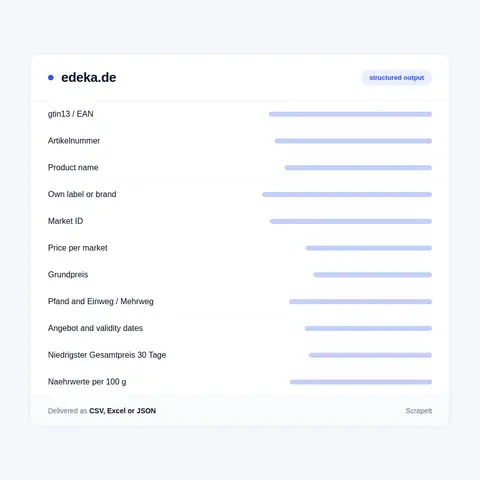
Offer record, from /maerkte/{id}/angebote/. One week, Monday to Saturday, stamped with the Kalenderwoche. Fields: the offer title with the origin country in front, as in Ecuador - GUT und GUENSTIG - Bananen; the pack line; a Festpreis or a discounted price with its percentage; Grundpreis; Pfand; the Niedrigster Gesamtpreis der letzten 30 Tage figure German law requires beside a discount; an App-Preis where the Edeka app has to be shown at the till; and the Superknueller, PAYBACK and App-Preis flags. Sections run Obst und Gemuese, Molkerei und Kaese, Grundnahrung, Tiefkuehl, Fleisch und Wurst, Getraenke, Knabbern und Naschen, Drogerie, Tiernahrung.
Shop record, from a market subdomain on edeka.shop. Artikelnummer, the price with a machine-readable amount and currency, Grundpreis per kilogram or litre, Pfand with an Einweg or Mehrweg badge, PAYBACK points earned, delivery availability, Rechtliche Bezeichnung, Zutatenverzeichnis, Allergene, Warnhinweis, Aufbewahrungshinweis, the food business operator with its address, and the nutrition table. Article ids close with MXST for piece goods and MXKG for loose produce sold by weight, which is how a scraper tells a 600 g pack of apples from apples at a price per kilogram.
German food listings carry more regulated detail than most retail pages, and Edeka renders it as fields rather than prose, so it is worth taking whole.
Nutrition arrives as a table per 100 g or 100 ml: Brennwert in kJ and kcal, Fett and its saturated share, Kohlenhydrate and its sugar share, Eiweiss and Salz. Zutatenverzeichnis prints ingredients with allergens capitalised in the German manner, and Allergene repeats them as a clean list. Rechtliche Bezeichnung gives the legal designation, Warnhinweis the mandatory warnings, Aufbewahrungshinweis the storage rule. Nutri-Score is printed on packs of Edeka own brands but is not published as a field in either catalogue, so we do not invent a column for it.
Drinks add Pfand as a separate amount beside the price, with an Einweg or Mehrweg badge and a crate deposit of its own on multipacks. Fresh produce exposes Herkunftsland as a facet, so apples narrow to DE, IT, NZ or ZA, and Klasse I appears in the pack line. Age-restricted goods are marked by an Alterskontrolle flag.
Two datasets sit beside the catalogue. Warenrueckrufe, the public recalls, are published centrally and repeated on every market page with the manufacturer and pack size named. Prospekte, the weekly leaflets, are page-image flipbooks on blaetterkatalog.edeka.de keyed by region and leaflet code, which is why we read the structured Angebote for figures and keep the leaflet as evidence rather than as a feed.
Edeka is a cooperative, not a single chain. The Edeka Verbund calls itself the Unternehmer-Unternehmen, the entrepreneurs' enterprise: a market belongs to a named Kaufmann, buys through one of six regional wholesale companies, and decides much of its own range, promotions and shelf prices. Every design choice in an Edeka scraper follows from that one fact.
The website is built the same way. The Marktsuche lists about 5,800 markets, each with a six-digit market ID and a page at /maerkte/{id}/. That page names the operating firm on its own line, a sole trader trading under the Firma heading, while the offer footnote names the regional company that published the leaflet, EDEKA Nordwest in Moers. The group site lists six regions today - Minden-Hannover, Nordwest, Hessenring, Nordbayern-Sachsen-Thueringen, Suedbayern and Suedwest - yet older store addresses under /eh/ still carry seven legacy region slugs, nord and rhein-ruhr among them, so the region string has to be normalised rather than trusted.
The national catalogue at /sortiment/ is a reference shelf, not a shop: about 6,000 product pages, nearly all of them Edeka own labels, and not one price among them. Money sits in two other places - the weekly Angebote bound to a single market, and the per-market online shops on edeka.shop, where a store such as EDEKA Struve trades on a subdomain of its own.
Get a Quote
Developers

Customers worldwide

Pages extracted

Hours saved for our clients
€199 / one-time
setup fee - included
€169 / mo
setup fee €499
€229 / mo
setup fee €499
€349 / mo
setup fee €499
€549 / mo
setup fee €799
Delivery: CSV, JSON or XLSX files, our API or a JSON feed. MCP server on request.
Full plan details →The German full-range grocery market is fought between Edeka and Rewe while the discounters press from below, and Edeka is the larger of the two by store count. Brand owners, category managers and price analysts scrape Edeka to learn where a line is listed, what it costs, and which promotion it is running against.
The cooperative structure is why one national figure settles nothing. In the same chilled aisle of two Edeka shops on the same day, seven of fifteen comparable articles carried different prices: a litre of Weihenstephan long-life milk was 0.99 EUR in one store and 1.59 EUR in the other, same Artikelnummer, same week. A number taken from a single store is not the Edeka price, it is one merchant's decision. We agree the market panel with you and then hold it, so a series stays comparable from week to week instead of drifting with whichever store answered first.
The Grundpreis carries the comparison. German sellers must publish it under the Preisangabenverordnung, normalised to a kilogram or a litre, so Edeka price data lines up across pack sizes without parsing weights out of titles, and a shrinking pack shows up as a Grundpreis move while the shelf figure sits still.
About 1.9 million auto parts listings from eBay.de with brand, OEM, EAN and fitment, plus titles and specs machine-translated for the client's team.
Learn More
A one-off Takealot product list for an entrepreneur choosing niches: only products rated 4 stars or higher with at least 50 reviews.
Learn More
Trendyol product data for an e-commerce startup reselling Turkish fashion: 27 categories in JSON on FTP, with in-stock status for every size.
Learn MoreLearn how to use web scraping to solve data problems for your organization
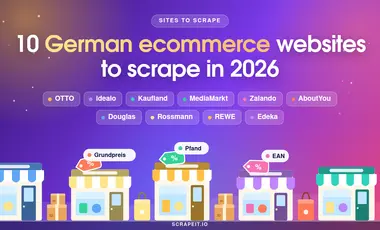
Ten German ecommerce websites worth scraping in 2026, from OTTO and idealo to REWE and Edeka: what each site shows, which fields matter to a data buyer, what is specific to German retail data and how to combine the sites into one dataset.
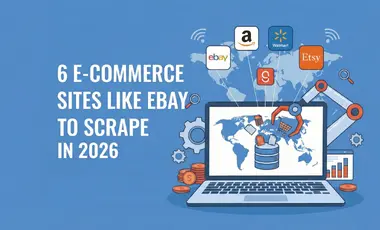
If you sell online, run a marketplace, or advise e-commerce clients, you already know why eBay matters: it’s one of the few places where big retailers compete side by side with thousands of small merchants and private sellers.

E-commerce teams do not just need “some” competitor data anymore. They need a continuous stream of real prices, discounts, stock levels, reviews, and seller behavior from the platforms that actually shape their markets.
ScrapeIt takes the whole job. We design the crawler, run it to your schedule, watch it, and repair it when the site changes shape. Your side receives files or an API on a timetable and keeps no scraping engineers of its own.
We have no connection with Edeka or the Edeka Verbund. We collect only publicly available data - everything a visitor can see on Edeka - and we collect it legally. Personal data stays out of scope: customer accounts, app coupons and personalised offers are not collected.
Yes. The ScrapeIt Edeka API returns gtin13, Artikelnummer, the price, Grundpreis, Pfand and the weekly Angebote per market as JSON from an endpoint we host, refreshed on the schedule you set. It is built on the public website: the /sortiment/ product pages with their Product JSON-LD, the /maerkte/{id}/ pages with GroceryStore JSON-LD, the weekly Angebote attached to each market, and the per-market shops on edeka.shop. The same data also comes as CSV or XLSX files or straight into your database.
Whichever markets you nominate, and every row says so. This is not a formality at Edeka. The national product pages carry no price at all, and the online shop opens on a Marktauswahl screen that asks for a postcode or town before it shows a single article, then sends the visitor to that store's own subdomain. So a price only exists once a market is attached. We resolve each market, keep its six-digit ID, and stamp the market, the postcode and the service type onto the record.
There is no single national assortment to pull. The reference catalogue on edeka.de is roughly 6,000 own-label articles with no prices, while the sellable range differs from merchant to merchant. A complete picture is built by combining that catalogue with a chosen panel of market shops and their weekly Angebote. Online ordering also does not cover the country: many large-city postcodes return no participating store at all, and Lieferservice is flagged on only a few hundred of the markets in the store finder. We map coverage during scoping so nobody expects rows that do not exist.
Once a week. Offers run Monday to Saturday and the small print names the Kalenderwoche they belong to, so a Saturday crawl and a Monday crawl belong to different weeks. Coverage differs by store: some markets publish a full structured list of a couple of hundred offers by category, others publish only a leaflet in the Blaetterkatalog viewer and nothing machine-readable. Weekly is the natural cadence for promotion tracking; shop prices on edeka.shop move on their own schedule and are usually taken daily.
Yes. We collect only publicly available data - everything a visitor can see on Edeka - and we collect it legally. Nothing behind a customer login is touched, and no personal data is gathered: no accounts, no app coupons, no personalised offers, no shopper identifiers. What we ship is product, price, promotion and store information that any visitor to Edeka can see.
Step 1 - Make a Request
You share your needs, expectations, and desired timeframe. We’ll suggest the best solution based on your request and budget.
Step 2 - Configuring Custom Web Crawlers
Our specialists configure the crawlers and extract a sample dataset for your review before proceeding with the full-scale extraction.
Step 3 - Collect and Deliver
Once you approve the sample, we launch the project and start full data collection. We gather, filter, and structure the data for easy use, delivering it on time in your preferred format.
Step 4 - Maintain and Support
Our team manages ongoing processes, monitors website changes, and supports all data extraction cycles. We can also help integrate data into your systems or create dashboards to simplify analysis.
Edeka data from €169/month. Free project assessment, reply within 1 business day.

Scrapeit Sp. z o.o.
10/208 Legionowa str., 15-099, Bialystok, Poland
KRS: 0000996672
NIP: 5423457175
REGON: 523384582