The Entire Iherb Supplements Catalog, Captured End-to-End in 3 Days
Scraping supplement products from iHerb.com with full details, including descriptions and packaging variations.
Learn More
REWE prices belong to a market, not to a product URL. We resolve the market first, then extract the catalogue and the labelling behind it.
Plans from €169/month · Free project assessment · Reply within 1 business day
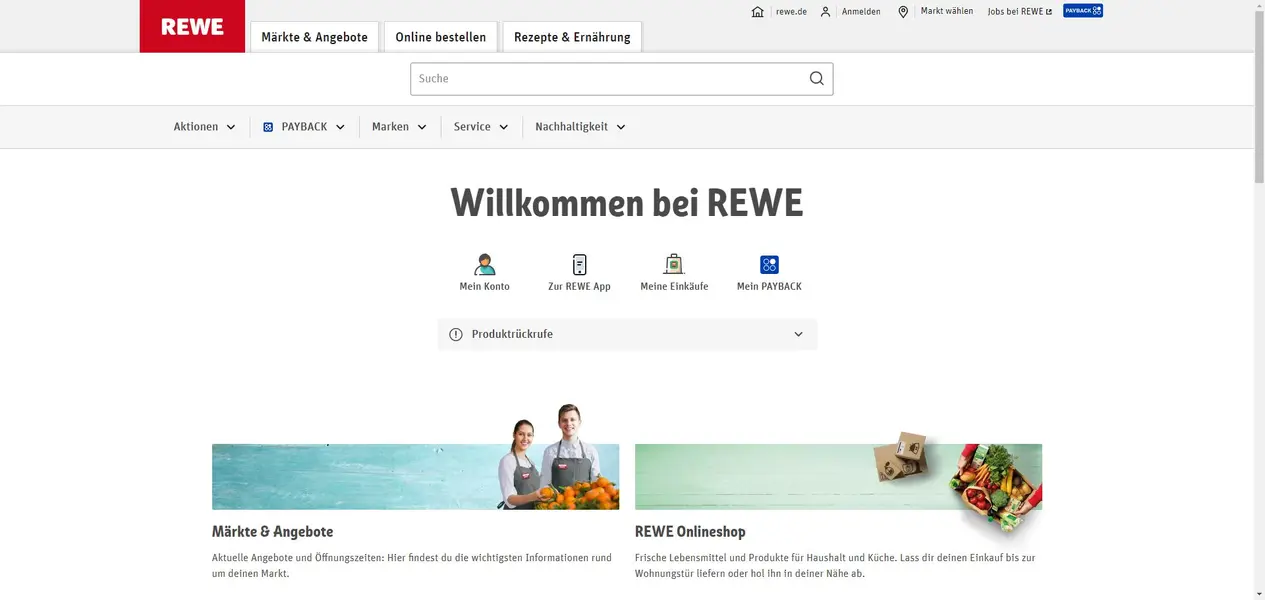
A REWE project starts with the market list, because that list decides what the numbers mean. Give us postcodes, a region, or named wwIdent market IDs, and we resolve each one before any catalogue work begins.
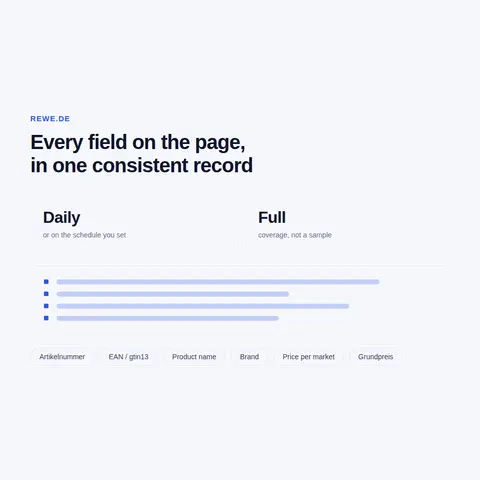
Scope comes next: the full catalogue walked from the sitemaps, a set of categories, or a watchlist of Artikelnummern. Cadence follows the question, daily for price and promotion movement, weekly or monthly for range and label audits. Output is CSV, JSON, XLSX or an API, with a fixed schema, a run timestamp and the source URL on every row.
A REWE record has two halves, and the seam between them shapes the whole project. One half is national and stable. The other exists only once a market is attached to the session.
The first eight items come back from an anonymous fetch. The price fields do not. Until a market is set, each product on a listing page carries no price at all, which is why an unscoped crawl of rewe.de returns a complete catalogue with no money in it. Every row we ship states the market ID, postcode and service type it was collected under, so two extracts can be compared without guesswork.
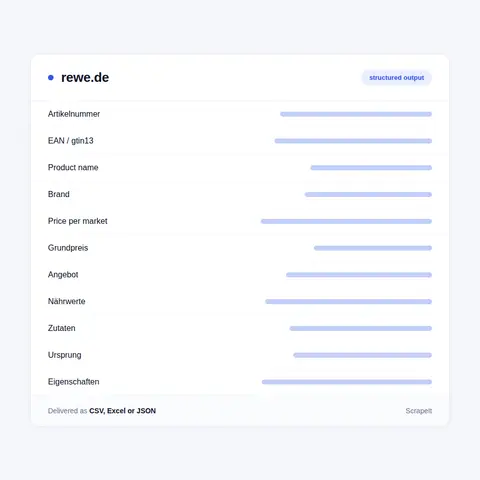
German food listings carry more regulated detail than most retail pages, and REWE renders it as structured tabs rather than loose prose, which makes it worth taking.
Nährwerte (nutrition values) arrive as a table headed pro 100 g or pro 100 ml with a % NRV column. The rows follow EU labelling: Energie in both kJ and kcal, Fett (fat) and its saturated share, Kohlenhydrate (carbohydrate) and its sugar share, Ballaststoffe (fibre) where declared, Eiweiß (protein) and Salz (salt). Zutaten (ingredients) and Allergene (allergens) share one tab, with organic components marked by the standard asterisk footnote. Kontaktname and Kontaktadresse give the food business operator behind the pack.
Origin is labelled Ursprung rather than Herkunft, and on fresh produce it frequently holds several countries at once: an apple listing can read Südafrika, Neuseeland, Chile oder Argentinien. A schema that assumes one country per product breaks in the produce aisle, so we keep the raw string alongside a parsed country list. Produce also carries Klasse, the EU quality grade.
Dietary marks appear twice, as Eigenschaften tags and again as Mögliche Auslobungen (possible claims) such as Vegan geeignet. Nutri-Score is on pages where the manufacturer has adopted it, and adoption in Germany is voluntary, so a missing score means unlabelled rather than poor.
REWE operates supermarkets across Germany and an online shop on the same host. The old shop.rewe.de now redirects to www.rewe.de/shop, so a single domain carries the store finder, the weekly leaflet and the ordering catalogue.
Product pages follow one pattern, /shop/p/{slug}/{Artikelnummer}. The trailing number is the Artikelnummer (article number), which the page also prints under the title and reuses as the record key. Category pages sit at /shop/c/{slug}/ and paginate with ?page=N. Store pages use a third scheme, /marktseite/{town}/{marketId}/{name-and-street}/, and that market ID is the same wwIdent value the shop uses internally when it prices a basket.
In August 2026, the two product sitemaps under /sitemaps/ listed 95,585 product URLs between them, next to 3,592 category URLs and 4,217 store pages. Those sitemaps are the sensible entry point for a REWE scraper: REWE publishes paginated category URLs in them outright, and every product URL leads to a record with its Artikelnummer, EAN, category path and Eigenschaften.
Little of it holds still. Assortment, promotions and seasonal lines turn over weekly, and REWE labels its own campaigns by Kalenderwoche (calendar week), so a late-August 2026 offer teaser carries KW35-2026 in its campaign parameters.
Get a Quote
Developers

Customers worldwide

Pages extracted

Hours saved for our clients
€199 / one-time
setup fee - included
€169 / mo
setup fee €499
€229 / mo
setup fee €499
€349 / mo
setup fee €499
€549 / mo
setup fee €799
Delivery: CSV, JSON or XLSX files, our API or a JSON feed. MCP server on request.
Full plan details →Teams scrape REWE to answer a narrow set of things: is our line listed, in which markets, at what price, and against which promotion. Germany's full-assortment grocery segment is contested between REWE and Edeka while the discounters press from below, so listing and price movement at REWE is read closely by brand and category managers.
Because REWE prices attach to a market, a single national figure hides most of what people are paid to find. A promotion that runs in one region and not another, a listing that quietly drops out across half the country, a Tiefpreis line held in some markets only - none of that surfaces unless markets are sampled on purpose. We agree the market set with you, then hold it fixed so the series stays comparable from one week to the next.
The Grundpreis does useful work here. German sellers must show it under the Preisangabenverordnung, the price indication ordinance, which normalises to a kilogram or a litre for packaged goods and permits 100 g or 100 ml for loose ones. That makes REWE data comparable across pack sizes without parsing weights out of product titles, and it makes shrinkflation visible as a Grundpreis move while the shelf figure sits still.

Scraping supplement products from iHerb.com with full details, including descriptions and packaging variations.
Learn More
Daily scraping of lowest prices for 150K products on Allegro.pl to support marketplace pricing and margin optimization.
Learn More
Regular monitoring of Ralph Lauren clothing, footwear, and accessories sold across Amazon subdomains: AE, DE, ES, FR, IT, NL, PL, UK.
Learn MoreLearn how to use web scraping to solve data problems for your organization
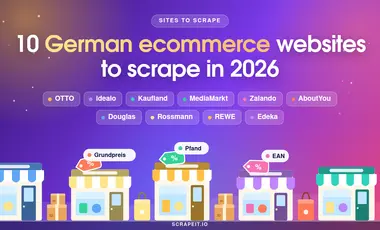
Ten German ecommerce websites worth scraping in 2026, from OTTO and idealo to REWE and Edeka: what each site shows, which fields matter to a data buyer, what is specific to German retail data and how to combine the sites into one dataset.
If you sell online, run a marketplace, or advise e-commerce clients, you already know why eBay matters: it’s one of the few places where big retailers compete side by side with thousands of small merchants and private sellers.

E-commerce teams do not just need “some” competitor data anymore. They need a continuous stream of real prices, discounts, stock levels, reviews, and seller behavior from the platforms that actually shape their markets.
ScrapeIt takes on the whole scraping job. We design the crawler, run it to your schedule, watch it, and repair it when a site changes shape. Your side receives data on a timetable; the engineering stays with us.
We have no affiliation with REWE or REWE Group. We keep request rates modest. We collect only publicly available data - everything a visitor can see on REWE - and we collect it legally. Where something is not reachable, we say so during scoping rather than after.
Yes. The ScrapeIt REWE API returns the Artikelnummer, EAN, price, Grundpreis, Angebot state and market ID as JSON from an endpoint we host, refreshed on the schedule you set. The same data also comes as CSV or XLSX files or straight into your database.
Whichever markets you nominate, and the file records them. This is not a formality at REWE. Request a product page without a market and the site prints "Konkreter Preis abhängig vom Standort" - actual price depends on the location - in the space where the price would sit, and offers the visitor a Standort wählen link instead. The chosen market and service type live in session state, not in the URL, so adding a marketCode parameter to a product link changes nothing. We resolve each market properly, then stamp the market ID, postcode and service type onto every row.
Not through the shop's search, and that is a structural limit rather than throttling. A result set there stops at 10,000 items; ask for a page past that window and the request is rejected as invalid, whatever page size you use. The catalogue is much larger, 95,585 product URLs across the two product sitemaps. A complete pull therefore walks the sitemaps and the category tree rather than paging one broad query.
Angebote run on a weekly Kalenderwoche cycle and split by surface: rewe.de keeps Angebote im Markt, the leaflet promotions tied to a single store, apart from Angebote im Lieferservice in the online shop. Individual markets also add promotions of their own, and some campaigns exclude sibling formats outright. REWE Bonus is different from a member price. REWE stopped PAYBACK point collection on 28 December 2024 and launched REWE Bonus the following day, and it accrues euro credit through Bonus-Coupons, Bonus-Aktionen and a Bonus-Booster at checkout. It does not print a second price on the listing, so we do not invent a column for one.
No, and they should not be merged. Every request carries a service type of DELIVERY (Lieferservice) or PICKUP (Abholservice), a given market supports only what it supports, and asking for the wrong one is rejected as an invalid market selection. Price, assortment and availability can all differ between the two for the same Artikelnummer. We collect the service types you name and label each row with its own, so a delivery series and a pickup series stay separable.
Step 1 - Make a Request
You share your needs, expectations, and desired timeframe. We’ll suggest the best solution based on your request and budget.
Step 2 - Configuring Custom Web Crawlers
Our specialists configure the crawlers and extract a sample dataset for your review before proceeding with the full-scale extraction.
Step 3 - Collect and Deliver
Once you approve the sample, we launch the project and start full data collection. We gather, filter, and structure the data for easy use, delivering it on time in your preferred format.
Step 4 - Maintain and Support
Our team manages ongoing processes, monitors website changes, and supports all data extraction cycles. We can also help integrate data into your systems or create dashboards to simplify analysis.
Rewe data from €169/month. Free project assessment, reply within 1 business day.

Scrapeit Sp. z o.o.
10/208 Legionowa str., 15-099, Bialystok, Poland
NIP: 5423457175
REGON: 523384582