eBay Data: 1.9M Auto Parts Listings from eBay.de, Specs Translated
About 1.9 million auto parts listings from eBay.de with brand, OEM, EAN and fitment, plus titles and specs machine-translated for the client's team.
Learn More
Every Home Depot price and every stock line hangs on one store number and one ZIP code. We pull the catalog with the store attached, so each row means something where you sell.
Plans from €169/month · Free project assessment · Reply within 1 business day
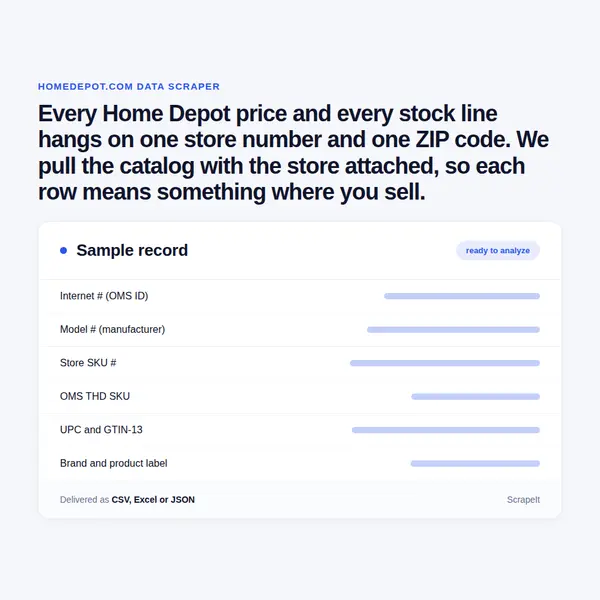
A Home Depot scraping project starts with two answers. Which stores, named by store number or by ZIP, should price and availability be resolved against - one, a regional panel, or a national grid. And which unit the price should arrive in: each, per case, or per square foot with the conversion kept beside it.
Scope follows from there: a whole merchandising department, a category subtree under one navigation token, a brand page, the rental catalog, or a watchlist of Internet numbers, store SKUs and UPCs you already hold. Homedepot.com blocks automated clients at the edge, so anti-bot handling, proxy rotation and CAPTCHA solving are part of the service rather than a surcharge. Delivery is CSV, JSON, XLSX, a database drop or an API of your own, on a schedule, with the store id and the source URL stamped on every row.
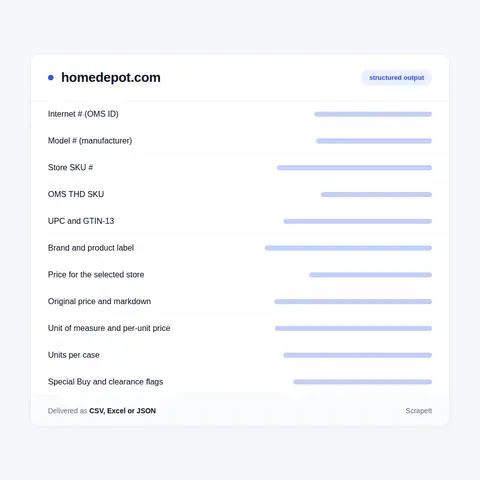
A Home Depot product page prints three numbers in a single bar: Internet #, Model # and Store SKU #. They are not interchangeable, and merging them is how these projects go wrong. The Internet number is the nine-digit OMS ID that closes the URL and keys the record. Model # is the manufacturer part number, and it repeats in the image file name. Store SKU # is what the register and the aisle label use; it runs six digits on a lumber item and ten on a packaged good. A fourth id, the OMS THD SKU, is carried separately and does not always match the store SKU. Add the UPC, held both plain and as a padded GTIN-13, and a Home Depot data extract joins to a vendor catalog four different ways.
Identity and classification. Brand name, product label, canonical URL, brand landing page, product type, and a SKU classification separating ordinary merchandise from lumber. Flags mark a special-order SKU, a paint sample id, a super SKU with the parent id of its variant family, and a tool rental SKU with its rental category and subcategory. Each item also carries a department number and a class number - the pair that names the sitemap file it appears in.
Money. Price is resolved against a chosen store and carries the current value, the original price where a markdown exists, the unit of measure, a promotion block, a clearance flag, a Special Buy flag, a preferred Pro price flag, and minimum advertised price details where a brand sets one. Goods sold by area or by the case add a second layer - units per case, case unit of measure and the original per-unit price - which is how a tile carton shows a carton price and a per-square-foot price at once. A per-order quantity limit sits beside it.
Description and evidence. Specifications arrive in named groups such as Details and Dimensions, each a list of spec name and value, with the returns window carried as a specification of its own. Then highlights, numbered bullet attributes, a marketing description, breadcrumbs, and key product features that link every attribute value to the faceted listing page it filters. Media comes as image URLs with a size token resolving to seven widths, plus slots for video, a 360 spin and an augmented reality view. Ratings arrive as an average and a review count; review and question threads are served separately.
Merchandise is only part of what The Home Depot publishes. Tool and equipment rental has a catalog of its own - aerators, chainsaws, concrete grinders, core drills, drywall lifts and sanders, ladders and scaffolding, pressure washers, pumps, sod cutters, stump grinders, tile saws, trailers, trenchers and vacuums - alongside truck and trailer rental, and any rentable item carries a rental SKU with its category and subcategory inside the same product record. Almost every store publishes a rentals page of its own, plus a services and a garden center page.
Installed services are a separate object type again. Service category pages live under /services/c/ with their own slug and hash and cover shower repair, panel upgrades, hot tub installation, electrical wiring, exterior painting and ceiling fan installation, while install programs are sitemapped by trade - cabinets, hardwood, laminate, tile, vinyl and HVAC repair. Service reviews are paginated.
The Pro side brings its own pricing vocabulary: Pro Xtra membership, volume and bulk pricing tiers, preferred pricing, tax-exempt purchasing, Pro special order, and a Pro Service Desk number printed on every store page. Layout requests even carry a customer type, so the Pro view and the consumer view of one page are two different documents.
Around the catalog sit collection pages that group a range under a Family id, seasonal Special Buy slots, project calculators, and specification sheets and manuals attached as info and guides. California Proposition 65 warning text ships with the record wherever it applies.
The Home Depot is the biggest home improvement retailer in North America, and its scale sets the shape of any Home Depot scraper. At the end of fiscal 2025 the chain ran 2,359 stores: 2,035 in the United States including Puerto Rico, Guam and the US Virgin Islands, 182 in Canada and 142 in Mexico. A store averages approximately 104,000 square feet of enclosed space with another 24,000 outside for the garden center, and carries roughly 30,000 to 40,000 items across sixteen merchandising departments - Appliances, Bath, Building Materials, Electrical, Flooring, Hardware, Indoor Garden, Kitchen and Blinds, Lighting, Lumber, Millwork, Outdoor Garden, Paint, Plumbing, Power, and Storage and Organization. What the shelves cannot hold lives online in what the company itself calls the extended aisle.
The addressing is consistent. A product page - the site calls it a PIP - sits at /p/ plus a slug ending in the manufacturer model number, then a nine-digit OMS ID. A listing page, a PLP, sits at /b/ plus a readable category path and an Endeca navigation token: N-5yc1v followed by refinement codes chained with Z, so Dishwashers is N-5yc1vZc3po and picking a brand or a finish appends a further code rather than a query string. Store pages sit at /l/ plus store name, state, city, ZIP and store number, with rentals, services and garden-center subpages under each one.
The sitemap index shows how much of that is published. Product URLs are split across hundreds of files named for the same department and class numbers an item carries in its own record, covering departments 21 to 30 plus 59. Beside them sit core category pages, files of faceted listing pages, brand pages, collection pages keyed by a Family id, and a local city page for every trading area.
Get a Quote
Developers

Customers worldwide

Pages extracted

Hours saved for our clients
€199 / one-time
setup fee - included
€169 / mo
setup fee €499
€229 / mo
setup fee €499
€349 / mo
setup fee €499
€549 / mo
setup fee €799
Delivery: CSV, JSON or XLSX files, our API or a JSON feed. MCP server on request.
Full plan details →One habit separates a usable Home Depot price feed from a decorative one: the store. Price on homedepot.com is not a catalog attribute. It is fetched with a store id in the request, badges are fetched the same way, and delivery promises are keyed to a ZIP code the visitor sets. Ask for an item with no store in context and the price fields come back empty. The site says as much in its own footer on every page - local store prices may vary from those displayed, and products shown as available are normally stocked but inventory levels cannot be guaranteed.
That line is the business case. With roughly 2,035 US stores trading, a Home Depot price comparison run against one default store describes one market and misstates the rest. Lumber, concrete, mulch and rock salt move on regional cost, clearance is set locally, and a Special Buy can be live in one metro and absent in the next. Listing queries carry a store filter too, so the same category reads either as the full online assortment or as what a chosen store actually holds - the only honest way to compare extended aisle against shelf.
Fulfillment is the second reason to scrape Home Depot with a store attached. The company's own shorthand names four store-linked routes - buy online and pick up in store, buy online and ship to store, buy online and deliver from store, buy online and return in store - and which of them an item offers depends on the store, not the item. Sacks of mortar, sheets of drywall and 12-foot boards are collected, not couriered, so a stock number with no store on it is not actionable.

About 1.9 million auto parts listings from eBay.de with brand, OEM, EAN and fitment, plus titles and specs machine-translated for the client's team.
Learn More
A one-off Takealot product list for an entrepreneur choosing niches: only products rated 4 stars or higher with at least 50 reviews.
Learn More
Trendyol product data for an e-commerce startup reselling Turkish fashion: 27 categories in JSON on FTP, with in-stock status for every size.
Learn MoreLearn how to use web scraping to solve data problems for your organization
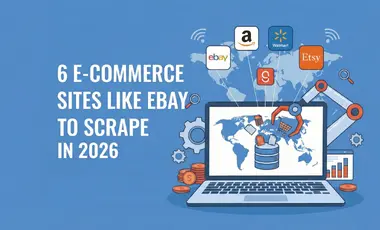
If you sell online, run a marketplace, or advise e-commerce clients, you already know why eBay matters: it’s one of the few places where big retailers compete side by side with thousands of small merchants and private sellers.

E-commerce teams do not just need “some” competitor data anymore. They need a continuous stream of real prices, discounts, stock levels, reviews, and seller behavior from the platforms that actually shape their markets.
Amazon provides valuable information gathered in one place: products, reviews, ratings, exclusive offers, news, etc. So scraping data from Amazon will help solve the problems of the time-consuming process of extracting data from e-commerce.
ScrapeIt takes the whole job as a managed service. We design the crawler, run it to your schedule, watch it, and repair it when the site changes shape. Your side receives files or an endpoint and keeps no scraping engineers of its own.
We are not affiliated with The Home Depot. We collect only publicly available data - everything a visitor can see on Home Depot - and we collect it legally. Nothing behind a login is touched, so account pricing and order history stay out of scope, and reviewer names, nicknames and photos are not collected.
Yes. The ScrapeIt Home Depot API returns Internet numbers, model numbers, store SKUs, UPCs, per-store prices and stock as JSON from an endpoint we host, refreshed on the schedule you set. It is built on the public storefront - product and listing pages, brand and collection pages, store pages and the rental catalog - and delivered as a documented endpoint with a stable schema. The same data also comes as CSV or XLSX files or straight into your database.
Yes, and that is the normal way we run it. You nominate stores by store number or by ZIP - a handful, a metro panel, or a national spread - and every row carries the store it was resolved against beside the price, the unit price, the availability state and the fulfillment routes offered there. We hold your panel fixed so a series stays comparable week over week. Adding stores multiplies volume rather than fields, so the size of the panel is a budget decision as much as a data one.
The identifier bar first - Internet number, model number and store SKU - then UPC and GTIN-13, brand, title, canonical URL, breadcrumbs, the full specification groups, highlights and bullet attributes, images at the width you want, ratings and review counts, the returns window, quantity limits and Proposition 65 text. Join on brand plus model number against a vendor catalog, on UPC for retail comparison, and on the Internet number when you need a stable Home Depot key that survives a title rewrite or a category move.
Cadence follows the question. Daily or intraday for Home Depot price and stock monitoring on a defined watchlist; weekly for promotions, clearance and Special Buy sweeps; monthly for full assortment, specification and new-item audits. Delivery is CSV, JSON, XLSX, a database drop or an endpoint we host, with a fixed schema, a run timestamp and the store id on every row, so two runs can be diffed without guesswork.
Yes. We collect only publicly available data - everything a visitor can see on Home Depot, from prices and stock to specifications, ratings and review text - and we collect it legally, at polite request rates. Nothing behind a login is touched, so account pricing, order history and saved lists are out of scope. Reviews and questions carry nicknames and photos; we leave reviewer identities out by default and keep the rating, the count and the text.
Step 1 - Make a Request
You share your needs, expectations, and desired timeframe. We’ll suggest the best solution based on your request and budget.
Step 2 - Configuring Custom Web Crawlers
Our specialists configure the crawlers and extract a sample dataset for your review before proceeding with the full-scale extraction.
Step 3 - Collect and Deliver
Once you approve the sample, we launch the project and start full data collection. We gather, filter, and structure the data for easy use, delivering it on time in your preferred format.
Step 4 - Maintain and Support
Our team manages ongoing processes, monitors website changes, and supports all data extraction cycles. We can also help integrate data into your systems or create dashboards to simplify analysis.
Home Depot data from €169/month. Free project assessment, reply within 1 business day.

Scrapeit Sp. z o.o.
10/208 Legionowa str., 15-099, Bialystok, Poland
KRS: 0000996672
NIP: 5423457175
REGON: 523384582