Grainger Data: 3 MRO Catalogs with UNSPSC, 250K Products from Cromwell
Full MRO catalogs from Grainger, Fastenal and Cromwell for a product content company: UNSPSC, EAN, every attribute and a taxonomy sheet.
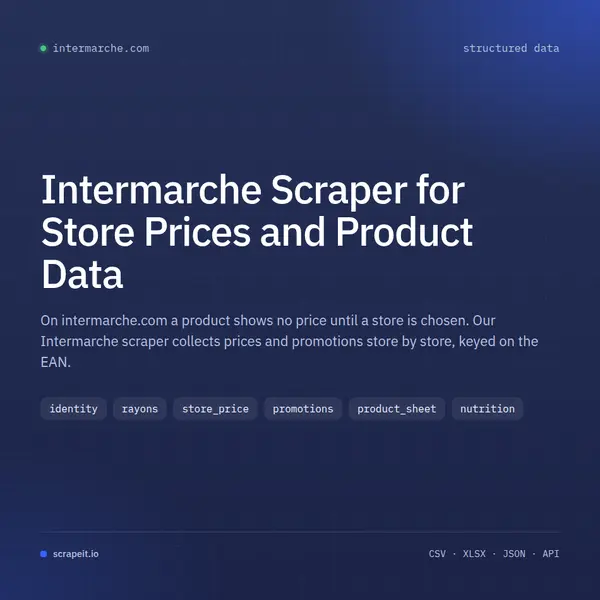
On intermarche.com a product shows no price until a store is chosen. Our Intermarche scraper collects prices and promotions store by store, keyed on the EAN.
Plans from €169 a month · Free project assessment · Reply within 1 business day
CSV · Excel · JSON · XML · FTP · SFTP · Amazon S3 · Google Cloud
API, JSON feed or CSV, XLSX and JSON files
ScheduleOne-time, monthly, weekly, daily or 3 times a day
Intermarché pages, filters, fields and a schedule
Built, monitored and repaired by our team
API, JSON feed or CSV, XLSX and JSON files
On intermarche.com the price depends on the store, so a project starts with the store list. You name the stores - by number, by department or the whole network - and the rayons or EAN codes to follow. We build the crawler, set the store context for each pass, keep it running and fix it whenever the site changes. Proxy rotation, pacing, rendering and CAPTCHA handling come with the service.
Store number plus EAN is the key of each row, which lets a product be compared between stores and between weeks. Collection is one-off or follows your calendar, for example every prospectus week. You receive CSV, Excel or JSONLines with field documentation, by FTP, Google Cloud Storage or through our API.
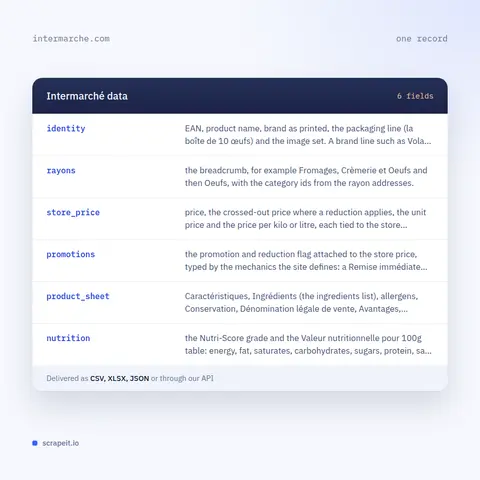
A product page lives at /produit/ followed by a slug and the product's EAN barcode number, so the identifier every retailer and supplier already uses is right in the address. The product sheet is the same nationwide. The price is not: without a chosen store the page shows the description and Indisponible (unavailable) where the price would be, and with a store it shows that store's price. The fields we collect:
Category pages list products with a Trier par sort and a Filtres panel, so a rayon can be swept from its listing and product sheets fetched only for new EANs.
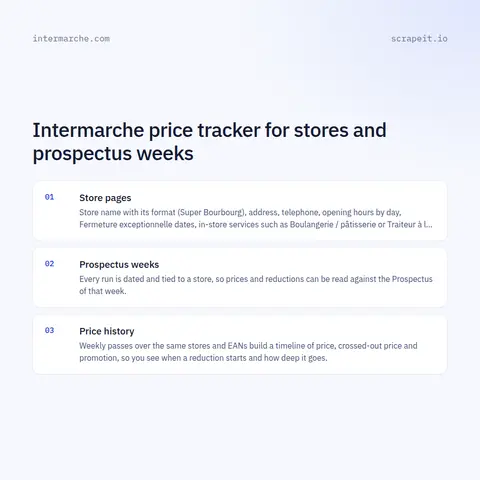
The store is the unit of an Intermarche dataset, and the store pages are data of their own. Each sits at /magasins/ followed by the store number and the town with its postcode, under a breadcrumb of region, department and area, as in Hauts-de-France, Nord, Dunkerque.
Mes offres de la semaine, the offers Intermarche shows to Carte de fidélité holders once they are signed in, can be added when the project runs on your own account.
Intermarché is a French supermarket chain; the site names ITM Alimentaire International as the company running the banner in France, and its footer links to the sister chains of Les Mousquetaires - Netto, Bricomarché, Bricorama, Bricocash and Roady. intermarche.com joins the stores' online shopping under Courses en ligne: an order is picked up at the Drive Intermarché or brought by Livraison à domicile from the chosen store.
That choice of store runs through everything a data buyer meets. The catalogue of product sheets is shared, but price, reduction and availability belong to the store, and so do the opening hours, services and delivery slots on its page. Store names carry the format, as in Intermarché Super.
Around the catalogue sit the sections the chain uses to push price: Prospectus, Offres de la semaine, Tous unis contre la vie chère, Opérations et conditions and Rappel produits. The Carte de fidélité works by credit: Avantage Carte amounts are added to the card and spent later, while a Remise immédiate is taken off at once. For price work these are two different numbers, and a dataset has to keep them apart.
Delivery: CSV, JSON or XLSX files, our API or a JSON feed. MCP server on request.
Full plan detailsBecause prices belong to stores, Intermarche data answers questions a national price list cannot.
Each use rests on the same two keys, store number and EAN, which is how we deliver the file and how it joins your own sales or listing data.
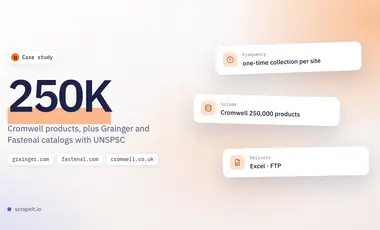
Full MRO catalogs from Grainger, Fastenal and Cromwell for a product content company: UNSPSC, EAN, every attribute and a taxonomy sheet.
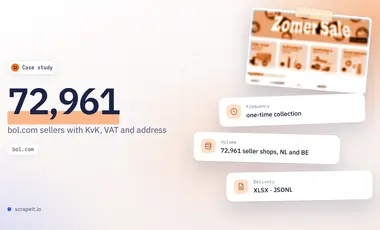
Every seller shop on bol.com with its trade name, business address, KvK and VAT number, collected once: 72,961 shops in 18 days.
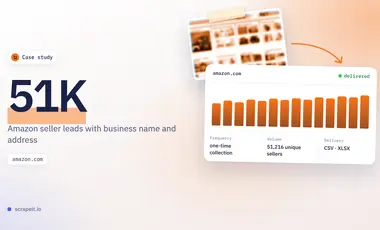
A one-time B2B lead file from Amazon seller profiles: 51,216 sellers with business name and address, 13,366 of them in the US and Canada.
Learn how to use web scraping to solve data problems for your organization
If you sell online, run a marketplace, or advise e-commerce clients, you already know why eBay matters: it’s one of the few places where big retailers compete side by side with thousands of small merchants and private sellers.
E-commerce teams do not just need “some” competitor data anymore. They need a continuous stream of real prices, discounts, stock levels, reviews, and seller behavior from the platforms that actually shape their markets.
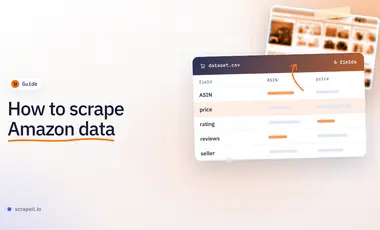
Amazon provides valuable information gathered in one place: products, reviews, ratings, exclusive offers, news, etc. So scraping data from Amazon will help solve the problems of the time-consuming process of extracting data from e-commerce.

ScrapeIt builds and runs crawlers as a managed service; clients describe the data and receive the dataset. On store-priced grocery sites like intermarche.com most of the work is setting the store context correctly for every pass and keeping it stable from week to week. We start with a free project assessment and can deliver a sample before a schedule begins. Plans start from EUR 169 a month, or EUR 199 for a one-time extract.
Still unsure? Write to info@scrapeit.io
Yes. The ScrapeIt Intermarche API returns store number, EAN, price, crossed-out price, price per kilo and promotion type as JSON from an endpoint we host, updated as often as your plan says. You can also take the same records as CSV or XLSX files, a JSON feed or a direct load into your database.
Yes. Product sheets, store prices once a store is chosen, and store pages with hours and services are open to every visitor. We collect only publicly available data - everything a visitor can see on Intermarche - and we collect it legally.
Yes. We take the store list from the /magasins/ pages, set each store in turn and collect the same EAN list for all of them. You can start with a department or a sample of stores and widen the run later without changing the file layout.
As separate fields. A Remise immédiate lowers the price paid, so it sits with the price and crossed-out price; an Avantage Carte is credited to the Carte de fidélité, so it goes into its own column with the offer wording. Lot offers keep the number of items they require.
Store number, name and format, address, telephone, opening hours by day, exceptional closures, in-store and station services, payment means and the next Drive and home delivery slots. These fields join to the price rows by store number.
You share your needs, expectations, and desired timeframe. We'll suggest the best solution based on your request and budget.
Our specialists configure the crawlers and extract a sample dataset for your review before proceeding with the full-scale extraction.
Once you approve the sample, we launch the project and start full data collection. We gather, filter, and structure the data for easy use, delivering it on time in your preferred format.
Our team manages ongoing processes, monitors website changes, and supports all data extraction cycles. We can also help integrate data into your systems or create dashboards to simplify analysis.
Tell us which sites, which fields and how often. A couple of lines is enough to start.
Intermarché data from €169/month. Free project assessment, reply within 1 business day.