The Entire Iherb Supplements Catalog, Captured End-to-End in 3 Days
Scraping supplement products from iHerb.com with full details, including descriptions and packaging variations.
Learn More
We build the crawlers, run them, repair them when Jumia changes its markup, and hand over clean data on the schedule you set.
Plans from €169/month · Free project assessment · Reply within 1 business day
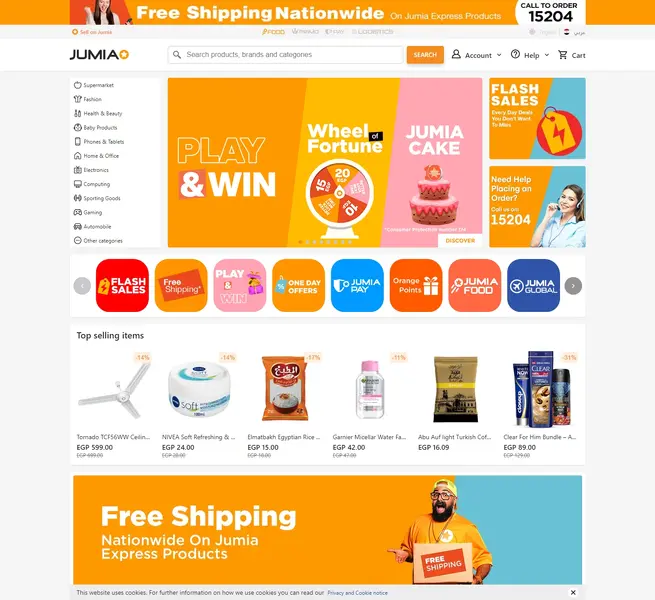
You tell us the country sites, the categories or the SKU list, the fields and the refresh rate. We build the crawler, run it and monitor it. Jumia's markup and query parameters change, so breakage is our maintenance work, not your problem.
Common shapes of work: a daily price and stock feed on a fixed SKU set, a monthly catalogue snapshot for a category across several countries, a seller and Seller Score panel, a review harvest keyed by SKU, and a campaign watch that reads the tag string through Black Friday and the mid-year Jumia Anniversary period. Output lands as CSV, JSON, XLSX or an API your systems call.
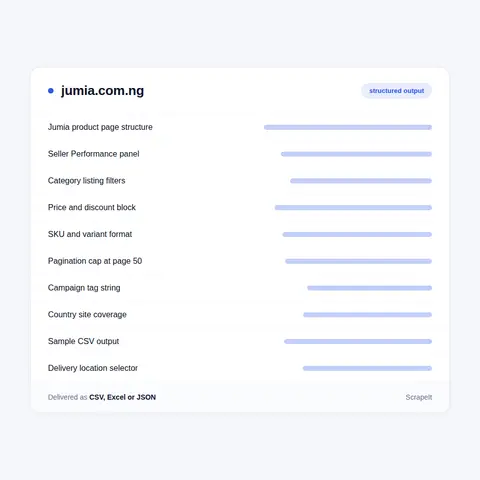
We extract listing pages and product pages across whichever country sites you pick. A normal delivery carries:
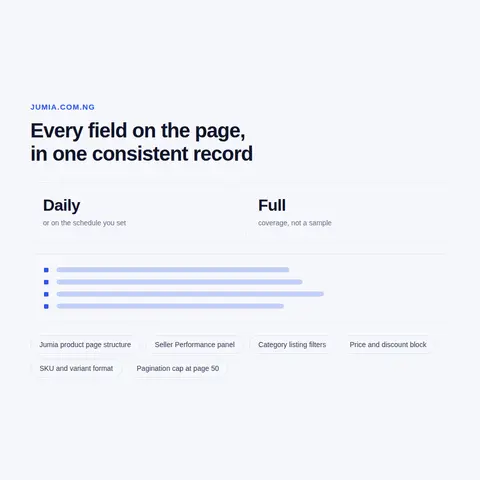
Delivered as CSV, JSON, XLSX or an API endpoint, on the schedule the work needs.
Jumia sits behind Cloudflare. A simple script is not a realistic way in: it gets a Cloudflare block page rather than the page it asked for. Anti-bot handling - pacing, proxy rotation, CAPTCHA handling and rendering - is part of the service, and we run the crawler at a considerate rate.
Coverage limits matter more than most buyers expect. A category header reports a large total while pagination refuses to go that far: a capture of jumia.com.ng/mobile-phones/ on 4 December 2025 read (9119 products found) yet its Last Page link pointed at ?page=50, and pages hold 40 items. Kenya behaved identically on 28 January 2026, reporting (31136 products found) against the same ?page=50 ceiling. Full coverage therefore gets assembled from narrower slices, by brand, price band or subcategory, rather than one deep crawl.
Jumia runs a separate storefront for each country it serves. A check of group.jumia.com on 26 August 2026 described the company as active across 8 countries: Egypt, Ghana, Ivory Coast, Kenya, Morocco, Nigeria, Senegal and Uganda. Nigeria trades at jumia.com.ng, Kenya at jumia.co.ke, Ghana at jumia.com.gh. The footprint keeps shrinking on purpose: Cameroon, Rwanda and Tanzania closed in 2019, South Africa and Tunisia were wound down after an October 2024 announcement, and the Algeria exit was disclosed in February 2026. Confirm the live country list before a coverage plan is signed off rather than inherit last year's.
The model is mixed. Independent sellers list beside Jumia's own retail and brand-run Official Stores, which the site tags internally with the identifier JMALL. Fulfilment is a separate signal: listings carry an isShopExpress flag whose on-page label reads Express Shipping, and category pages expose a Jumia Express filter at ?shop_premium_services=shop_express. Sellers are graded in public, and payment leans on JumiaPay, cards and cash on delivery. That mix is the point of Jumia data: the same handset can sit in a category four times at four prices, and only one of those offers is one a buyer will actually receive next week.
Get a Quote
Developers

Customers worldwide

Pages extracted

Hours saved for our clients
€199 / one-time
setup fee - included
€169 / mo
setup fee €499
€229 / mo
setup fee €499
€349 / mo
setup fee €499
€549 / mo
setup fee €799
Delivery: CSV, JSON or XLSX files, our API or a JSON feed. MCP server on request.
Full plan details →Three reasons come up again and again. The first is price. Naira and Egyptian pound moves have been large enough in recent years that a Jumia price list means little without a timestamp attached, and Jumia concedes the point itself by shipping a euro conversion beside every local amount in its own page state. Pull the local number and the euro number together and a real repricing can be told apart from a currency move. A shelf price is also not a landed cost: a Nigerian product page quotes shipping against a state picked in a regionId selector, so Lagos and Borno do not see the same total.
The second is seller mix. In a category that can be dominated by resellers of the same imported box, knowing which offer belongs to an Official Store, which seller sits at 90 percent and which one is graded Average on Customer Rating decides whether a cheap competing price is worth reacting to at all.
The third is assortment by country. Category slugs and ids are shared, so /mobile-phones/ resolves on Nigeria and Kenya alike, but the catalogues behind them do not match. Measuring what a brand actually lists in Lagos against what it lists in Nairobi is a question only repeated extraction answers.

Scraping supplement products from iHerb.com with full details, including descriptions and packaging variations.
Learn More
Daily scraping of lowest prices for 150K products on Allegro.pl to support marketplace pricing and margin optimization.
Learn More
Regular monitoring of Ralph Lauren clothing, footwear, and accessories sold across Amazon subdomains: AE, DE, ES, FR, IT, NL, PL, UK.
Learn MoreLearn how to use web scraping to solve data problems for your organization
If you sell online, run a marketplace, or advise e-commerce clients, you already know why eBay matters: it’s one of the few places where big retailers compete side by side with thousands of small merchants and private sellers.

E-commerce teams do not just need “some” competitor data anymore. They need a continuous stream of real prices, discounts, stock levels, reviews, and seller behavior from the platforms that actually shape their markets.
Amazon provides valuable information gathered in one place: products, reviews, ratings, exclusive offers, news, etc. So scraping data from Amazon will help solve the problems of the time-consuming process of extracting data from e-commerce.
ScrapeIt is a managed web scraping agency. We are not a library and not a self-service tool. We scope the extract with you, build and host the crawlers, watch them, repair them when a site changes, and deliver structured data on a schedule.
We collect only publicly available data - everything a visitor can see on Jumia - and we collect it legally. Our crawlers keep request rates moderate, and anti-bot handling is part of the service. Tell us the fields and the frequency and we will say what is realistically collectable.
Yes. The ScrapeIt Jumia API returns titles, current and old prices, parent and variant SKUs, seller names with Seller Scores, and stock hints as JSON from an endpoint we host, refreshed on the schedule you set, for the country sites you pick. The same data also comes as CSV or XLSX files or straight into your database.
Whichever ones are live when the project starts. On a check of group.jumia.com dated 26 August 2026 the company described itself as active across 8 countries, naming Egypt, Ghana, Ivory Coast, Kenya, Morocco, Nigeria, Senegal and Uganda. That list has moved several times, with South Africa and Tunisia wound down after an October 2024 announcement and Algeria disclosed as an exit in February 2026, so we re-check it at kickoff instead of quoting an old figure back at you. Each country site is a separate crawl with its own currency and its own catalogue.
Yes, but not by paging further. Jumia listings stop at ?page=50 with 40 items a page, which is 2,000 rows no matter what the header count says. An archived jumia.com.ng/mobile-phones/ page from 4 December 2025 announced (9119 products found) above a Last Page link that ended at 50. We work around it by splitting the category into slices that each fall under the ceiling: subcategory, brand, price band, seller, or the campaign tag filters under /all-products/. The slices are then merged and deduplicated on SKU.
Not on SKU alone. Jumia SKU strings are country-specific: in archived listings, Xiaomi phones on jumia.com.ng carry SKUs beginning XI363 while the same brand on jumia.co.ke begins XI996. The category taxonomy is shared, and both sites returned catFilterIds 8070/8244 for Phones and Tablets, Mobile Phones, so categories line up even where products do not. We match across countries on brand plus model plus specification fields, and report a confidence score rather than pretending the join is exact.
Refresh rate is a scoping decision, not a fixed product. A narrow SKU watchlist can run several times a day. A full multi-country catalogue sweep is usually daily or weekly, with the request rate kept moderate. Delivery is CSV, JSON, XLSX or an API endpoint, with a stable schema across runs so price and seller changes can be diffed rather than re-parsed each time.
Step 1 - Make a Request
You share your needs, expectations, and desired timeframe. We’ll suggest the best solution based on your request and budget.
Step 2 - Configuring Custom Web Crawlers
Our specialists configure the crawlers and extract a sample dataset for your review before proceeding with the full-scale extraction.
Step 3 - Collect and Deliver
Once you approve the sample, we launch the project and start full data collection. We gather, filter, and structure the data for easy use, delivering it on time in your preferred format.
Step 4 - Maintain and Support
Our team manages ongoing processes, monitors website changes, and supports all data extraction cycles. We can also help integrate data into your systems or create dashboards to simplify analysis.
Jumia data from €169/month. Free project assessment, reply within 1 business day.

Scrapeit Sp. z o.o.
10/208 Legionowa str., 15-099, Bialystok, Poland
NIP: 5423457175
REGON: 523384582