The Entire Iherb Supplements Catalog, Captured End-to-End in 3 Days
Scraping supplement products from iHerb.com with full details, including descriptions and packaging variations.
Learn More
ScrapeIt builds and runs the crawler for groceries.morrisons.com, then hands over clean product, price and promotion data as CSV, JSON, XLSX or an API on your schedule.
Plans from €169/month · Free project assessment · Reply within 1 business day
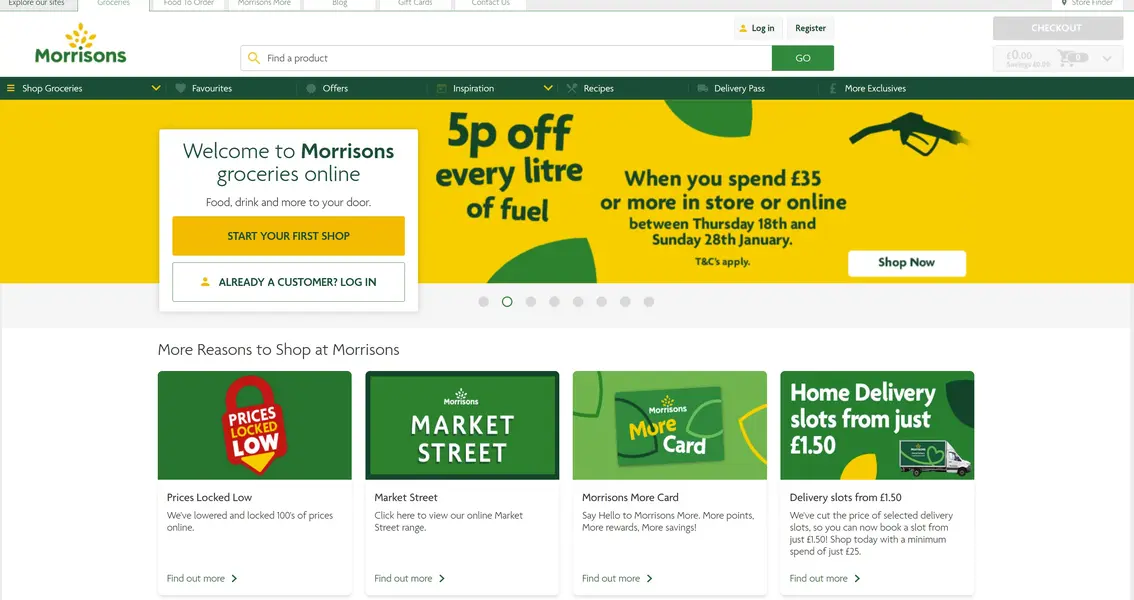
Most requests to scrape Morrisons start narrow, and they should. Usually it is a named set of category branches, a competitor basket matched against your own SKUs, or the whole promotional surface. We scope to the question rather than the site, run at a polite rate, and take only what an ordinary visitor is shown.
Output arrives as CSV, JSON, XLSX or a REST endpoint, at whatever cadence the question needs: daily for price and promotion series, weekly or monthly for range and attribute audits. Column schemas stay stable between runs, changed fields are flagged, and when Morrisons alters its markup we repair the crawler. Nothing is left for your team to maintain.
A Morrisons scraper is only worth having if the grocery specific fields survive the trip. These are the ones we pull and normalise, one row per line:
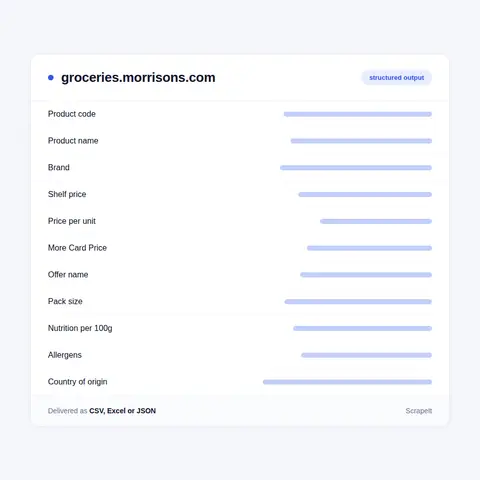
Product records carry a long tail of regulated and descriptive fields, and Morrisons names them plainly in its own markup. The nutrition block is titled Nutritional Data and carries values per 100g or per 100ml alongside per serving. Allergens is a field of its own, separate from the ingredients text, and the ingredients heading itself carries the warning that ingredients and allergens may be subject to change. Dietary flags show up twice: as tile badges reading Vegetarian, Vegan or Gluten Free, and again in a Dietary Information field.
Provenance is where Morrisons goes further than most grocers. Instead of a single origin field, the schema carries Country Of Origin plus separate slots for Country Of Birth, Country Of Rearing, Country Of Slaughter, Country Of Farming, Country Of Bottling, Country Of Packaging and Country Of Last Processing, with Fishing Area, Method Of Capture and Breed on meat and seafood. For a sourcing or compliance team that is the difference between knowing a joint is British and knowing where the animal was born, reared and slaughtered.
Market Street counter lines live in the same catalogue under their own branches, including Fresh From The Butcher, Fresh From The Fishmonger and Fresh From The Deli Counter. Many of them are weighed items, so the figure you capture is a typical price against a stated weight range rather than a fixed one, and it has to be stored that way to stay honest.
Morrisons trades online at groceries.morrisons.com, a separate application from the corporate site at www.morrisons.com. Product pages follow the pattern /products/{slug}/{id}. That trailing number is the stable identifier: on the product page it is repeated as the sku value inside the schema.org Product block in the source. Marketing renames slugs; the number survives, so it is the key worth joining on.
Category pages sit under /categories/ with four to six path segments and a numeric category id, for example /categories/food-cupboard/tea-hot-drinks/tea/fruit-herbal-tea/fruit-tea/171812. Every category path exists a second time under /promotions/, listing only the lines in that branch currently on deal. Individual deals live at /offers/{slug}/{id}. All of it is published through the XML sitemap index at /sitemaps/sitemap_index.xml, which splits into products, categories, collections, promotions and recipes.
Search runs at /search?q= and pulls further results through a Show more control rather than numbered pages. The sort menu is telling: alongside total price it offers Price per: Low to High and Life: Long to short. Morrisons treats unit price and remaining shelf life as first class sort keys, a fair guide to how the catalogue is meant to be read.
One deployment detail matters first. The storefront sits behind Amazon CloudFront with a geographic restriction, so groceries.morrisons.com answers a UK visitor and turns away clients in regions the distribution does not serve. www.morrisons.com does not. In practice the job has to run from where the storefront is served.
Get a Quote
Developers

Customers worldwide

Pages extracted

Hours saved for our clients
€199 / one-time
setup fee - included
€169 / mo
setup fee €499
€229 / mo
setup fee €499
€349 / mo
setup fee €499
€549 / mo
setup fee €799
Delivery: CSV, JSON or XLSX files, our API or a JSON feed. MCP server on request.
Full plan details →Grocery pricing only becomes comparable once you divide by the pack. Two own label pasta lines can sit within pennies of each other on the shelf and be far apart per kilo, and that gap is where range and margin decisions get made. Because Morrisons prints the comparison price on every tile, a Morrisons scraper that preserves the Ordinarily figure and its basis hands you a table you can sort by cost per unit instead of by pack size.
The second question is which price a shopper really pays. Since More Card Prices arrived, a Morrisons price series has two lines rather than one: the shelf price everyone sees and the lower price a registered customer gets. Follow only the first and you overstate what Morrisons charges its regulars. Follow only the second and you understate it. We record both, with the offer id attached, so you can measure how much of the range is sitting behind the card at any point in the cycle.
Third is the promotion clock. Multibuys, price cuts and Unbeatable Price lines rotate on their own schedules, and a weekly crawl will miss short deals outright. Daily capture with the offer id attached lets you reconstruct when a deal opened, how long it ran, and which lines moved together. The same series exposes range gaps: a line that stops appearing in its category branch but stays in the sitemap is behaving differently from one that has been withdrawn.

Scraping supplement products from iHerb.com with full details, including descriptions and packaging variations.
Learn More
Daily scraping of lowest prices for 150K products on Allegro.pl to support marketplace pricing and margin optimization.
Learn More
Regular monitoring of Ralph Lauren clothing, footwear, and accessories sold across Amazon subdomains: AE, DE, ES, FR, IT, NL, PL, UK.
Learn MoreLearn how to use web scraping to solve data problems for your organization

If you sell online, run a marketplace, or advise e-commerce clients, you already know why eBay matters: it’s one of the few places where big retailers compete side by side with thousands of small merchants and private sellers.

E-commerce teams do not just need “some” competitor data anymore. They need a continuous stream of real prices, discounts, stock levels, reviews, and seller behavior from the platforms that actually shape their markets.
Amazon provides valuable information gathered in one place: products, reviews, ratings, exclusive offers, news, etc. So scraping data from Amazon will help solve the problems of the time-consuming process of extracting data from e-commerce.
ScrapeIt is a managed web scraping agency. We build the crawler, run it on your schedule, monitor it, and fix it when the site moves. What you receive is data on a timetable, not a repository to look after.
We are independent of Morrisons and claim no partnership or affiliation with the company. We collect only publicly available data - everything a visitor can see on Morrisons - and we collect it legally.
Yes. The ScrapeIt Morrisons API returns Morrisons data one row per line - product code, shelf price, the Ordinarily unit price with its basis, promotion name and offer id, and the More Card Price - as JSON from an endpoint we host, refreshed on the schedule you set. The same data also comes as CSV or XLSX files or straight into your database.
Both, with a caveat worth understanding. A logged out visitor browsing a category does not see the More Card price on the product tile. It is published elsewhere: the deal itself lives under /offers/ with a slug ending in more-card-price and an id carrying a BUL- prefix, and that page shows the member price together with the terms More Card Exclusive Price. Registered Customers Only. We read the shelf price where the item is listed and reconcile the member price from the offer surface, so each row carries both figures and the offer id that ties them together.
Yes, and it shapes how a job is scoped. Morrisons serves an empty category with the message that there are no products in that category for your location, and warns in the trolley that prices and promotions are different for a different location. Live availability and delivery slots sit behind login altogether. We fix the delivery location for a run and stamp it onto every row, so a series stays comparable with itself over time instead of quietly mixing locations. If you need several regions, we treat each as its own series.
It depends on the field. Price and promotion move fastest: multibuys and price cuts rotate weekly or quicker, and the Unbeatable Prices commitment Morrisons announced on 24 August 2026 covers a set of weekly essentials priced against other major grocers, so those lines are reviewed on their own rhythm. Daily is the normal cadence for a price series. Nutrition, ingredients, allergens and origin change rarely, so a weekly or monthly attribute pass is enough. Range turns over seasonally, heavily around Christmas and summer, and listings and delistings are caught best by diffing the product sitemap each day.
Morrisons flags them as a Weighed item and states the price as a typical figure against a weight range, because the final charge depends on the piece that gets picked. We keep the flag, the range and the typical price as separate fields rather than flattening them into a single number that would be wrong for most orders. This matters most on Market Street lines, where comparing a counter cut against a pre-packed equivalent only works per kilo, never per pack.
Step 1 - Make a Request
You share your needs, expectations, and desired timeframe. We’ll suggest the best solution based on your request and budget.
Step 2 - Configuring Custom Web Crawlers
Our specialists configure the crawlers and extract a sample dataset for your review before proceeding with the full-scale extraction.
Step 3 - Collect and Deliver
Once you approve the sample, we launch the project and start full data collection. We gather, filter, and structure the data for easy use, delivering it on time in your preferred format.
Step 4 - Maintain and Support
Our team manages ongoing processes, monitors website changes, and supports all data extraction cycles. We can also help integrate data into your systems or create dashboards to simplify analysis.
Morrisons data from €169/month. Free project assessment, reply within 1 business day.

Scrapeit Sp. z o.o.
10/208 Legionowa str., 15-099, Bialystok, Poland
NIP: 5423457175
REGON: 523384582