Premier League Scraper for Fixtures, Tables and Player Stats

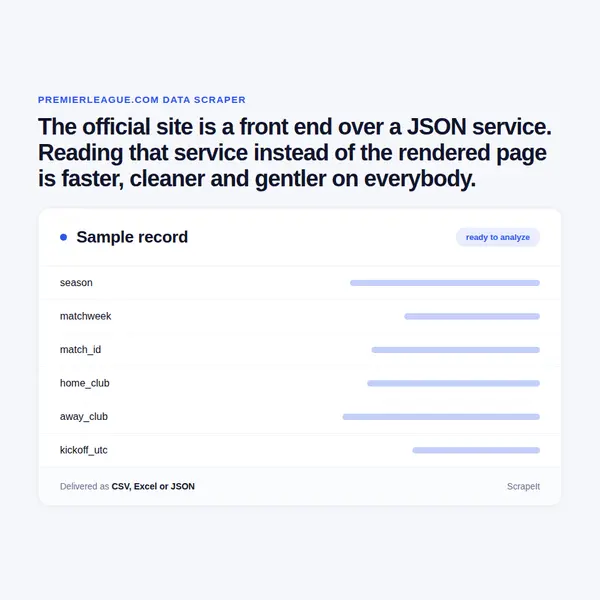
The official site is a front end over a JSON service. Reading that service instead of the rendered page is faster, cleaner and gentler on everybody.

Premier League Scraper
Solutions

Managed official league data, run end to end by us

ScrapeIt runs the collection as a managed service. You name the seasons and the depth of statistics; we build the pipeline against the structured layer where it is available, run the historical backfill once and the in season updates around matchdays, and hand back CSV, JSON, Excel or a push into your warehouse, with tables stored per matchweek and identities normalised for joining.

We read the structured responses the site renders from rather than driving a browser across rendered pages. That is fewer requests, more stable output and considerably less load on the league's infrastructure than the alternative, and we pace what we do send.

Competition data is a compilation with rights attached, and official sites carry terms on automated collection and reuse. The dataset is built for analysis and internal product use rather than for republication of their pages. If your use case touches betting or public redistribution, take it to your own counsel before the project starts.

Premier League fields in every export

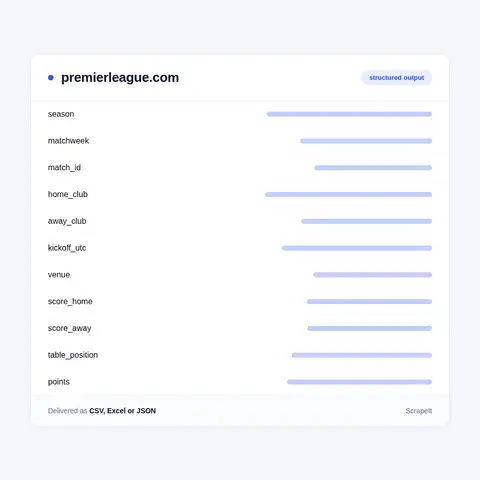
Fixture and result records cover season, matchweek, match identifier, home and away club, kickoff in local time and UTC, venue, attendance where published, final and half time score, and status.

Table records carry the season, matchweek, position, club, played, won, drawn, lost, goals for, goals against, goal difference and points, plus the form sequence where published. Tables are stored per matchweek rather than only as a final state, which is what makes any question about the shape of a season answerable.

Match detail includes goals with scorer, assist and minute, cards with type and minute, substitutions, and the team statistics the league publishes: possession, shots, shots on target, passes, pass accuracy, tackles, fouls and offsides.

Player records carry player identifier, name, position, club, shirt number, nationality, date of birth, and season and career aggregates across appearances, minutes, goals, assists, clean sheets for goalkeepers and disciplinary totals.

Every row carries the season, the source and the collection timestamp, with kickoff times stored in both local and UTC so that a matchweek spanning a clock change does not quietly shift by an hour.

Premier League fields in every export
Historical seasons, reconciliation and club-level joins

Historical seasons, reconciliation and club-level joins

Historical backfill is straightforward and, as everywhere in sports, a one time job. Past seasons are immutable, so once a season is collected it is finished. Most clients start with a five to ten season panel and then add a light in season feed on top.

Reconciliation is worth setting up deliberately rather than discovering later. Where a client runs this alongside a results aggregator, we match fixtures on date, clubs and competition, then report differences in scores, scorers, cards and attendance as their own records. Those differences are usually small in number and highly informative when they appear, because they show which source drifts and where.

Club and player identity are normalised so that this source joins cleanly to valuation and transfer data. The same player carries different identifiers on every site, and matching on birth date, squad and position is what makes a combined dataset possible at all.

Cadence in season is naturally low: fixtures are known in advance, tables change after matches, and statistics settle shortly afterwards. A collection tied to matchday plus a settle window is both sufficient and cheap, which is a pleasant change from the live scores side of this vertical.

An application over a data service, not a document site

The Premier League site is the authoritative source for its own competition: fixtures, results, tables, squads, player and club statistics, and match centre detail. When an aggregator and the league disagree, the league is right, which is the whole reason to collect here rather than only from a results service.

Technically it is a client side application. The pages a visitor sees are rendered in the browser from a JSON service, and that service responds directly. That matters a great deal for collection design: parsing rendered HTML from a framework that changes with every deploy is fragile, while structured responses are stable, cheaper to request and far kinder to the site than driving a headless browser across it.

So the correct approach is to read the structured layer where it is available and reserve page rendering for the parts that genuinely need it. Fewer requests, less load, more reliable output, and a collector that survives a redesign.

The data itself is deep. Beyond fixtures and tables there are per match statistics, per player season and career figures, squad lists with shirt numbers and positions, and club information. Coverage of past seasons is substantial, which makes historical work practical.

Get a Quote
dev_w
25

Developers

customers
500+

Customers worldwide

pages
1 500 000 000+

Pages extracted

stime
15000+

Hours saved for our clients

Plans

Airplane

€199 / one-time

setup fee - included

Data limits100,000
Frequencyone-time
Run timeup to 5 days
Data storing7 days

Helicopter

€169 / mo

setup fee €499

Data limits250,000
Frequencymonthly
Run timeup to 5 days
Data storing14 days

Glasses

€229 / mo

setup fee €499

Data limits1,000,000
Frequencyweekly
Run timeup to 5 days
Data storing30 days

DNA

€549 / mo

setup fee €799

Data limits3,000,000
Frequency3 times daily
Run timesame day
Data storing90 days

Why official data settles arguments that aggregators start

Any product built on several sports sources eventually hits a disagreement. Two services report a different assist, a different attendance, a different disciplinary total. Somebody has to be the referee, and for a competition's own data that is the competition.

That is the first reason to collect the official source even when an aggregator already covers the fixtures: it is the reconciliation baseline. Where our clients run multiple sources, this one is usually configured as authoritative and the others are checked against it, with disagreements surfaced rather than silently resolved by whichever source loaded last.

The second reason is depth of statistics. Official match centre data goes further than most aggregators publish, and it is consistent across seasons, which matters for any modelling that spans more than one campaign.

The third is matchweek level tables. A final table tells you who won. A table per matchweek tells you when a title race turned, how long a club spent in a relegation place and whether a run of form actually changed anything. That history only exists if somebody stored it week by week, and storing it is trivial while reconstructing it later is not.

The fourth is that the structured layer makes all of this cheap. Because the site serves its data as structured responses, collecting a full season of detail is a modest number of requests rather than a crawl, which is better for the client's budget and better for the league's servers.

Our Blog

Reads Our Latest News & Blog

Learn how to use web scraping to solve data problems for your organization

How Artificial Intelligence Is Used In Web Scraping

How Artificial Intelligence Is Used In Web Scraping

Leveraging advances in technology, the AI-powered web scraper has skyrocketed in demand and is helping to expand capabilities by automating tedious daily tasks and speeding up data collection from thousands of websites several times over.

What is Web Scraping and What is it Used For?

What is Web Scraping and What is it Used For?

Web scraping is a method of obtaining web data by extracting it from pages of web resources with the help of a program, that is, in automatic mode. It is used to syntactically convert web pages into more usable forms.

Web Scraping for Machine Learning

Web Scraping for Machine Learning

If you specialize in machine learning, you need to feed large amounts of data to the algorithms. Web scraping is the easiest and the most efficient method of collecting the data from all over the Internet.

scrapeit logo

Who builds and keeps your league data feed

ScrapeIt is a managed extraction company, not a tool you have to learn. Our team builds the pipeline, watches it through the season as the site and its responses change, and repairs it before matchday.

You see a sample first, in your format, across the seasons you actually need, with matchweek tables and reconciliation against your existing source so you can judge it on real disagreements.

FAQ

Why is official data worth collecting if an aggregator covers the same fixtures?

Because it settles disagreements. Any product on several sources eventually finds two of them reporting a different assist or attendance, and somebody has to be authoritative. For a competition's own data that is the competition. Clients typically configure this source as the baseline and check the others against it, with differences surfaced rather than quietly overwritten.

Do you collect league tables for every matchweek?

Yes, and it is one of the more valuable things here. A final table says who won; a table per matchweek shows when a title race turned and how long a club spent in trouble. Storing it week by week is trivial, and reconstructing it afterwards from results is error prone and often impossible where deductions apply.

The site is a JavaScript application. Does that make it harder?

Easier, in fact. The pages render from a structured service that responds directly, so we read that rather than parsing HTML from a framework that changes on every deploy. It is fewer requests, more stable output and much gentler on the site than driving a headless browser across it.

How far back can you go?

Many seasons, and because past seasons never change the backfill is collected once and never revisited. Most clients begin with a five to ten season panel and then add a light in season feed around matchdays.

Can I republish the tables and statistics?

Competition data is a compilation with rights attached and official sites carry terms on automated collection and reuse, so the dataset we build is for analysis and internal product use rather than republication. If your plan involves publishing tables or statistics, or anything touching betting, take it to your own counsel before the project starts.

How does it Work?

Step 1 - Make a Request

You share your needs, expectations, and desired timeframe. We’ll suggest the best solution based on your request and budget.

Step 2 - Configuring Custom Web Crawlers

Our specialists configure the crawlers and extract a sample dataset for your review before proceeding with the full-scale extraction.

Step 3 - Collect and Deliver

Once you approve the sample, we launch the project and start full data collection. We gather, filter, and structure the data for easy use, delivering it on time in your preferred format.

Step 4 - Maintain and Support

Our team manages ongoing processes, monitors website changes, and supports all data extraction cycles. We can also help integrate data into your systems or create dashboards to simplify analysis.

Request a Quote

Tell us more about you and your project information.
Which sites, which fields, how often. A couple of lines is enough.

We reply within 1 business day. No obligation.

scrapiet

Scrapeit Sp. z o.o.
10/208 Legionowa str., 15-099, Bialystok, Poland
NIP: 5423457175
REGON: 523384582