Hulu Scraper for US Catalogue, Title and Plan Data

Hulu is a single storefront and it faces the United States. From anywhere else hulu.com hands you Disney+ instead, so a Hulu scrape begins by making sure you are reading Hulu at all.

Hulu Scraper
Solutions

Scoping and running a Hulu scrape from an American exit

You set the scope: which title types, which genre or network hubs, whether plan and add-on pricing rides along, and whether this is one snapshot or a standing run that becomes a change log. We build the Hulu scraper, run it on your schedule and hand back CSV, JSON, XLSX or an API endpoint, field names agreed before the first pass.

The engineering is ours: anti-bot handling, proxy rotation and CAPTCHA solving come with the managed service, and Hulu scraping needs American exit points, because nothing else reaches the site. We read only what a signed-out visitor sees and never sign in. We do not touch the video stream, go nowhere near content protection, and collect no account, profile or viewing records. The Hulu subscriber agreement prohibits automated access and extraction by robot, spider or script, data mining, web scraping and disguising your location - we name it plainly, and the basis for a run is agreed with you.

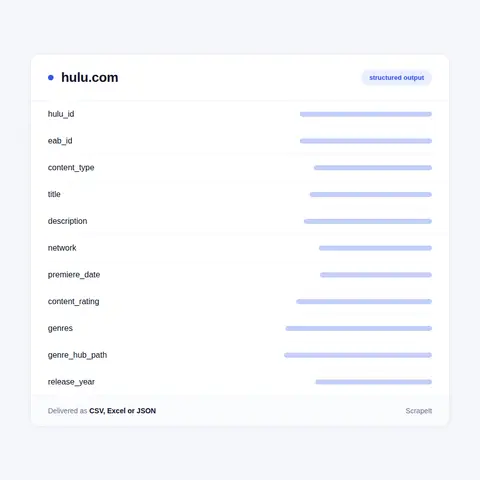
Hulu title metadata: fields on a series, movie and episode record

Every Hulu title sits at a readable address - /series/ or /movie/, then a slug, then a UUID - and the UUID is the stable half: slugs get rewritten, UUIDs do not, so it is the join key between runs. Playable assets carry a second identifier, the eabId - EAB followed by the content id and two numeric codes - which ties an episode to the asset that plays.

A signed-out visitor can read, on a series record: name, description, network, premiere date, content rating (TVG, TVPG, TV14, TVMA on shows, film ratings including Not Rated on movies), genres with the hub path each one links to, credits split by role prefix - Starring, Director - and audio and video features such as hd and 5.1. A headline field counts the shelf in the form 9 seasons available (79 episodes), with season total and episode count also held as plain numbers. Flags mark Hulu Originals and whether a title needs the premium tier. On a movie record the network field carries the distributor rather than a channel.

The episode list is a first-class record, not a footnote. Each episode carries its own id and eabId, season number, episode number, name, description, premiere date, rating, genres, parent series name and a runtime in seconds rather than minutes. Artwork arrives as a set - horizontal hero, horizontal programme tile, vertical hero, vertical tile, title art and brand art - and each image carries a hue value the page uses as its accent colour. Structured data is published too: series records ship TVSeries markup with cast and a publication event dated to the United States, movie records ship Movie markup with a director, and a series can also carry a subscription offer with a dollar price and a US eligible region.

To extract Hulu title metadata at scale, start at sitemap_index.xml. It lists nine files, all prefixed en-us: series, movies, genres, networks, collections, bundles, landing pages and two guide files. About 2,500 series and 1,250 movie addresses are enumerated there in mid-2026. Browse rails will not substitute: a rail stops at seventy tiles, the A-Z rail included, so full coverage means the sitemap plus 113 genre hubs, 87 network hubs and the numbered collections under the tv, movies, kids, originals and networks roots.

Hulu title metadata: fields on a series, movie and episode record
Hulu plan and pricing data: ad tier, no-ads, Live TV and add-ons

Hulu plan and pricing data: ad tier, no-ads, Live TV and add-ons

Hulu sells the same library several ways at once, and the plan pages publish every combination. The base service runs at $11.99 a month with ads and $18.99 without. Hulu + Live TV, a separate product carrying 100+ channels, runs at $89.99 and $99.99 for the same two ad choices. A verified-student bundle of Disney+ with Hulu runs at $6.49.

Bundles are quoted against a list price with both numbers printed side by side, so a Hulu price scrape captures the discount and not only the amount charged: Disney+ with Hulu at $12.99 basic and $19.99 premium against a $23.98 and $37.98 list, the Disney+, Hulu and HBO Max bundle at $19.99 and $32.99, ESPN Select at $21.99 and $32.99, ESPN Unlimited at $35.99 and $44.99.

Above that sit add-ons with prices of their own - a sports pack at $9.99, a Spanish-language pack at $4.99, an entertainment pack at $7.99 - and premium channel add-ons for HBO Max, Cinemax, Paramount+ with Showtime and Starz. The comparison table also exposes the feature rows themselves: simultaneous streams, downloads, and which subscriptions each plan includes. Parsed, that is a tidy tier-by-feature grid.

Live TV adds a dimension the streaming library does not have. The channel lineup is keyed to a ZIP code, local affiliates differ by market, and the pages state that programming is subject to regional restrictions and blackouts. A lineup dataset is therefore a ZIP-by-channel matrix rather than a single list, and it moves on its own schedule, separate from the catalogue.

How the Hulu catalogue sits behind one American storefront

Hulu is Disney's American streaming service, and hulu.com is one storefront rather than a family of country sites. The subscriber agreement says it outright: the ESPN and Hulu services are available only in the United States and certain of its territories, and the live channel product is sold for the 50 states and the District of Columbia. Everything a data buyer needs to know about coverage follows from that sentence.

Asked from an address outside the United States, hulu.com does not serve a thinner catalogue - it serves a different service. Series records, movie records, genre hubs and even robots.txt all resolve to the Disney+ home page. Whatever is collected that way is a Disney+ storefront for that country, with its own rights, its own ids and its own artwork. It is not Hulu data, and a Hulu scraper that ignores the distinction quietly fills the dataset with the wrong service.

The two brands are converging from the other side as well. Hulu now runs as a hub inside Disney+, and Hulu's own records point into it: the record for one FX drama sends an English-dub viewer either to a series collection on Hulu or to the Extras row in Hulu on Disney+, and the press room marks new episodes as streaming on Hulu and on Hulu on Disney+ together. One subscriber agreement now covers Disney+, Hulu and ESPN. For anyone buying catalogue data that turns a loose question into a precise one: not what is on Hulu, but which surface, which territory, and which of the two apps the record came from.

Get a Quote
dev_w
25

Developers

customers
500+

Customers worldwide

pages
1 500 000 000+

Pages extracted

stime
15000+

Hours saved for our clients

Plans

Airplane

€199 / one-time

setup fee - included

Data limits100,000
Frequencyone-time
Run timeup to 5 days
Data storing7 days

Helicopter

€169 / mo

setup fee €499

Data limits250,000
Frequencymonthly
Run timeup to 5 days
Data storing14 days

Glasses

€229 / mo

setup fee €499

Data limits1,000,000
Frequencyweekly
Run timeup to 5 days
Data storing30 days

DNA

€549 / mo

setup fee €799

Data limits3,000,000
Frequency3 times daily
Run timesame day
Data storing90 days

What Hulu data answers for rights, pricing and research teams

Hulu is the large American catalogue that cannot be inferred from anywhere else. Disney runs a Disney+ storefront in most markets, so an analyst outside the United States can read Disney's international shelf all day and still know nothing about Hulu. A picture of the US streaming market has to come from hulu.com itself, which is the whole reason anyone commissions a Hulu scraper.

Rights and acquisition teams use it to see where a Disney-controlled title has been placed - Hulu, Disney+, or both - and which badge it carries: ABC, FX, Freeform, National Geographic, Adult Swim, Crunchyroll, or a film label such as Neon, Magnolia or IFC Films. Catalogue teams track arrivals and departures. Hulu prints no leaving date anywhere on a record, so churn is measured by returning: an address the sitemap still lists but that no longer resolves is a licence that has run out, and the only way to date it is a repeat pass.

Pricing and product teams come for a different reason. Hulu is the ad-supported half of Disney's bundle, and the same library is sold at several prices at once, which makes it the cleanest place to watch how an ad tier is positioned against an ad-free one. Metadata vendors, TV guides and recommendation engines buy the descriptive fields; measurement firms and equity research buy the counts. All of it comes off pages a guest can open, which is why this is a catalogue instrument and never an account tool.

Our Blog

Reads Our Latest News & Blog

Learn how to use web scraping to solve data problems for your organization

How Artificial Intelligence Is Used In Web Scraping

How Artificial Intelligence Is Used In Web Scraping

Leveraging advances in technology, the AI-powered web scraper has skyrocketed in demand and is helping to expand capabilities by automating tedious daily tasks and speeding up data collection from thousands of websites several times over.

What is Web Scraping and What is it Used For?

What is Web Scraping and What is it Used For?

Web scraping is a method of obtaining web data by extracting it from pages of web resources with the help of a program, that is, in automatic mode. It is used to syntactically convert web pages into more usable forms.

Web Scraping for Machine Learning

Web Scraping for Machine Learning

If you specialize in machine learning, you need to feed large amounts of data to the algorithms. Web scraping is the easiest and the most efficient method of collecting the data from all over the Internet.

scrapeit logo

Buying Hulu data from ScrapeIt: scope, price and support

ScrapeIt is a managed web scraping agency. You describe the dataset, we design the crawl, operate it and keep it alive - no framework for you to learn, no proxy invoice for you to reconcile. A Hulu data project is quoted on volume and refresh rate, and that price is fixed before the first run.

Most projects open with a paid sample - a few hundred title ids across series, movies and the plan pages - so you can test the fields against your own records before committing. You get a named engineer, and when a field moves we tell you and repair the crawl.

FAQ

Does Hulu have a public API for catalogue or pricing data?

No. There is no developer portal, no partner data product, and no supported route to a Hulu API for an outside buyer. The service the site calls for its own rails, discover.hulu.com, is internal and refuses anonymous requests, and robots.txt disallows the /api path outright. What is open is the page layer: series and movie records, episode lists, genre and network hubs, the sitemap set and the plan pages, all readable without an account. That is what we scrape, and it is why the deliverable is a file or an endpoint we host rather than a key to theirs.

Why does hulu.com show Disney+ when opened from outside the United States?

Because Hulu is sold only in the United States and certain American territories, and the site enforces that at the edge. Requests from other countries are sent to the Disney+ home page - not just the front door, but series and movie addresses and robots.txt as well. The Disney+ catalogue you land on is a different service under different rights, so it cannot stand in for Hulu, and a title present on one says nothing about the other. Collecting Hulu data needs American exit points, which are part of the managed service on our side.

Can you collect Hulu plan and add-on prices and the Live TV channel lineup?

Yes. The plan comparison table publishes every tier and bundle with the list price and the discounted price side by side, plus the feature rows behind them, so a Hulu pricing dataset can carry the discount and not only the charge. Add-ons - sports, Spanish-language, entertainment and the premium channels - each carry their own price. The Live TV lineup is keyed to a ZIP code, so it comes back as a ZIP-by-channel matrix built from the postcode list you name, refreshed on its own cycle rather than with the catalogue.

How fresh can a Hulu data feed be, and how is it delivered?

Anything from a single snapshot to daily. Catalogue metadata moves slowly, so most buyers take a weekly full pass with a daily check on the new-and-leaving edge; pricing is usually monthly unless you are waiting on a change. Output is CSV, JSON, XLSX, a database load or a REST endpoint we host, pushed to S3, GCS, SFTP or a webhook. Schema and field names are fixed up front, and every row carries its snapshot date so a departure can be placed in time.

Is it legal to scrape Hulu, and what will you not touch?

The Hulu subscriber agreement bars automated access, copying and extraction by robot, spider or script, bars data mining and web scraping, and bars disguising your location; robots.txt disallows anonymous crawlers by default and names an allowlist of search, social, advertising and AI bots. We state that rather than talk around it: the lawful basis for a run is yours to establish and we agree it with you in writing first. What we will not do is fixed - we never sign in, never touch the video stream or content protection, and never collect account, profile or viewing records. Personal data is out of scope by default.

How does it Work?

Step 1 - Make a Request

You share your needs, expectations, and desired timeframe. We’ll suggest the best solution based on your request and budget.

Step 2 - Configuring Custom Web Crawlers

Our specialists configure the crawlers and extract a sample dataset for your review before proceeding with the full-scale extraction.

Step 3 - Collect and Deliver

Once you approve the sample, we launch the project and start full data collection. We gather, filter, and structure the data for easy use, delivering it on time in your preferred format.

Step 4 - Maintain and Support

Our team manages ongoing processes, monitors website changes, and supports all data extraction cycles. We can also help integrate data into your systems or create dashboards to simplify analysis.

Request a Quote

Tell us more about you and your project information.
Which sites, which fields, how often. A couple of lines is enough.

We reply within 1 business day. No obligation.

scrapiet

Scrapeit Sp. z o.o.
10/208 Legionowa str., 15-099, Bialystok, Poland
NIP: 5423457175
REGON: 523384582