JioHotstar Scraper for Library Titles and Live Sport

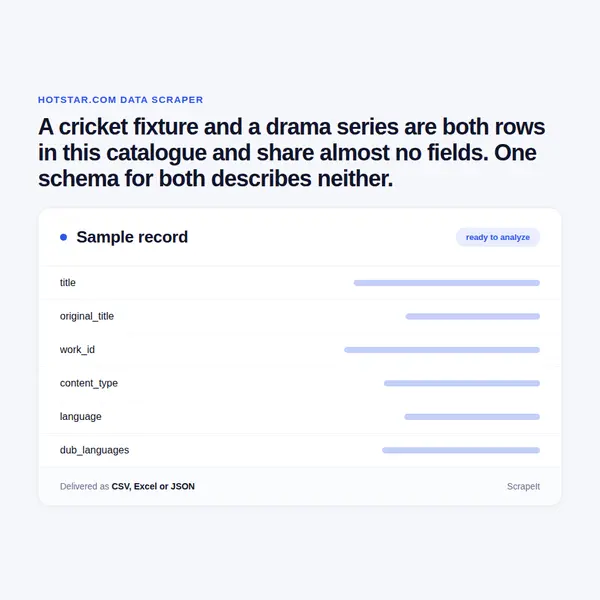
A cricket fixture and a drama series are both rows in this catalogue and share almost no fields. One schema for both describes neither.

JioHotstar Scraper
Solutions

Managed streaming metadata, run end to end by us

ScrapeIt runs the collection as a managed service. You name the languages, genres or the full catalogue; we build separate schemas for library and sport, group language variants under a work identifier, record offer type per row, and hand back CSV, JSON, Excel or a push into your warehouse.

Where turnover matters we run repeat collection and keep every observation, because a title that has left leaves no trace behind it.

We collect published metadata only - never streams, never anything behind a sign in, no viewer or account data - honour the crawl rules the site publishes and pace requests. The content is copyrighted and terms restrict reuse, so the dataset is for analysis rather than republication. Your counsel should see the use case before the project starts.

JioHotstar fields in every export

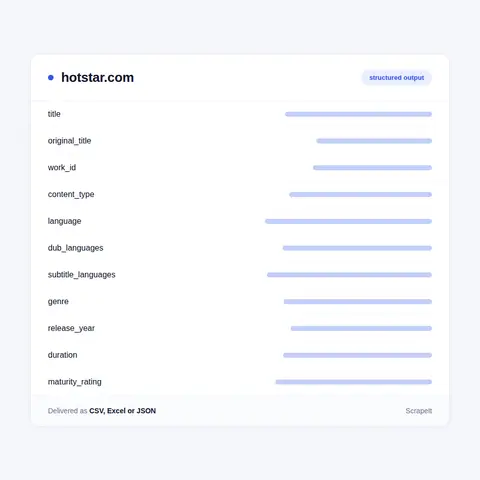
Library records carry the title, original title, content type, language, available dub and subtitle languages, genre, release year, duration, maturity rating, cast and crew where published, and series or episode identifiers.

A work identifier groups language variants of the same film, so a client can ask about the title as a work or about each language version, rather than being forced to guess which rows are duplicates.

Sport records are their own type: competition, teams, start time, venue, status and the language feeds available. They sit in a separate table with a shared key rather than being merged into the library schema.

Offer type is recorded per row - included with subscription, free, or a separate tier - because in this market the free and paid split is a large part of what makes the catalogue interesting.

Every row carries the collection timestamp and the surface it came from, so a figure can be traced back to the page that produced it.

JioHotstar fields in every export
Catalogue turnover, language coverage and limits

Catalogue turnover, language coverage and limits

Turnover tracking is the standard output: what arrived, what left, and how long licensed titles stayed. It requires repeat collection with every observation kept and it cannot be reconstructed from a current snapshot.

Language coverage analysis is the one clients find most immediately useful here: which titles are available in which languages, where dubs exist and where they do not, and how coverage differs by genre. Once the work identifier and per-language rows exist, that is a straightforward query and it is impossible without them.

Cross service comparison is usually the wider brief. The same title is licensed to different services in different markets and often at different times, so matching works across services is the step that makes rights analysis possible - and like any inferred match, it ships with a confidence value rather than as a certainty.

What we do not do is content and we do not do people. Metadata only, nothing behind a sign in, no viewer data, no account access. The personalised paths the crawl rules disallow are exactly the ones a catalogue project has no business reading.

India's largest service, and two catalogues inside it

JioHotstar is the largest streaming service in India, formed from the merger of Disney+ Hotstar and JioCinema. It carries an on demand library of films and series alongside live sport, and during major cricket tournaments it handles some of the largest concurrent audiences anywhere.

Those two halves are different data. A library title has a synopsis, a cast, a genre, a duration and a release year. A live fixture has two teams, a competition, a start time, a venue and a state that changes from upcoming to live to finished. Forcing both into one schema produces a table where half the columns are empty for half the rows, and it is the most common way an Indian streaming brief goes wrong.

The second structural feature is language. The same film exists in Hindi, Tamil, Telugu, Kannada, Malayalam and more, and the service treats those as entries a viewer chooses between. Collapsing them to one title loses the axis that Indian catalogue analysis actually runs on.

Show and category surfaces respond directly and crawl rules are published, disallowing personalised recommendation paths - continue watching, because you watched, suggestion lists - none of which belongs in a catalogue dataset anyway.

Get a Quote
dev_w
25

Developers

customers
500+

Customers worldwide

pages
1 500 000 000+

Pages extracted

stime
15000+

Hours saved for our clients

Plans

Airplane

€199 / one-time

setup fee - included

Data limits100,000
Frequencyone-time
Run timeup to 5 days
Data storing7 days

Helicopter

€169 / mo

setup fee €499

Data limits250,000
Frequencymonthly
Run timeup to 5 days
Data storing14 days

Glasses

€229 / mo

setup fee €499

Data limits1,000,000
Frequencyweekly
Run timeup to 5 days
Data storing30 days

DNA

€549 / mo

setup fee €799

Data limits3,000,000
Frequency3 times daily
Run timesame day
Data storing90 days

Why language is an axis and not a tag

Catalogue analysis in India that treats language as an attribute on a title produces numbers that do not match what anybody in the market recognises.

A film released in five languages is five distinct products with different audiences, different promotion and often different availability dates. Counting them as one title undercounts the catalogue; counting them as five unrelated titles overcounts distinct works. The only honest structure is both: a work identifier that groups them and a row per language version, which is what we build.

The second reason is the sport split. Live rights are the commercial engine of this service and they behave nothing like a library. Fixtures appear, change state and disappear on a schedule, and any analysis of them is a time series rather than a catalogue query. Typed separately, both halves work; merged, neither does.

The third is turnover. Licensed titles arrive and leave as deals change, and the departures are invisible unless somebody was watching. The change record is the product, and it starts when collection starts.

The fourth is scope honesty. This is one service in a market with several large ones, and a catalogue question about Indian streaming needs more than one source. We scope it that way rather than letting a single service stand in for a market.

Our Blog

Reads Our Latest News & Blog

Learn how to use web scraping to solve data problems for your organization

How Artificial Intelligence Is Used In Web Scraping

How Artificial Intelligence Is Used In Web Scraping

Leveraging advances in technology, the AI-powered web scraper has skyrocketed in demand and is helping to expand capabilities by automating tedious daily tasks and speeding up data collection from thousands of websites several times over.

What is Web Scraping and What is it Used For?

What is Web Scraping and What is it Used For?

Web scraping is a method of obtaining web data by extracting it from pages of web resources with the help of a program, that is, in automatic mode. It is used to syntactically convert web pages into more usable forms.

Web Scraping for Machine Learning

Web Scraping for Machine Learning

If you specialize in machine learning, you need to feed large amounts of data to the algorithms. Web scraping is the easiest and the most efficient method of collecting the data from all over the Internet.

scrapeit logo

Who builds and keeps your JioHotstar feed

ScrapeIt is a managed extraction company, not a tool you have to learn. Our team builds the pipeline, maintains the work grouping as language versions are added, and repairs the collector before your turnover record loses a month.

You see a sample first, in your format, over the languages and genres you actually track, with library and sport typed separately so you can judge the structure on real titles.

FAQ

Why keep sport separate from the library?

Because a fixture and a series share almost no fields. A fixture has teams, a competition, a start time and a state that changes; a series has a synopsis, a cast and a run time. Merged, half the columns are empty for half the rows and neither analysis works.

How do you handle the same film in five languages?

As five rows grouped under one work identifier. Counting them as one title undercounts the catalogue and counting them as five unrelated works overcounts distinct films, so we deliver both views and let you choose per question.

Can you tell me what left the catalogue last year?

Only from when collection started. Licensed titles leave as deals change and the departure leaves no trace on the site, so the change record is something that accumulates rather than something we can recover.

Is this a picture of Indian streaming?

No, it is the largest single service in a market with several. A catalogue question about Indian streaming needs more than one source, and we scope it that way rather than letting one service stand in for the market.

Do you collect viewer or recommendation data?

No. The crawl rules disallow the personalised paths - continue watching, because you watched, suggestion lists - and those are exactly what a catalogue project has no business reading. Metadata only, nothing behind a sign in.

How does it Work?

Step 1 - Make a Request

You share your needs, expectations, and desired timeframe. We’ll suggest the best solution based on your request and budget.

Step 2 - Configuring Custom Web Crawlers

Our specialists configure the crawlers and extract a sample dataset for your review before proceeding with the full-scale extraction.

Step 3 - Collect and Deliver

Once you approve the sample, we launch the project and start full data collection. We gather, filter, and structure the data for easy use, delivering it on time in your preferred format.

Step 4 - Maintain and Support

Our team manages ongoing processes, monitors website changes, and supports all data extraction cycles. We can also help integrate data into your systems or create dashboards to simplify analysis.

Request a Quote

Tell us more about you and your project information.
Which sites, which fields, how often. A couple of lines is enough.

We reply within 1 business day. No obligation.

scrapiet

Scrapeit Sp. z o.o.
10/208 Legionowa str., 15-099, Bialystok, Poland
NIP: 5423457175
REGON: 523384582