Mediaset Infinity Scraper for Catalog and Offer Types

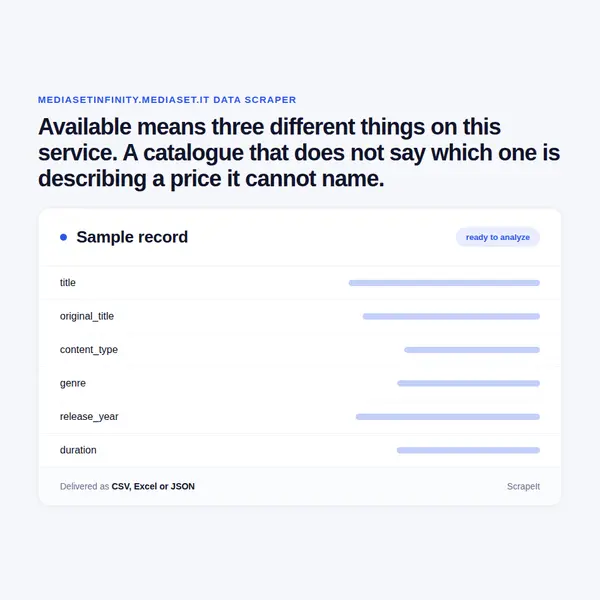
Available means three different things on this service. A catalogue that does not say which one is describing a price it cannot name.

Mediaset Infinity Scraper
Solutions

Managed Italian catalogue data, run end to end by us

ScrapeIt runs the collection as a managed service. You name the sections, genres or the full catalogue; we build the pipeline, put offer type on every row, separate catch-up from the permanent library, and hand back CSV, JSON, Excel or a push into your warehouse.

Where tier migration or turnover matters we run repeat collection and keep every observation, because a title that moved tiers leaves no record of having moved.

We collect published metadata only - never streams, never anything behind a sign in, no viewer data - honour the crawl rules the site publishes and pace requests. Content is copyrighted and terms restrict reuse, so the dataset is for analysis rather than republication. Your counsel should see the use case before the project starts.

Mediaset Infinity fields in every export

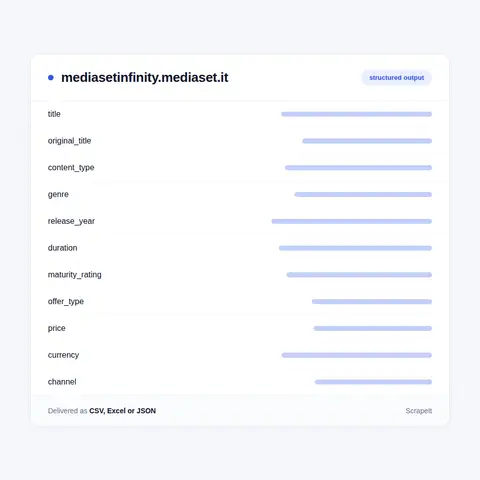
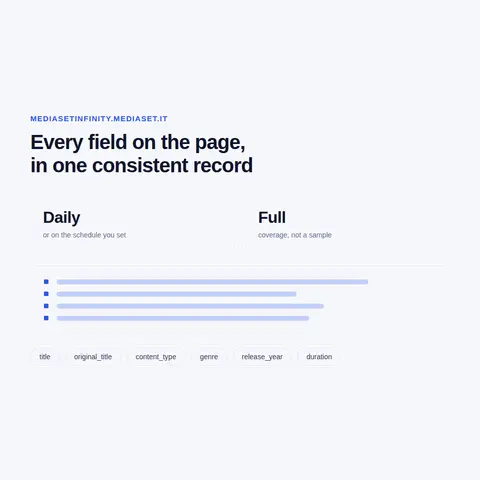
The title record covers the title, original title, content type, genre, release year, duration, maturity rating, synopsis, cast and crew where published, and series or episode identifiers.

Offer type sits on every row: free with advertising, included with subscription, or rental and purchase with the price where published. Where a title is offered on more than one basis, each is its own row rather than a merged flag, because that is what it actually is.

Availability windows are recorded for catch-up material, with the broadcast date and the expiry where published, so the temporary part of the catalogue can be separated from the permanent part rather than being averaged with it.

The originating channel is kept for broadcast material. A programme from a general entertainment channel and one from a news channel are different editorial products and the field costs nothing to carry.

Every row carries the collection timestamp and the section it came from.

Mediaset Infinity fields in every export
Tier migration, local content share and limits

Tier migration, local content share and limits

Tier migration tracking is the most interesting output and is pure change detection: which titles moved from paid to free or the reverse, and when. It needs repeat collection with every observation kept, and it is invisible to any single snapshot.

Local content share analysis answers how much of the catalogue is Italian production versus imported, by genre and by tier. Once original title and production data are collected as fields it is a straightforward query, and for anyone studying European content quotas or commissioning it is the useful one.

Catch-up turnover, kept separate from the library, shows what the broadcaster puts on demand after transmission and for how long - the same analysis a public broadcaster catalogue supports, from a commercial angle.

The limits are the ones that apply across this whole category. Metadata only, never content, nothing behind a sign in and no viewer data. Rental and purchase prices are collected where the site publishes them openly and not otherwise.

Free, paid and catch-up in one catalogue

Mediaset Infinity is the streaming service of Italy's largest commercial broadcaster. It combines three things that most services keep apart: a free ad-supported catalogue, a paid subscription tier, and catch-up for programmes broadcast on the Mediaset channels.

That mix is the reason offer type has to be a field. A title marked available might be free with advertising, included in a subscription, or offered for rent or purchase, and those are different products at different prices. A catalogue that flattens them into a single availability flag cannot answer the only commercial question anybody asks of it.

Catch-up adds a second wrinkle. A programme that aired on television appears on demand for a window, which makes part of this catalogue temporary in the way a broadcaster's is, while the film library behaves like a permanent one. Both live in the same place and need the same treatment as any mixed catalogue: typed, not merged.

Catalogue sections respond directly with substantial content, and crawl rules are published, disallowing little beyond parameterised URLs and mailing preference pages.

Get a Quote
dev_w
25

Developers

customers
500+

Customers worldwide

pages
1 500 000 000+

Pages extracted

stime
15000+

Hours saved for our clients

Plans

Airplane

€199 / one-time

setup fee - included

Data limits100,000
Frequencyone-time
Run timeup to 5 days
Data storing7 days

Helicopter

€169 / mo

setup fee €499

Data limits250,000
Frequencymonthly
Run timeup to 5 days
Data storing14 days

Glasses

€229 / mo

setup fee €499

Data limits1,000,000
Frequencyweekly
Run timeup to 5 days
Data storing30 days

DNA

€549 / mo

setup fee €799

Data limits3,000,000
Frequency3 times daily
Run timesame day
Data storing90 days

Why a mixed catalogue needs the offer type

The brief usually asks for the catalogue. Delivered as a flat title list it looks complete and cannot answer the question that follows, which is always some version of what does it cost.

Free ad-supported, subscription and transactional are three distinct businesses running through one interface. How large the free tier is relative to the paid one, which genres sit where, and whether titles migrate between them over time are questions about strategy, and they need the offer type as a first class field to be askable at all.

The second reason is the catch-up layer. Part of this catalogue exists because something was broadcast and will disappear when its window closes. Mixed with a permanent film library and counted together, it inflates the catalogue size and hides the turnover.

The third is that Italy is a distinct market with strong local production, and a service like this is one of the better windows onto it. Local titles, their genres and where they sit in the offer structure are visible here in a way they are not from a global service's Italian page.

The fourth is comparison over time. Titles move between free and paid, and those migrations are a strategy signal that only exists if somebody recorded the state before and after.

Our Blog

Reads Our Latest News & Blog

Learn how to use web scraping to solve data problems for your organization

How Artificial Intelligence Is Used In Web Scraping

How Artificial Intelligence Is Used In Web Scraping

Leveraging advances in technology, the AI-powered web scraper has skyrocketed in demand and is helping to expand capabilities by automating tedious daily tasks and speeding up data collection from thousands of websites several times over.

What is Web Scraping and What is it Used For?

What is Web Scraping and What is it Used For?

Web scraping is a method of obtaining web data by extracting it from pages of web resources with the help of a program, that is, in automatic mode. It is used to syntactically convert web pages into more usable forms.

Web Scraping for Machine Learning

Web Scraping for Machine Learning

If you specialize in machine learning, you need to feed large amounts of data to the algorithms. Web scraping is the easiest and the most efficient method of collecting the data from all over the Internet.

scrapeit logo

Who builds and keeps your Mediaset feed

ScrapeIt is a managed extraction company, not a tool you have to learn. Our team builds the pipeline, watches it as sections and offer labels change, and repairs it before a migration record develops a gap.

You see a sample first, in your format, over the genres you actually track, with offer types resolved and catch-up separated so you can judge the structure on real titles.

FAQ

Why is offer type a separate field?

Because available means three things here: free with advertising, included with a subscription, or rent and buy. Those are different products at different prices, and a single availability flag cannot answer the question that always follows a catalogue list, which is what it costs.

What if a title is offered two ways at once?

It gets a row for each, because that is what it actually is. Merging them into one row with a combined flag loses the price and makes tier analysis impossible.

Why separate catch-up from the library?

Because catch-up is temporary and the film library is not. Counted together they inflate the catalogue size and hide the turnover, which is usually the thing worth measuring.

Can you show how much of the catalogue is Italian?

Yes, by genre and by tier, once original title and production fields are collected. For anyone studying European content quotas or local commissioning that is the most directly useful output this source has.

Do you collect rental prices?

Where the site publishes them openly, yes, on the row with the offer type. We do not go behind a sign in to find a price, and a row without a published price says so rather than carrying a guess.

How does it Work?

Step 1 - Make a Request

You share your needs, expectations, and desired timeframe. We’ll suggest the best solution based on your request and budget.

Step 2 - Configuring Custom Web Crawlers

Our specialists configure the crawlers and extract a sample dataset for your review before proceeding with the full-scale extraction.

Step 3 - Collect and Deliver

Once you approve the sample, we launch the project and start full data collection. We gather, filter, and structure the data for easy use, delivering it on time in your preferred format.

Step 4 - Maintain and Support

Our team manages ongoing processes, monitors website changes, and supports all data extraction cycles. We can also help integrate data into your systems or create dashboards to simplify analysis.

Request a Quote

Tell us more about you and your project information.
Which sites, which fields, how often. A couple of lines is enough.

We reply within 1 business day. No obligation.

scrapiet

Scrapeit Sp. z o.o.
10/208 Legionowa str., 15-099, Bialystok, Poland
NIP: 5423457175
REGON: 523384582