Sun NXT Scraper for South Indian Language Catalogs

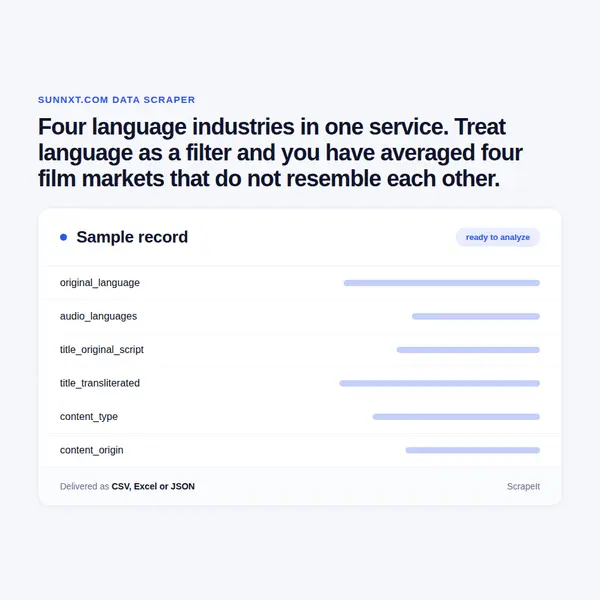
Four language industries in one service. Treat language as a filter and you have averaged four film markets that do not resemble each other.

Sun NXT Scraper
Solutions

Managed regional catalogue data, run end to end by us

ScrapeIt runs the collection as a managed service. You name the languages, genres or the full catalogue; we build the pipeline with language primary, keep original scripts alongside transliterations, separate film library from broadcast archive, and hand back CSV, JSON, Excel or a push into your warehouse.

Where dub timing or release windows matter we run repeat collection and keep every observation, because an addition date only exists if somebody was watching for it.

We collect published metadata only - never streams, never anything behind a sign in, no viewer data - honour the crawl rules the site publishes and pace requests. Content is copyrighted and terms restrict reuse, so the dataset is for analysis rather than republication. Your counsel should see the use case before the project starts.

Sun NXT fields in every export

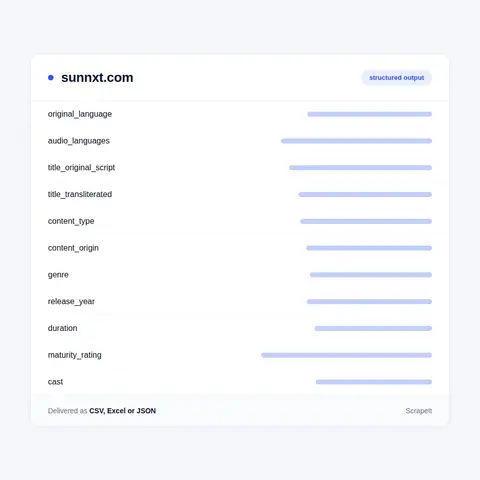
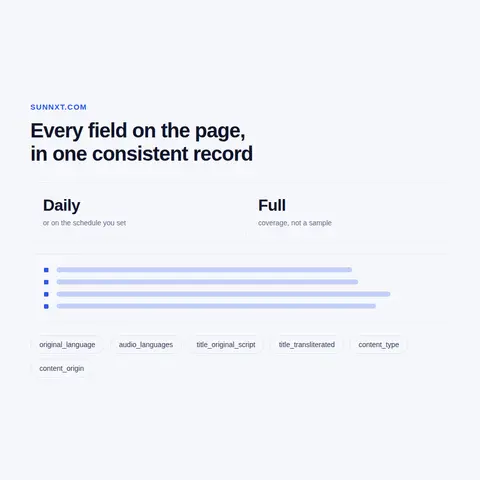
Language is a first class field on every row rather than a tag, and it carries the original language of the work separately from the audio tracks available, because a Telugu film with a Tamil dub is a different fact from a Tamil original.

Title records cover the title in its original script where published, a transliteration, content type, genre, release year, duration, maturity rating, synopsis, cast and crew where published, and series or episode identifiers.

The original script is preserved rather than replaced by its transliteration. Overwriting a Tamil title with a Latin rendering destroys the value that matches anything else and leaves nothing to join on later.

Content origin separates the film library from the network's broadcast material, since serials and shows follow a different production and availability logic from films.

Every row carries the collection timestamp and the section it came from.

Sun NXT fields in every export
Dub tracking, release timing and limits

Dub tracking, release timing and limits

Dub tracking is the output most specific to this source: which titles exist in which languages, how long after the original a dub appears, and which direction dubbing flows between industries. It needs original language and audio tracks as separate fields and repeat collection to catch the timing.

Release timing analysis - how long after theatrical release a film reaches streaming, by language and by studio - is answerable where release years and additions are tracked over time, and it is a window into windowing strategy that the industries themselves do not publish.

Catalogue composition by language and content origin answers the basic structural question and is the usual first deliverable, since it is cheap and it reframes most briefs before anyone spends on depth.

The limits are the ones this whole category shares. Metadata only, never content or streams, nothing behind a sign in, no viewer data. Original scripts are preserved rather than normalised away.

A service built around four film industries

Sun NXT is the streaming service of Sun TV Network, and its catalogue is organised around the South Indian language industries: Tamil, Telugu, Kannada, Malayalam and Bengali. Films, series and the network's television content sit alongside each other.

Language here is not metadata about a title. Each of these is a separate film industry with its own studios, stars, release calendars and audience, and a catalogue drawn across all of them without keeping language primary produces averages that describe none of them. Tamil cinema and Malayalam cinema are as distinct as two European national cinemas, and a genre breakdown that merges them is a genre breakdown of nothing in particular.

The catalogue also carries a large amount of the network's broadcast content - serials, shows and archive - which behaves differently from the film library and belongs in its own type.

Catalogue sections respond directly and crawl rules are published, allowing the site broadly and disallowing only the internal search endpoint.

Get a Quote
dev_w
25

Developers

customers
500+

Customers worldwide

pages
1 500 000 000+

Pages extracted

stime
15000+

Hours saved for our clients

Plans

Airplane

€199 / one-time

setup fee - included

Data limits100,000
Frequencyone-time
Run timeup to 5 days
Data storing7 days

Helicopter

€169 / mo

setup fee €499

Data limits250,000
Frequencymonthly
Run timeup to 5 days
Data storing14 days

Glasses

€229 / mo

setup fee €499

Data limits1,000,000
Frequencyweekly
Run timeup to 5 days
Data storing30 days

DNA

€549 / mo

setup fee €799

Data limits3,000,000
Frequency3 times daily
Run timesame day
Data storing90 days

Why regional catalogues are their own analysis

Most catalogue work on Indian streaming is built around Hindi and treats everything else as a long tail. On this service that framing fails immediately, because there is no Hindi centre - the catalogue is South Indian by design.

That makes it one of the better sources for a question that is otherwise hard to answer: what the South Indian language industries actually produce and how their catalogues compare. Release volume by language, genre mix, and how much of each industry's output reaches streaming are all answerable here and poorly served by the general services.

The second reason is dubbing, which is a commercial strategy rather than an afterthought. Which films get dubbed into which languages, and how quickly, tells you where a distributor thinks the audience is. That requires original language and available audio tracks as separate fields; with one language column it is unanswerable.

The third is the broadcast archive. A network service carries serials running to hundreds of episodes, and those will dominate any naive count of the catalogue. Typed separately they are interesting in their own right; merged, they drown the film library.

The fourth is scope. This is one network's service, strong in its languages and not a survey of Indian streaming, and we describe it that way.

Our Blog

Reads Our Latest News & Blog

Learn how to use web scraping to solve data problems for your organization

How Artificial Intelligence Is Used In Web Scraping

How Artificial Intelligence Is Used In Web Scraping

Leveraging advances in technology, the AI-powered web scraper has skyrocketed in demand and is helping to expand capabilities by automating tedious daily tasks and speeding up data collection from thousands of websites several times over.

What is Web Scraping and What is it Used For?

What is Web Scraping and What is it Used For?

Web scraping is a method of obtaining web data by extracting it from pages of web resources with the help of a program, that is, in automatic mode. It is used to syntactically convert web pages into more usable forms.

Web Scraping for Machine Learning

Web Scraping for Machine Learning

If you specialize in machine learning, you need to feed large amounts of data to the algorithms. Web scraping is the easiest and the most efficient method of collecting the data from all over the Internet.

scrapeit logo

Who builds and keeps your Sun NXT feed

ScrapeIt is a managed extraction company, not a tool you have to learn. Our team builds the pipeline, watches it as language sections and templates change, and repairs it before a dub timing record loses the weeks that mattered.

You see a sample first, in your format, over the languages you actually track, with original scripts preserved and library separated from archive so you can judge the structure on real titles.

FAQ

Why is language the primary field?

Because these are separate film industries with their own studios, stars and audiences, not variants of one catalogue. A genre breakdown that merges Tamil and Malayalam cinema is a breakdown of nothing in particular - they are about as alike as two European national cinemas.

How do you handle dubbed versions?

Original language and available audio tracks are separate fields, so a Telugu film with a Tamil dub reads as exactly that. With one language column the question of which films get dubbed where, and how fast, cannot be asked at all.

Do you keep titles in their original script?

Yes, alongside a transliteration. Replacing a Tamil title with its Latin rendering destroys the value that matches anything else and leaves nothing to join on when you later need to reconcile against another source.

Will the serials swamp the film data?

Not if they are typed separately, which is why we do it. A network service carries serials running to hundreds of episodes and they dominate any naive catalogue count. Separated, both the archive and the film library are usable.

Is this representative of Indian streaming?

No, and that is its value. It is one network's service, strong in the South Indian languages, which makes it a good source for industries the general services cover thinly - and a poor one for a national picture.

How does it Work?

Step 1 - Make a Request

You share your needs, expectations, and desired timeframe. We’ll suggest the best solution based on your request and budget.

Step 2 - Configuring Custom Web Crawlers

Our specialists configure the crawlers and extract a sample dataset for your review before proceeding with the full-scale extraction.

Step 3 - Collect and Deliver

Once you approve the sample, we launch the project and start full data collection. We gather, filter, and structure the data for easy use, delivering it on time in your preferred format.

Step 4 - Maintain and Support

Our team manages ongoing processes, monitors website changes, and supports all data extraction cycles. We can also help integrate data into your systems or create dashboards to simplify analysis.

Request a Quote

Tell us more about you and your project information.
Which sites, which fields, how often. A couple of lines is enough.

We reply within 1 business day. No obligation.

scrapiet

Scrapeit Sp. z o.o.
10/208 Legionowa str., 15-099, Bialystok, Poland
NIP: 5423457175
REGON: 523384582