HBO Max Scraper for Catalogue, Country and Licence Data

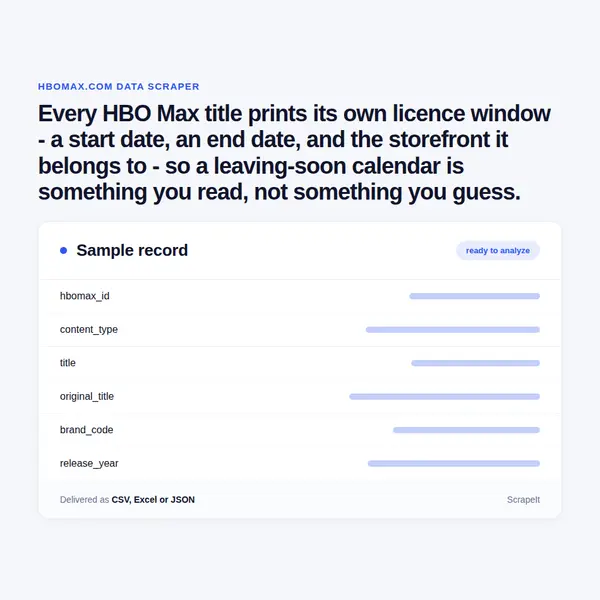
Every HBO Max title prints its own licence window - a start date, an end date, and the storefront it belongs to - so a leaving-soon calendar is something you read, not something you guess.

HBO Max Scraper
Solutions

How ScrapeIt runs an HBO Max scraping project

You set the scope: which storefronts, which brand or genre hubs, which title ids, and whether you want a single snapshot or a standing run that becomes a change log of arrivals and expiries. We build the HBO Max scraper, run it on your schedule and deliver CSV, JSON, XLSX or an API endpoint. Field names, the country list and the matching rules are agreed before the first run.

The engineering is ours: anti-bot handling, proxy rotation and CAPTCHA solving are part of the managed service. We work only on pages a signed-out visitor can reach and we never sign in. We do not touch the video stream, we go nowhere near content protection, and we collect no account, profile or viewing records. The HBO Max terms of use prohibit data mining, robots, scraping and extraction tools, and separately prohibit extraction for training a machine learning model - we say so plainly, and anything contested should go past your own counsel first.

HBO Max title metadata: what a show or movie page publishes

Show and movie pages are open to a signed-out visitor: no account, no player, nothing hidden but the video. The title id is a UUID in the /show/ or /movie/ address, and the same UUID works in every storefront that licenses the title. These are the fields we extract HBO Max titles into.

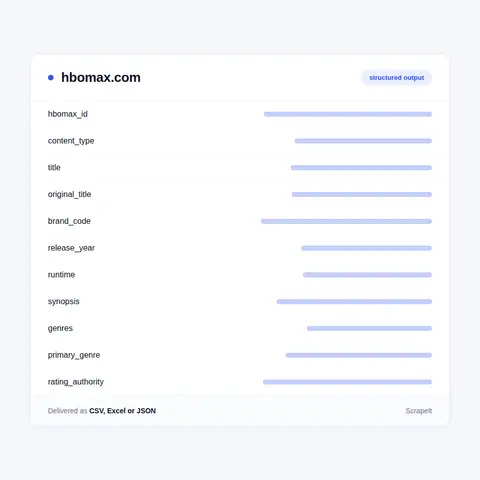
  • Identity - hbomaxId, with seriesId on a show and featureId on a film, and a category resolving to Series or Feature.
  • Core record - title in short and full form with original-language variants beside them, short and full synopsis, release year, and on films a release date and a runtime like 1h 32m.
  • Brand code - a network tag on every title: HBOTV for HBO, HBOM for an HBO Max Original, then WB, DC, TCM, TLC, DSC, ID, FOOD, HGTV, CTN, ASWM, CNN. The Warner and Discovery libraries share one app but stay separable title by title.
  • Genres - a genre list with a primary and a secondary genre, drawn from 183 hub names running from Westerns and Adult Animation to Flipping Houses and Novelas.
  • Credits - starring, directors, writers, producers, creators, sources and sign interpreters, plus a cast and crew block typed by role.
  • Classification - the local board mark with the authority that issued it, so one series reads TV-MA in the US and 16 under a European board, with descriptor letters D, L, S and V.
  • Playback flags - audio description, UHD, Dolby Atmos, Dolby Vision and a photosensitive-epilepsy advisory, each set per market.
  • Licence window - a start date and an end date on the title, and again on every episode.
  • Seasons and episodes - season id, number and episode count; per episode the number, name, synopsis, still image, its own licence window and a free-to-watch flag. Episodes load a season at a time.
  • Artwork and trailer - named crops rather than one poster - default-wide, centered-background, cover-artwork-square, poster-with-logo - plus a trailer with a programme id.

Three honest gaps: no person ids behind cast names, no audio or subtitle track lists, and no viewing figures at all, so there is no engagement table to join against. What the page does carry, and most catalogues do not, is the date the licence ends.

HBO Max title metadata: what a show or movie page publishes
Licence windows, brand hubs and what leaves HBO Max next

Licence windows, brand hubs and what leaves HBO Max next

The strongest thing this platform publishes is the licence window itself. Every title carries a start date and an end date; owned and original programming sits on a sentinel date a century out, while a licensed film carries its real expiry. Across one genre hub of 96 films and series, dated expiries outnumbered evergreen ones roughly four to one, and about a quarter of those dates fell inside the current year. A leaving-soon calendar here is read off the page, not inferred by comparing snapshots.

Coverage per storefront is just as open. Each market publishes a flat catalogue index at /sitemap/shows and /sitemap/movies - id, name and address, nothing else - which makes the country deltas countable rather than anecdotal. The US index runs to roughly 1,961 series and 2,315 films as of September 2026, against roughly 710 series in the United Kingdom and 705 in Germany, with Latin America holding the largest film library outside the States. Barely half the German film index also appears in the American one.

The rest of the structure is walkable: brand hubs at /channel for HBO, Max Originals, DC, TCM, Cartoon Network, Adult Swim, Discovery, TLC, HGTV, Food Network, Investigation Discovery, Magnolia Network and CNN Max; 183 genre hubs; a whats-new shelf; and sports hubs for whichever leagues a market carries. Trailers and extras are the only free shelf on the web, and plan tiers, stream limits and prices are quoted to signed-out visitors in each storefront's own currency.

HBO Max country storefronts and how the address picks one

HBO Max is addressed, not geolocated. Every storefront sits behind a country and language prefix - /gb/en, /de/de, /br/pt, /pl/pl - and that prefix decides which library answers. A browser gets nudged toward its local storefront by a script that also names the search crawlers it should leave alone, but the prefix itself is what the server honours. Ask for the Brazilian path and the Brazilian catalogue comes back, wherever the request began. That one behaviour is why an HBO Max scraper is built as a matrix of addresses rather than as a fleet of exit points.

There are 182 country and language storefronts covering 124 countries and 35 languages, sorted internally into four regions the platform calls amer, apac, emea and latam. Switzerland runs four languages, Belgium and Luxembourg three, Malaysia and Singapore three. Language is presentation only: the Spanish US storefront lists exactly the same titles as the English one. Country is where licensing lives. A market with no service - Japan among them - has no path to ask for at all.

The name has moved further than the data has. HBO Max became Max, then went back to HBO Max, and max.com now sends every request to hbomax.com, while the Max era is still wired into the markup as the internal tenant name. Ownership is moving too: the parent group has been separating its studio and streaming arm from its global networks arm, and its shareholders have approved a change of control. Brand strings are the least stable thing on this platform, which is precisely why an HBO Max scraper keys on the title id and treats the name as one more field that can change under it.

Get a Quote
dev_w
25

Developers

customers
500+

Customers worldwide

pages
1 500 000 000+

Pages extracted

stime
15000+

Hours saved for our clients

Plans

Airplane

€199 / one-time

setup fee - included

Data limits100,000
Frequencyone-time
Run timeup to 5 days
Data storing7 days

Helicopter

€169 / mo

setup fee €499

Data limits250,000
Frequencymonthly
Run timeup to 5 days
Data storing14 days

Glasses

€229 / mo

setup fee €499

Data limits1,000,000
Frequencyweekly
Run timeup to 5 days
Data storing30 days

DNA

€549 / mo

setup fee €799

Data limits3,000,000
Frequency3 times daily
Run timesame day
Data storing90 days

What rights and research teams do with HBO Max data

Nobody pays for a list of what is on HBO Max. They pay for the same title observed across markets and across time, because a title id on its own answers nothing.

  • Rights and distribution teams - confirming that a licensed film actually surfaced in the territories a contract names, and reading the end date the platform prints against the window the deal really granted.
  • Competing streamers and broadcasters - watching a licence run down so the acquisition conversation starts before a title moves rather than after it has gone.
  • Availability guides and TV listings - where the product is title by country by service, and a wrong flag becomes a support ticket the same day.
  • Media analysts and investors - counting HBO originals against Warner and Discovery stock market by market, and measuring how fast a national library turns over.
  • Advertisers and agencies - reading which markets carry an ad-supported tier and what the HBO Max plan prices are in local currency, next to the catalogue those plans actually buy.
  • Regulators and academics - European content quotas are measured in this exact shape, as a share of a national catalogue by country of origin.

The deliverable is one row per title, per storefront, per run, stamped with the country prefix and the run date. Stack the runs and you have HBO Max catalogue churn: what arrived, what left, and how long the window really lasted against how long it was advertised.

Our Blog

Reads Our Latest News & Blog

Learn how to use web scraping to solve data problems for your organization

How Artificial Intelligence Is Used In Web Scraping

How Artificial Intelligence Is Used In Web Scraping

Leveraging advances in technology, the AI-powered web scraper has skyrocketed in demand and is helping to expand capabilities by automating tedious daily tasks and speeding up data collection from thousands of websites several times over.

What is Web Scraping and What is it Used For?

What is Web Scraping and What is it Used For?

Web scraping is a method of obtaining web data by extracting it from pages of web resources with the help of a program, that is, in automatic mode. It is used to syntactically convert web pages into more usable forms.

Web Scraping for Machine Learning

Web Scraping for Machine Learning

If you specialize in machine learning, you need to feed large amounts of data to the algorithms. Web scraping is the easiest and the most efficient method of collecting the data from all over the Internet.

scrapeit logo

ScrapeIt as your HBO Max data supplier

ScrapeIt is a managed web scraping agency. You describe the dataset; we build and operate the HBO Max scraper and hand back files or an endpoint. There is no tool for you to run and no proxy bill for you to manage. Most HBO Max scraping projects open with a paid sample - a few hundred title ids across three or four storefronts - so you can test the fields and the country matrix against your own rights records before committing to a schedule. Delivery goes to S3, GCS, an SFTP drop, a webhook or a database you nominate.

FAQ

Does HBO Max have a public API for catalogue data?

No. There is no developer portal, no published catalogue endpoint and no data programme open to buyers; the help centre serves subscribers and the partner pages cover distribution deals, not datasets. Everything usable comes from public show and movie pages, the per-storefront catalogue index and the brand and genre hubs. What we deliver is an HBO Max API of our own: an endpoint over the extracted dataset, with your field names, your country list and your refresh schedule behind it.

Is the HBO Max title id the same in every country?

Yes. Each film and series has a UUID that appears both in the address and in the page record, and the same UUID resolves in every storefront where the title is licensed. Where it is not licensed, that address returns a not-found page instead of a title record, so walking one id through the country prefixes is a direct availability test. Seasons and episodes carry their own ids underneath the series id, which is how episode-level rows join back to the parent title.

Which countries can you cover, and how do you show a title has gone?

Any market the service reaches: 124 countries across 182 country and language storefronts, grouped into the platform's own amer, apac, emea and latam regions. You give us the list; we run the same title set against each prefix and record what resolves. Departures do not have to be guessed here, because the licence end date is printed on the title and on each episode, so an expiry calendar falls out of a single run. We still diff successive runs, since a window can be extended or cut short without notice.

How often can HBO Max data be refreshed, and in what formats?

Daily, weekly or monthly, whichever matches how you use it. Weekly suits catalogue and availability tracking; daily makes sense around a premiere, a regional launch or the end of a large licence. Output is CSV, JSON, XLSX or a REST endpoint, delivered to S3, GCS, SFTP, a webhook or straight into a database. Every row carries the storefront prefix and the run date, so successive runs stack into a history of HBO Max catalogue churn instead of overwriting one another.

Is it legal to scrape HBO Max, and what will you not do?

Be clear-eyed about it. The HBO Max terms of use prohibit data mining, robots, scraping and extraction tools, prohibit building any database out of platform content, and separately prohibit extraction for training an artificial intelligence or machine learning model. Terms differ by market and each storefront has its own document. We work only on pages a signed-out visitor can reach, we never log in, we do not touch the video stream or content protection, and we collect no personal data about subscribers. We are a contractor, not your legal adviser: take the terms and your intended use to your own counsel first.

How does it Work?

Step 1 - Make a Request

You share your needs, expectations, and desired timeframe. We’ll suggest the best solution based on your request and budget.

Step 2 - Configuring Custom Web Crawlers

Our specialists configure the crawlers and extract a sample dataset for your review before proceeding with the full-scale extraction.

Step 3 - Collect and Deliver

Once you approve the sample, we launch the project and start full data collection. We gather, filter, and structure the data for easy use, delivering it on time in your preferred format.

Step 4 - Maintain and Support

Our team manages ongoing processes, monitors website changes, and supports all data extraction cycles. We can also help integrate data into your systems or create dashboards to simplify analysis.

Request a Quote

Tell us more about you and your project information.
Which sites, which fields, how often. A couple of lines is enough.

We reply within 1 business day. No obligation.

scrapiet

Scrapeit Sp. z o.o.
10/208 Legionowa str., 15-099, Bialystok, Poland
NIP: 5423457175
REGON: 523384582