Charter Flight Data from 12 Danish Tour Operators: a Pilot in 2 Weeks
A paid pilot for a regional airport in Scandinavia: direct charter departures from 12 Danish tour operator sites, sampled in two weeks.
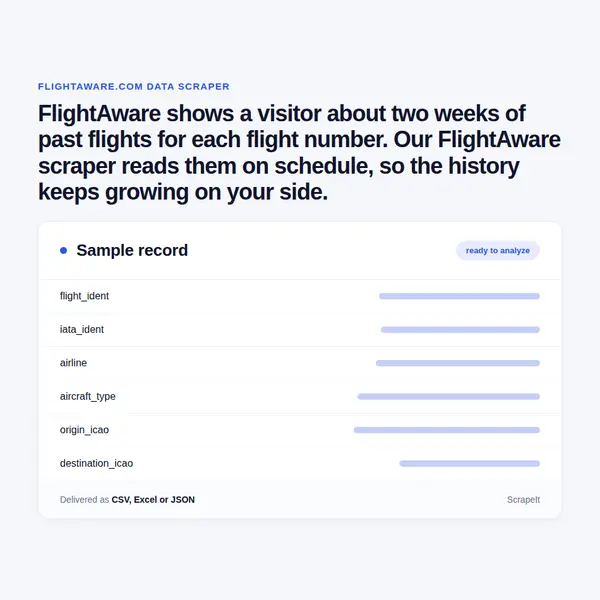
FlightAware shows a visitor about two weeks of past flights for each flight number. Our FlightAware scraper reads them on schedule, so the history keeps growing on your side.
Plans from €169 a month · Free project assessment · Reply within 1 business day
CSV · Excel · JSON · XML · FTP · SFTP · Amazon S3 · Google Cloud
API, JSON feed or CSV, XLSX and JSON files
ScheduleOne-time, monthly, weekly, daily or 3 times a day
FlightAware pages, filters, fields and a schedule
Built, monitored and repaired by our team
API, JSON feed or CSV, XLSX and JSON files
You tell us what to follow - flight numbers, airports, airlines, aircraft types or tail numbers - and how often; we build the crawlers, keep them running and fix them when FlightAware changes a page. A flight page keeps changing while the aircraft is airborne, so we agree with you when a reading counts: once after arrival for history, or at set intervals for status and delay monitoring. Anti-bot handling, proxy rotation and rendering are included.
Times are delivered in UTC with the local time zone kept beside them, airports carry both ICAO and IATA codes, and each flight keeps the permanent address FlightAware gives it. Delivery is one-off or scheduled, after a free assessment and a sample.
Every flight on FlightAware has a permanent address built from the ident, the date, the scheduled departure time and the two airports, for example /live/flight/UAL1/history/20261111/0650Z/KSFO/WSSS, and that address becomes the key of each row.
Every field in this list sits on the flight page, its track log or the airport page, as a visitor sees them without an account.
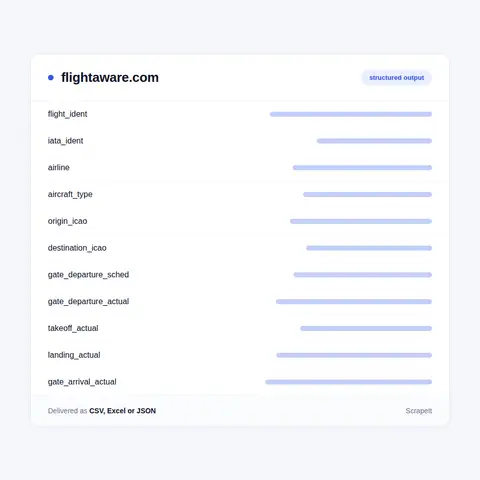
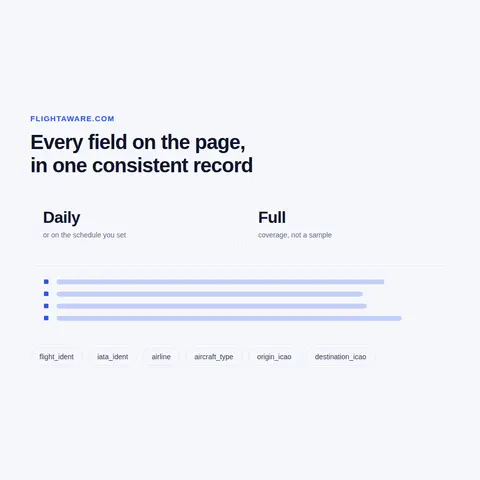
A visitor without an account sees about two weeks of past flights in each flight number's activity log, every line with date, aircraft type, origin, destination, departure, arrival and duration or status; a free Basic account, registered through FlightAware's own sign-up form, extends that to three months. Anything older is not on the public pages, so a long record is built on your side: each run appends the flights that have landed since the last one, and the archive grows with every day of collection.
FlightAware is a flight tracking site founded in 2005 and part of Collins Aerospace since 2021. It sells no tickets and shows no fares. What it publishes is the movement of aircraft - airline, cargo, business and private flights - with schedules, delays and positions, for airports and operators around the world, in English and in a long list of language versions on their own subdomains, such as de.flightaware.com and ja.flightaware.com.
Where does FlightAware get its data? Its data sources page names radar and flight plan data from air navigation service providers in 45 countries, ACARS datalink messages, a terrestrial ADS-B network of receivers hosted by its users, space-based ADS-B from Aireon, and out, off, on and in times from airline systems. That mix explains why one flight can show an airline schedule next to an actual wheels-off time, and why the reporting facility changes along a track log.
The site is organised around identifiers: flight idents, airport ICAO codes, operator prefixes such as UAL on fleet pages, aircraft type codes and registrations. Each identifier has its own page and the pages link to one another, so coverage can start from any of them and fan out.
Delivery: CSV, JSON or XLSX files, our API or a JSON feed. MCP server on request.
Full plan detailsFlightAware data is operational rather than commercial: it records what flew, when and on which aircraft type, and it serves a different set of buyers than fare data does.
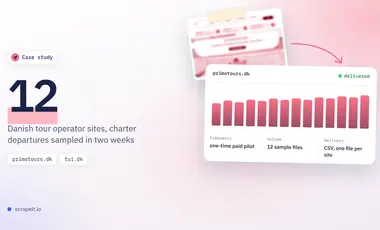
A paid pilot for a regional airport in Scandinavia: direct charter departures from 12 Danish tour operator sites, sampled in two weeks.
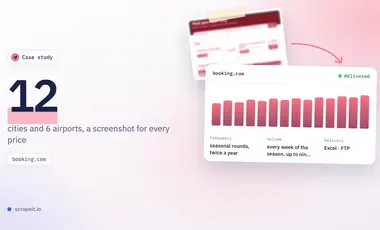
For several years, weekly car rental and, more recently, hotel prices from Booking.com for a tourism organization comparing its destination with rivals.
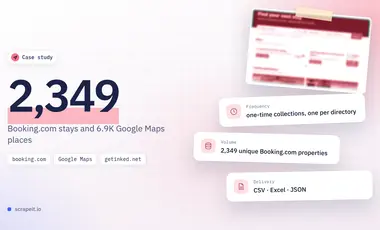
Four datasets for a studio that builds directory websites: Hawaii stays from Booking.com, UK schools and tattoo studios from Google Maps, GetInked profiles.
Learn how to use web scraping to solve data problems for your organization

If you work in travel tech, an OTA, a hotel chain, or at an airport, you are in a price-and-availability arms race. Fares change by the hour, room inventory disappears in minutes, and competitors test new bundles and ancillaries constantly.

Data scraping is the wide term that includes documents, scans and old screens; web scraping is the part that works on websites. We compare sources, daily work, output and cost drivers, give a briefing checklist and walk through two of our projects.

Leveraging advances in technology, the AI-powered web scraper has skyrocketed in demand and is helping to expand capabilities by automating tedious daily tasks and speeding up data collection from thousands of websites several times over.

ScrapeIt builds and runs web data collection for clients, from one-off extracts to datasets refreshed every day. Flight tracking pages suit that model: the information is public, changes constantly and is only valuable when it is captured at the right moment and kept. We agree the identifiers and timing with you, send a sample, and deliver with field documentation; personal data is handled under GDPR, and private aircraft owners stay out of scope.
Still unsure? Write to info@scrapeit.io
Yes. The ScrapeIt FlightAware API returns ident, aircraft type, origin and destination, scheduled and actual times, status and delay notes as JSON from an endpoint we host, refreshed on the schedule you set. The same records also arrive as CSV or Excel files, on SFTP or Amazon S3, or as a load into your database.
Yes. Flight pages, track logs, airport boards and delay statistics are open to anyone who visits flightaware.com. We collect only publicly available data - everything a visitor can see on FlightAware - and we collect it legally. Owners of private aircraft are individuals, so their names stay out of the dataset.
Without an account, the activity log of a flight number shows roughly the last two weeks; a free Basic account shows three months. We cover what those pages show and extend it forward: a daily run appends each completed flight, so your archive grows from the first run on and no day ages out unseen.
It depends on the use. Delay and on-time work needs one reading per flight after arrival, best taken daily so nothing drops out of the activity log. Status monitoring and airport boards need repeated readings while flights are moving, and we schedule those for the hours and airports you name.
Yes. Give us the airports by ICAO or IATA code and we deliver their arrival and departure boards, delay banners and cancellation counts as CSV, XLSX or JSONLines, one row per flight and reading. Files can go to SFTP, Amazon S3, Google Drive or e-mail on each run.
You share your needs, expectations, and desired timeframe. We'll suggest the best solution based on your request and budget.
Our specialists configure the crawlers and extract a sample dataset for your review before proceeding with the full-scale extraction.
Once you approve the sample, we launch the project and start full data collection. We gather, filter, and structure the data for easy use, delivering it on time in your preferred format.
Our team manages ongoing processes, monitors website changes, and supports all data extraction cycles. We can also help integrate data into your systems or create dashboards to simplify analysis.
Tell us which sites, which fields and how often. A couple of lines is enough to start.
FlightAware data from €169/month. Free project assessment, reply within 1 business day.