Charter Flight Data from 12 Danish Tour Operators: a Pilot in 2 Weeks
A paid pilot for a regional airport in Scandinavia: direct charter departures from 12 Danish tour operator sites, sampled in two weeks.
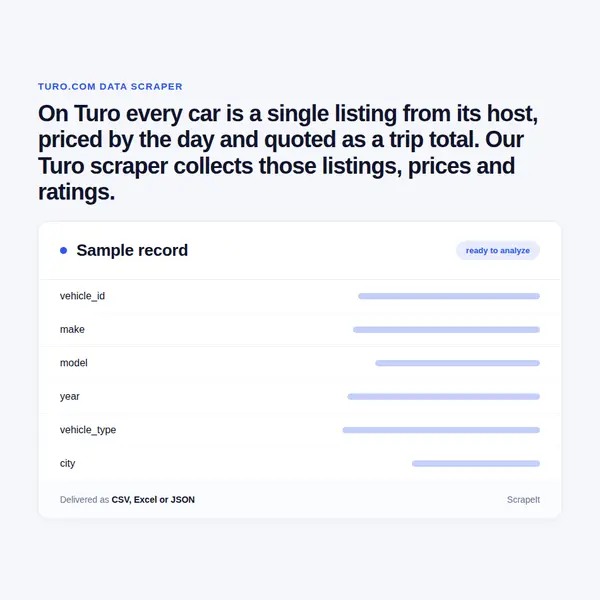
On Turo every car is a single listing from its host, priced by the day and quoted as a trip total. Our Turo scraper collects those listings, prices and ratings.
Plans from €169 a month · Free project assessment · Reply within 1 business day
CSV · Excel · JSON · XML · FTP · SFTP · Amazon S3 · Google Cloud
API, JSON feed or CSV, XLSX and JSON files
ScheduleOne-time, monthly, weekly, daily or 3 times a day
Turo pages, filters, fields and a schedule
Built, monitored and repaired by our team
API, JSON feed or CSV, XLSX and JSON files
You choose the scope - cities, airports, makes or vehicle types, the trip windows to price and how often - and we run the Turo data scraper, maintain it and deliver the files. A Turo price only exists for a trip, so each project begins by fixing the pickup and return dates and times that every search will use; nothing is booked and no licence or personal details are entered. Turo answers unfamiliar traffic on vehicle pages with a challenge page, so anti-bot handling, CAPTCHA handling, proxy rotation and rendering are part of the service.
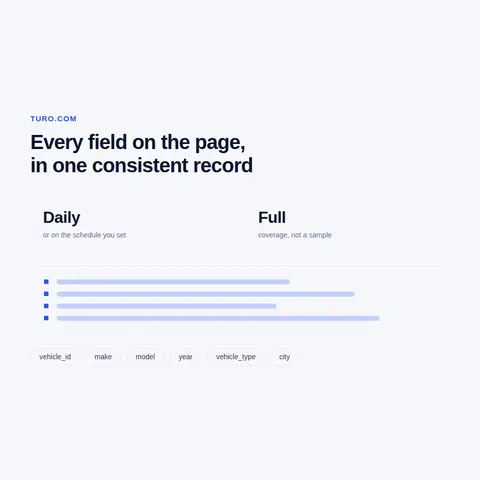
Rows are keyed on the vehicle id from the listing address, which keeps a car stable across runs. Delivery is CSV, Excel or JSON, our API, Google Cloud Storage or a database load, one-off or daily, weekly or on demand.
Turo listings appear in two places: as cards on city, airport, make and vehicle-type pages, and as vehicle pages at an address that ends in the make, the model and a numeric vehicle id, for example /los-angeles-ca/bmw/3-series/ followed by the id. Cards carry the summary; the vehicle page carries the terms.
Hosts are often private persons, so host first names, photos and profile links stay out of the data by default; a host that trades as a rental business can be named. GDPR governs how any personal data is handled.
One search shows the cars available for one trip window. The rest of the picture comes from repeating searches and covering every page type.
Put next to All-Star Host badges and trip counts, this shows which models carry a local market and how much of that supply sits with All-Star Hosts.
Turo is a car rental marketplace where local hosts - private owners and small rental businesses - list their own vehicles, and guests book the exact car rather than a category with "or similar". Its own comparison with traditional rental stresses the same points: the car you choose, delivery options and thousands of pickup locations, and vehicles and hosts rated by guests.
The site runs country versions on one domain: /us/en for the United States, /ca/en and /ca/fr for Canada, /gb/en for the United Kingdom, /au/en for Australia and /fr/fr for France, where Turo carries on what used to be OuiCar. Prices follow the country - dollars in Los Angeles, pounds in London, euros in Paris.
Inside each country, pages are organised by city, airport, make and vehicle type, and the home page has tabs for All, Airports, Monthly, Nearby, Delivered and Cities. Vehicle types run from car, SUV, truck, van and minivan to exotic and luxury, sports, convertible, classic and electric, and the US footer also lists cargo van and box truck rental. Guests rate vehicles and hosts, and the All-Star Host programme marks hosts with high five-star, cleanliness and maintenance ratings and a low cancellation rate, with Power Host as the next step up.
Delivery: CSV, JSON or XLSX files, our API or a JSON feed. MCP server on request.
Full plan detailsTuro prices fluctuate because each car is priced for a specific trip, and the same car quotes a different daily rate for a weekend, a week or a month. That makes the data useful well beyond Turo itself.
Why do Turo prices keep changing for the same car? The quote depends on the trip window, its length discount and whether a non-refundable discount is chosen, so a tracker has to hold the trip window constant.
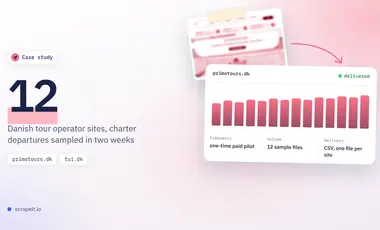
A paid pilot for a regional airport in Scandinavia: direct charter departures from 12 Danish tour operator sites, sampled in two weeks.
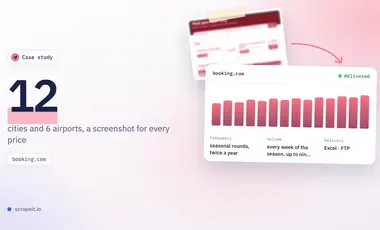
For several years, weekly car rental and, more recently, hotel prices from Booking.com for a tourism organization comparing its destination with rivals.
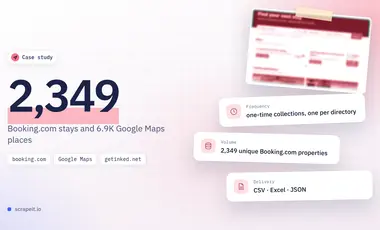
Four datasets for a studio that builds directory websites: Hawaii stays from Booking.com, UK schools and tattoo studios from Google Maps, GetInked profiles.
Learn how to use web scraping to solve data problems for your organization
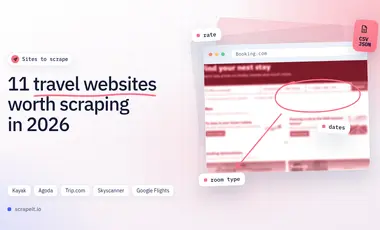
If you work in travel tech, an OTA, a hotel chain, or at an airport, you are in a price-and-availability arms race. Fares change by the hour, room inventory disappears in minutes, and competitors test new bundles and ancillaries constantly.

Data scraping is the wide term that includes documents, scans and old screens; web scraping is the part that works on websites. We compare sources, daily work, output and cost drivers, give a briefing checklist and walk through two of our projects.

Leveraging advances in technology, the AI-powered web scraper has skyrocketed in demand and is helping to expand capabilities by automating tedious daily tasks and speeding up data collection from thousands of websites several times over.

ScrapeIt runs web scraping as a managed service. We design the searches, run the crawlers, repair them when a site changes and deliver the data with field documentation. Marketplaces like Turo, where each listing is one host's vehicle and every price belongs to a trip window, need that planning: fixed windows, stable vehicle ids, personal data left out. Plans start from EUR 169 a month, or EUR 199 for a one-time extract.
Still unsure? Write to info@scrapeit.io
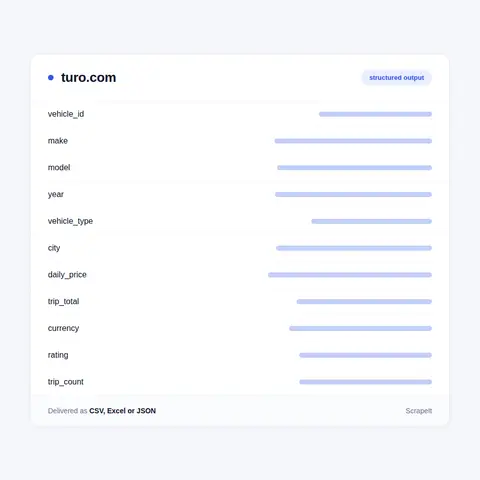
Yes. The ScrapeIt Turo API returns vehicle id, make, model, year, daily price, trip total, rating and trip count as JSON from our hosted endpoint, refreshed on the schedule you set. The same data can also arrive as CSV or XLSX files, a JSON feed or a load into your database.
Yes. City, airport, make and vehicle-type pages show cars, prices, ratings and trip counts to any visitor, and a listing shows its price, distance allowance and cancellation policy before any booking. We collect only publicly available data - everything a visitor can see on Turo - and we collect it legally. Host and guest names are personal data and are left out by default.
We fix the search in advance - city or airport, pickup and return dates and times - and repeat it on schedule, so every price row carries the trip window it was quoted for. City pages quote average daily prices for a 3-day trip; a weekend, a week or a month is searched as a separate window.
Often enough to need repeated runs: prices are quoted per trip window, discounted rates apply to bookings of 3+, 7+ or 30+ days, and a non-refundable trip discount can lower the total. Daily runs on fixed windows suit pricing work; weekly runs are enough to follow fleet size and new listings in a city.
Turo runs country versions for the United States, Canada in English and French, the United Kingdom, Australia and France. Within each we scope by city, airport, make or vehicle type - SUV, truck, van, minivan, exotic and luxury, convertible, classic or electric.
You share your needs, expectations, and desired timeframe. We'll suggest the best solution based on your request and budget.
Our specialists configure the crawlers and extract a sample dataset for your review before proceeding with the full-scale extraction.
Once you approve the sample, we launch the project and start full data collection. We gather, filter, and structure the data for easy use, delivering it on time in your preferred format.
Our team manages ongoing processes, monitors website changes, and supports all data extraction cycles. We can also help integrate data into your systems or create dashboards to simplify analysis.
Tell us which sites, which fields and how often. A couple of lines is enough to start.
Turo data from €169/month. Free project assessment, reply within 1 business day.