DataCamp Scraper for Courses, Tracks, Certifications and Prices

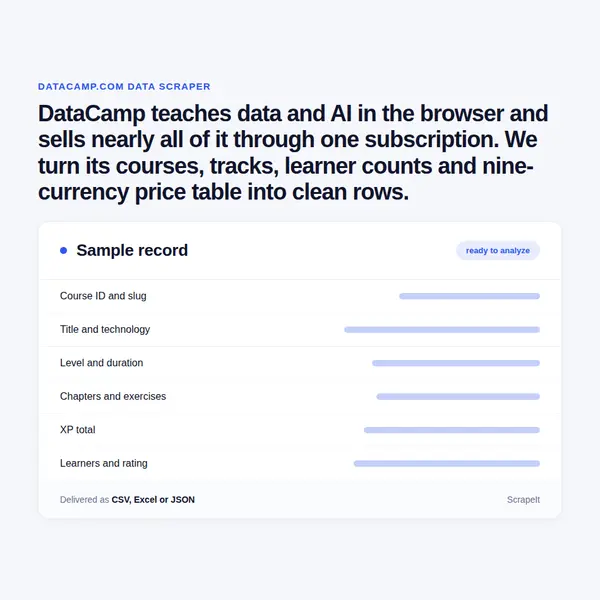
DataCamp teaches data and AI in the browser and sells nearly all of it through one subscription. We turn its courses, tracks, learner counts and nine-currency price table into clean rows.

Plans from €169/month · Free project assessment · Reply within 1 business day

DataCamp Scraper
Solutions

How DataCamp Scraping Works as a Managed Service

ScrapeIt runs DataCamp scraping as a managed service. datacamp.com sits behind Cloudflare bot protection, so anti-bot handling, proxy rotation and CAPTCHA solving are part of the job, along with fixes when page templates change. To scrape DataCamp completely we merge the catalog listing with the sitemaps, deduplicate on the course id, then read every course, track, project and certification page and the plan table in all nine currencies. We extract DataCamp data from public pages only: no logins, no learner accounts, no DataLab workbooks. A sample comes first; after sign-off, runs follow your schedule and arrive as CSV, JSON or XLSX, in S3, SFTP or your warehouse, or through the DataCamp API we host.

DataCamp Course List Fields: Chapters, XP, Learners and Ratings

Course pages carry DataCamp's own course markup, so every record keeps the platform's ids and labels instead of our guesses.

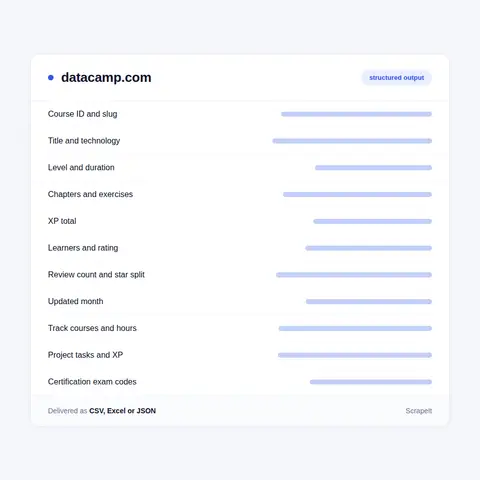
  • Course record. Slug and numeric course id, title, short and long description, technology, topic, level, duration in minutes with the band the catalog filters on, the Updated month, the launch date and the locales the course is published in.
  • Chapters and exercises. Chapter titles and summaries in order, every exercise with its XP, and the totals printed under the title, currently 4 hr, 11 videos, 46 exercises and 3,900 XP for Introduction to Python.
  • Demand signals. Learner count (7.0M+ on the same course), average rating, review count and the five-bar star split, plus the starts and completions counters of the catalog listing. Ratings are tightly bunched, with all but one listed course at 4.5 or higher, so learners and review counts carry most of the signal.
  • Credits and links. The instructor credit as printed with its one-line title, the Offered by line on partner courses, prerequisites, What you'll learn outcomes, the tracks a course belongs to with their certification flag, datasets listed under Course Resources, CPE credits (2.6 for Introduction to Python) and the free, mobile and AI Tutor flags.
  • Career tracks and skill tracks. Title, technology, hours as printed (39hrs, 28 hrs or a bare 44, normalized to a number), ordered courses and bonus projects, rating, learners and the Collaboration or Partner content label.
  • DataCamp projects. Title, skill level, tasks, duration, XP, learners (230K+ on Investigating Netflix Movies), rating with review count and prerequisite courses.
  • Certifications. Family (career, technology or fundamentals), exam codes and time limits, the practical exam, attempts, the 30-day window, validity and partner exam discounts.

Reviewer names, learner profiles and anything behind the login stay out.

DataCamp Course List Fields: Chapters, XP, Learners and Ratings
Scrape DataCamp Data Beyond Courses: Tutorials, Locales, DataLab

Scrape DataCamp Data Beyond Courses: Tutorials, Locales, DataLab

The content library. DataCamp tutorials form a catalog of their own, about 2,090 pages in 52 categories, beside about 1,530 blog posts in 73 categories, 78 DataCamp cheat sheets, about 390 DataFramed podcast episodes and some 230 code-alongs. Pages carry a headline, summary, category and publish date; tutorials add an updated date, read time and table of contents; and the articles link to related courses, so the export shows which course each tutorial sends readers to.

Localized catalogs. The catalog index holds course titles in up to 23 locales, yet the local sites are smaller than the English one: in late September 2026 the Spanish folder listed 640 course pages, Portuguese 638 and German 632, against 751 in English, and 130 courses exist in English only. Local pages translate titles and descriptions but share the global learner count and rating.

DataCamp DataLab. The notebook product runs its own gallery of practice datasets in Python and R versions, each with a topic tag, a short brief and a source line, next to a set of analysis templates.

Change tracking. Each DataCamp content update shows as a new Updated month on the course page and a new publish date in its markup. Sitemap dates lag behind: the sitemap entry for Introduction to Python is more than a year older than the Updated month on its page, and new titles such as the Claude Cowork series reach the catalog listing before the sitemap.
The DataCamp Course Catalog: Courses, Tracks and Certifications

A DataCamp scraper reads datacamp.com, the New York platform that teaches data and AI skills in the browser: short videos, then coding exercises checked on the spot. DataCamp courses cover Python, R, SQL, Power BI, Tableau, Excel, the big cloud platforms and a fast-growing AI shelf, and the catalog page currently counts 796 of them. Around the courses sit 32 career tracks and 114 skill tracks, a projects library the site puts at 252, a certification program and DataLab, the platform's data notebook. The site puts DataCamp users at 20.8 million learners and credits 416 instructors.

Each unit has its own address. A course lives at /courses/{slug} and splits into numbered chapters of videos and exercises that earn XP; a track at /tracks/{slug} strings courses and bonus projects together, and several career tracks prepare for a certification. Projects sit at /projects/{id}, certifications at /certification/{slug}, and localized copies of courses, tracks, tutorials and the blog live in folders such as /es/, /pt/, /de/ and /ja/.

The catalog is filed three ways: by 43 technologies, from Python with 179 courses down to single titles in Kafka or Scala; by 18 topics such as Artificial Intelligence, Cloud and Probability & Statistics; and by level. Beginner courses print as Basic on the course page, so levels are mapped before anything is counted.

Get a Quote
dev_w
25

Developers

customers
500+

Customers worldwide

pages
1 500 000 000+

Pages extracted

stime
15000+

Hours saved for our clients

Plans

DataCamp Scraping Plans and Pricing

Airplane

€199 / one-time

setup fee - included

Data limits100,000
Frequencyone-time
Run timeup to 5 days
Data storing7 days

Helicopter

€169 / mo

setup fee €499

Data limits250,000
Frequencymonthly
Run timeup to 5 days
Data storing14 days

Glasses

€229 / mo

setup fee €499

Data limits1,000,000
Frequencyweekly
Run timeup to 5 days
Data storing30 days

DNA

€549 / mo

setup fee €799

Data limits3,000,000
Frequency3 times daily
Run timesame day
Data storing90 days

DataCamp Price Monitoring Across Plans, Currencies and Promos

There are no DataCamp course prices as such: paid courses come with the subscription, so DataCamp subscription prices are the whole price list. Basic is free and opens the first chapter of every course. In late September 2026 the DataCamp price per month was $35 on monthly billing and the DataCamp price per year $370, shown as $30.84 a month; one Teams seat cost the same $370, and an October offer took 99 percent off the first month of Premium. DataLab has plans of its own at $149 a year.

The plan table carries nine currencies, and each is the dollar price converted at one rate per currency: DataCamp UK prices put Premium at GBP 278.96 a year, and the DataCamp price in India is currently INR 35,513.72. Local prices can therefore shift with exchange rates while the dollar list price stays put, and a DataCamp price tracker has to tell the two apart. The DataCamp price for students is a separate Premium Student Plan: EUR 162 a year instead of 325, or EUR 21 a month instead of 30, for a visitor billed in euros.

Labels drift as well. The Teams seat reads EUR 28 on the pricing page and EUR 27.16 on the business plan page, and certification pages still print Premium at $25 per month. A DataCamp price history, and the date of any DataCamp price increase, come from dated snapshots of the plan table itself, with the promotion name, discount and end time kept beside the list price.

Our Blog

Reads Our Latest News & Blog

Learn how to use web scraping to solve data problems for your organization

How Artificial Intelligence Is Used In Web Scraping

How Artificial Intelligence Is Used In Web Scraping

Leveraging advances in technology, the AI-powered web scraper has skyrocketed in demand and is helping to expand capabilities by automating tedious daily tasks and speeding up data collection from thousands of websites several times over.

What is Web Scraping and What is it Used For?

What is Web Scraping and What is it Used For?

Web scraping is a method of obtaining web data by extracting it from pages of web resources with the help of a program, that is, in automatic mode. It is used to syntactically convert web pages into more usable forms.

Web Scraping for Machine Learning

Web Scraping for Machine Learning

If you specialize in machine learning, you need to feed large amounts of data to the algorithms. Web scraping is the easiest and the most efficient method of collecting the data from all over the Internet.

scrapeit logo

Ordering a DataCamp Dataset or a DataCamp API Feed

ScrapeIt is a managed web scraping agency: we build the collector, run it on our own infrastructure and hand over a finished DataCamp dataset instead of a tool. Typical buyers are DataCamp alternatives benchmarking catalogs and prices, L&D teams comparing providers and analysts sizing demand by technology. Scoping takes one call: which content types, technologies, currencies and locales, and how often. You check a sample before committing; pricing follows volume and refresh rate.

FAQ

Do you offer a DataCamp API?

Yes. The ScrapeIt DataCamp API returns courses, tracks, projects and certifications as JSON: titles, technologies, levels, durations, chapters, exercise and XP counts, learner counts, ratings with review counts, and plan prices per currency with promotion fields. You set the schedule, from a daily price check to a weekly catalog refresh, and the same data comes as CSV and XLSX exports or lands in S3, SFTP or your warehouse.

How much is a DataCamp subscription, and are DataCamp courses free?

Basic is free and opens the first chapter of every course, and 17 courses are free in full, mostly titles on Claude, Snowflake and Polars. Everything else needs Premium: $35 on monthly billing or $370 a year, the same as one Teams seat. The plan table quotes USD, GBP, CAD, AUD, EUR, BRL, MXN, INR and JPY, students get up to half off, and a first-month offer can cut the entry price to $1. We record every currency with its promotion fields and the date seen.

How many DataCamp courses are there, and how often do they change?

The catalog page counts 796 courses, its listing currently shows 776 public course records and the English sitemap 751 course URLs, so a full DataCamp courses list merges the sources on the course id. The shelf moves fast: 160 listed courses launched in 2026, 94 of them Google Cloud titles and most of those in English only, while Updated months flag revisions to older ones. A weekly run catches launches and revisions; a daily one tracks prices and promotions.

Which DataCamp certifications do you track, and what do they cost?

All of them: career certifications such as the DataCamp Data Analyst certification and the DataCamp Data Engineer certification, technology ones like SQL Associate, and fundamentals such as AI Fundamentals and EU AI Act Literacy. DataCamp certification prices are folded into Premium, and partner exams carry their own discounts: 50 percent off Microsoft PL-300 and AZ-900, $50 off SnowPro Core. Each record keeps exam codes such as DA101 and DE201, time limits, attempts, the 30-day window and validity.

Is it legal to scrape DataCamp?

We collect only publicly available data - everything a visitor can see on DataCamp - and we collect it legally. That covers course, track, project and certification pages, tutorials, the blog and the plan table in every currency. No logins, no paywalls: learner progress, individual XP and certificates, DataLab workbooks and paid course content stay out, reviewer names are dropped, and personal data is handled under GDPR.

How does it Work?

Step 1 - Make a Request

You share your needs, expectations, and desired timeframe. We’ll suggest the best solution based on your request and budget.

Step 2 - Configuring Custom Web Crawlers

Our specialists configure the crawlers and extract a sample dataset for your review before proceeding with the full-scale extraction.

Step 3 - Collect and Deliver

Once you approve the sample, we launch the project and start full data collection. We gather, filter, and structure the data for easy use, delivering it on time in your preferred format.

Step 4 - Maintain and Support

Our team manages ongoing processes, monitors website changes, and supports all data extraction cycles. We can also help integrate data into your systems or create dashboards to simplify analysis.

Request a Quote

Tell us more about you and your project information.
Which sites, which fields, how often. A couple of lines is enough.

We reply within 1 business day. No obligation.

scrapiet

Scrapeit Sp. z o.o.
10/208 Legionowa str., 15-099, Bialystok, Poland
NIP: 5423457175
REGON: 523384582