MIT OpenCourseWare Scraper for Syllabi and Materials

The search box returns nothing to a crawler and every course has its own sitemap. Read the second thing and the first stops mattering.

MIT OpenCourseWare Scraper
Solutions

Managed open courseware data, run end to end by us

ScrapeIt runs the collection as a managed service. You name the departments, subjects or the full archive; we enumerate from the published sitemaps, type materials by kind, record the licence per course, and hand back CSV, JSON, Excel or a push into your warehouse.

Because the archive is historical rather than live, most briefs here are one-time collections rather than monitored feeds, and we will say so rather than quoting a subscription for something that is not changing.

We collect published materials only, honour the crawl rules the site publishes and pace requests. Licence terms are recorded per item so reuse decisions rest on what the licence actually says, and your counsel should see the intended use before the project starts.

MIT OpenCourseWare fields in every export

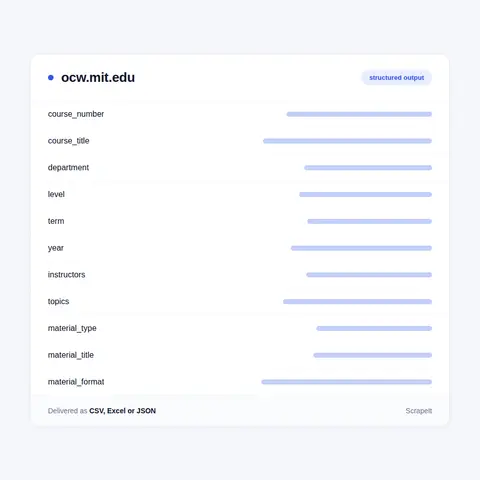
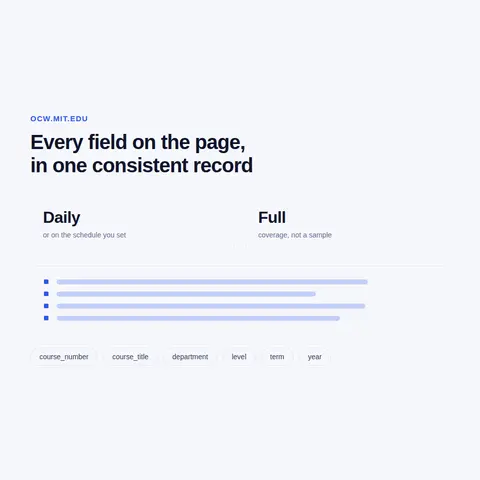
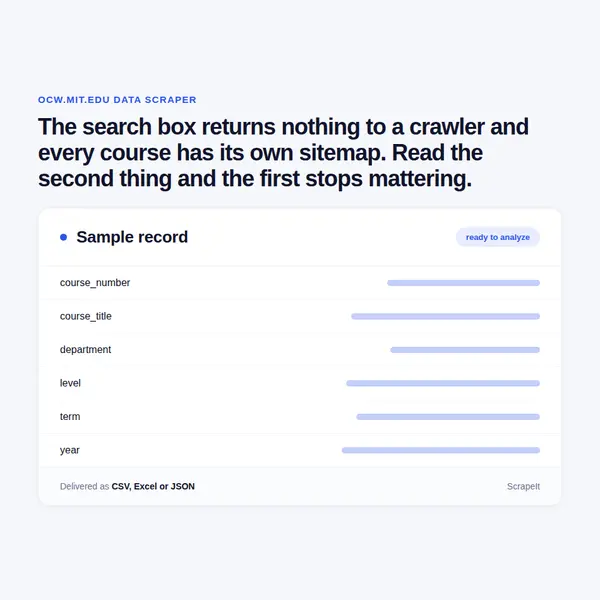
The course record covers the course number, title, department, level, the term and year it was taught, instructors as credited, topics and the course description.

Material records are keyed to the course: type such as lecture notes, assignment, exam or reading list, title, format and the address it sits at. That typing is what makes the archive usable - a client wanting problem sets does not want a list of every file.

The licence is recorded per course rather than assumed for the collection. Open licensing on this site is the norm and not a guarantee, and a dataset that records the licence lets a reuse decision be made per item instead of as a leap of faith.

Term and year are kept as fields because the same course number appears across many years with different materials, and a course record without its year is ambiguous in exactly the cases somebody cares about.

Every row carries the collection timestamp and the sitemap it was discovered through.

MIT OpenCourseWare fields in every export
Curriculum history, reading lists and licensing

Curriculum history, reading lists and licensing

Curriculum change over time is the most distinctive analysis this source supports, because the same course numbers recur across years with their materials attached. What appeared, what disappeared, and when, is answerable retrospectively here rather than only going forward - a rarity in this whole category.

Reading list extraction produces a citation graph between courses and the works they teach, which for academic publishers and libraries is a direct read on what is actually assigned rather than what is bought.

Material type inventories answer practical questions for anyone building learning products: how many courses publish exams, how many include video, how completeness varies by department.

On licensing we check rather than assume. Open licences carry conditions - attribution, non-commercial use, share-alike - and they differ between courses and occasionally between materials within one. We record what each says and leave the reuse decision to you and your counsel, with the facts in front of you.

Openly licensed course materials from one university

MIT OpenCourseWare publishes teaching materials from MIT courses: syllabi, lecture notes, problem sets, exams, reading lists and in many cases video lectures. It has been running for over two decades and covers a large share of the institution's curriculum.

It differs from every commercial source in this section in one important way: the materials are published under open licences. That means reuse is often actually permitted rather than merely tolerated - subject to the specific licence terms on the specific course, which vary and which should be read rather than assumed.

Technically it has one characteristic that decides how collection works. The search interface renders in the browser and returns almost nothing to a plain request, while individual course pages are ordinary static documents that respond fully. Crawling the search is therefore pointless and crawling the courses is straightforward.

What makes that workable is that the site publishes a sitemap, and each course carries its own sitemap listing its materials. Enumeration comes from there rather than from trying to make the search cooperate.

Get a Quote
dev_w
25

Developers

customers
500+

Customers worldwide

pages
1 500 000 000+

Pages extracted

stime
15000+

Hours saved for our clients

Plans

Airplane

€199 / one-time

setup fee - included

Data limits100,000
Frequencyone-time
Run timeup to 5 days
Data storing7 days

Helicopter

€169 / mo

setup fee €499

Data limits250,000
Frequencymonthly
Run timeup to 5 days
Data storing14 days

Glasses

€229 / mo

setup fee €499

Data limits1,000,000
Frequencyweekly
Run timeup to 5 days
Data storing30 days

DNA

€549 / mo

setup fee €799

Data limits3,000,000
Frequency3 times daily
Run timesame day
Data storing90 days

Why enumeration comes from sitemaps here

A collector pointed at the search on this site comes back nearly empty and the usual conclusion is that the source is protected. It is not; it is simply built so that discovery happens through published sitemaps rather than through crawlable listing pages.

Reading the sitemap first turns a difficult crawl into a simple one, and the per-course sitemaps do more than list addresses - they describe what each course contains, which is exactly the material inventory a client wants and would otherwise have to assemble by walking pages.

The second reason this source is unusual is licensing. Most educational content is collectable for analysis and not reusable. Here reuse is frequently permitted, which makes it one of the few sources where a client can build something on the content itself rather than only on statistics about it. That makes recording the licence per course a functional requirement rather than a compliance gesture.

The third is curriculum research. Two decades of syllabi from one institution, with terms and years attached, is a record of how a curriculum changed - what was added, what stopped being taught, how a subject's reading list drifted. That question is hard to answer anywhere else with this consistency.

The fourth is scope. This is one university, and a strong one, which makes it excellent for depth and unrepresentative for anything claiming to describe higher education generally.
Our Blog

Reads Our Latest News & Blog

Learn how to use web scraping to solve data problems for your organization

How Artificial Intelligence Is Used In Web Scraping

How Artificial Intelligence Is Used In Web Scraping

Leveraging advances in technology, the AI-powered web scraper has skyrocketed in demand and is helping to expand capabilities by automating tedious daily tasks and speeding up data collection from thousands of websites several times over.

What is Web Scraping and What is it Used For?

What is Web Scraping and What is it Used For?

Web scraping is a method of obtaining web data by extracting it from pages of web resources with the help of a program, that is, in automatic mode. It is used to syntactically convert web pages into more usable forms.

Web Scraping for Machine Learning

Web Scraping for Machine Learning

If you specialize in machine learning, you need to feed large amounts of data to the algorithms. Web scraping is the easiest and the most efficient method of collecting the data from all over the Internet.

scrapeit logo

Who builds and keeps your OpenCourseWare feed

ScrapeIt is a managed extraction company, not a tool you have to learn. Our team builds the pipeline, follows the sitemaps as courses are added and re-published, and repairs the collector when material templates change.

You see a sample first, in your format, over the departments you actually care about, with materials typed and licences recorded so you can judge both the structure and the reuse question on real courses.

FAQ

Why does crawling the search not work?

Because it renders in the browser and returns almost nothing to a plain request. That is not protection, just how the site is built - individual course pages respond fully, and discovery is meant to come from the published sitemaps instead.

Can I reuse the content?

Often yes, which is unusual in this category, and the answer is per course rather than blanket. Open licences carry conditions like attribution, non-commercial use or share-alike, so we record what each course states and leave the decision to you with the facts in front of you.

Can you collect the history of a course?

Yes, and here that works retrospectively - rare in this field. The same course numbers recur across years with their materials attached, so what was added and what stopped being taught is answerable from the archive rather than only from the day collection starts.

Do you extract reading lists?

Yes, as their own records, which produces a graph between courses and the works they assign. For academic publishers and libraries that is a direct read on what is taught rather than what is purchased.

Is this representative of higher education?

No. It is one university, in depth, over two decades. That makes it excellent for curriculum research and unsuitable for any claim about higher education generally, and we scope briefs on that basis.

How does it Work?

Step 1 - Make a Request

You share your needs, expectations, and desired timeframe. We’ll suggest the best solution based on your request and budget.

Step 2 - Configuring Custom Web Crawlers

Our specialists configure the crawlers and extract a sample dataset for your review before proceeding with the full-scale extraction.

Step 3 - Collect and Deliver

Once you approve the sample, we launch the project and start full data collection. We gather, filter, and structure the data for easy use, delivering it on time in your preferred format.

Step 4 - Maintain and Support

Our team manages ongoing processes, monitors website changes, and supports all data extraction cycles. We can also help integrate data into your systems or create dashboards to simplify analysis.

Request a Quote

Tell us more about you and your project information.
Which sites, which fields, how often. A couple of lines is enough.

We reply within 1 business day. No obligation.

scrapiet

Scrapeit Sp. z o.o.
10/208 Legionowa str., 15-099, Bialystok, Poland
NIP: 5423457175
REGON: 523384582