MasterClass Scraper for Classes, Instructors and Plan Prices

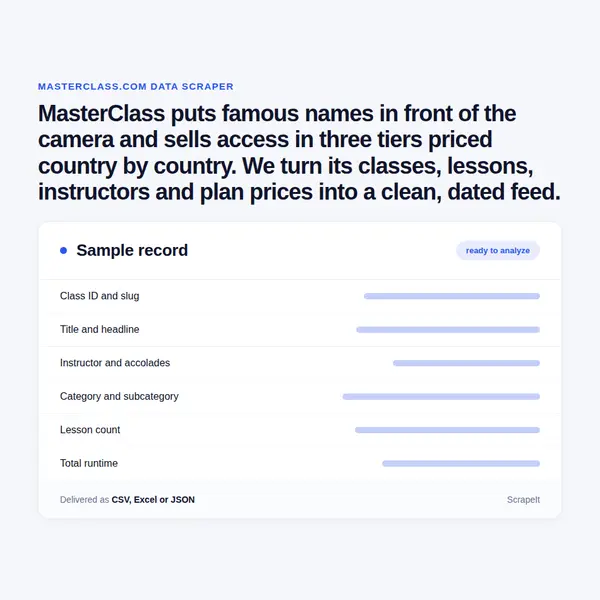
MasterClass puts famous names in front of the camera and sells access in three tiers priced country by country. We turn its classes, lessons, instructors and plan prices into a clean, dated feed.

MasterClass Scraper
Solutions

A managed MasterClass dataset beyond the partner-only MasterClass API

ScrapeIt runs MasterClass scraping as a managed service. masterclass.com sits behind bot management that challenges automated clients, so anti-bot handling, proxy rotation and CAPTCHA solving are part of the job, along with repairs when page structure moves. We extract MasterClass data from public class, lesson, series, Sessions, category, article and plan pages only - no login, no member areas, no video. Lists come from the published sitemaps and category pages, deduplicated on ids, and prices are captured country by country as a local visitor sees them, with currency and tax flags kept. After a sample we run weekly or daily and deliver CSV, JSON or XLSX, or push to S3, SFTP or your warehouse.

MasterClass data fields for classes, lessons and instructors

Class, lesson and category pages embed the platform's own records, so the export keeps its field names and stable ids.

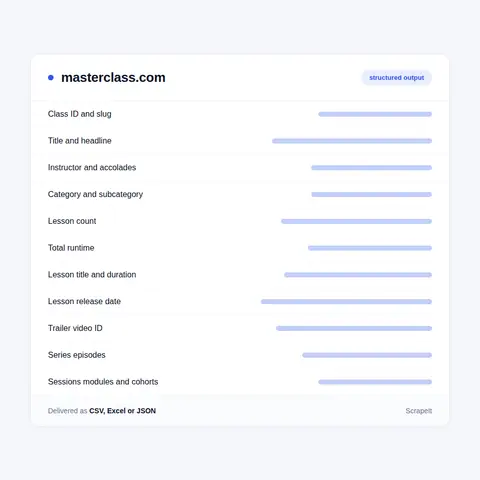
  • Class record. Numeric id and slug, title and headline, the instructor line as billed, a one-line pitch and the long overview, primary category and every subcategory, lesson count, total runtime in seconds, the new tag, and pre-launch and post-launch marketing dates for titles announced before they open.
  • MasterClass instructors. Name, the accolades printed under it - 7 Michelin stars and 25+ cookbooks published for Gordon Ramsay - a one-sentence bio and a headshot. In series episodes and multi-expert classes each lesson names its own experts with their bios. Instructors are public figures fronting a commercial product, and we record them only as billed.
  • MasterClass lessons. Number, title, abstract, duration as mm:ss and in seconds, the offline flag, the release date on lessons that open on a schedule, and the last update time. Titles carry their own lesson types: in Gordon Ramsay's class, Method marks a technique and Make a recipe.
  • Trailer and sample. The Brightcove video id and thumbnail, and a schema.org VideoObject with upload date and embed URL - the closest public clue to when an older class went live.
  • Outcomes and skills. The Skills You'll Learn list and outcome labels with one-liners, such as Cook the Perfect Brisket on Aaron Franklin's barbecue class.
  • Popularity. The order of the homepage Popular now row, the site's own pick of the most popular MasterClass courses of the moment, and a visitor rank stored on categories and subcategories.
  • Sessions. Modules, video activities timed in minutes, projects, an equipment note and cohort fields: total cohorts, remaining spots and the enrollment window.

We collect metadata, not media: no video files, no transcripts, no class workbooks and nothing from member accounts.

MasterClass data fields for classes, lessons and instructors
Articles, series and the full MasterClass course list

Articles, series and the full MasterClass course list

MasterClass articles. The /articles library dwarfs the class catalog: how-to guides, recipes and explainers under the byline MasterClass, filed in categories that follow the older taxonomy - Food, Design & Style, Wellness and the rest - rather than the 13 class categories. Each article carries a last updated date, read time and an average rating with its count, usually with a linked instructor and a featured class, so the library maps which class each search-driven page promotes. Recipes add schema.org Recipe data: ingredients, prep and cook times, yield and cuisine. The hub's own latest rail has not moved for years, so freshness is read article by article.

MasterClass series. Original series such as GOAT are cut into episodes, each with its own expert, bio and runtime, and some list episodes newest first, so episode order gets a field of its own.

The full course list. The class sitemap carries series under /classes/ paths but leaves Sessions out, and one title shows up under several categories. Complete MasterClass course offerings come from merging the sitemap with the category pages and deduplicating on the class id.

Certificates and Executive. Certificates form a separate catalog of 15 to 20 hour programs with projects and learning paths, and MasterClass Executive runs application-based cohorts with a deadline, a start date and a faculty that mixes executives with Chicago Booth professors.
MasterClass course catalog: classes, series and Sessions

MasterClass is a subscription video platform run by Yanka Industries in San Francisco, where chefs, athletes, novelists, scientists and business leaders teach filmed classes. A MasterClass scraper works from the public catalog around those classes - class and lesson pages, trailers, the category tree and the plan table - none of which needs an account.

The core unit is the class, at /classes/{slug}, with each lesson on its own page at /classes/{slug}/chapters/{lesson}. The format is shifting. Classic MasterClass courses follow the "Teaches" formula and mostly run 10 to 20 lessons: Gordon Ramsay Teaches Cooking I has 20 lessons and 3 hr 54 min. Recent titles such as The Conflict Playbook or Revolutionize Your Workflows With AI ship as one feature-length lesson, sometimes with three experts on screen. Original series live at /series/{slug} and are cut into episodes, and MasterClass Sessions, at /sessions/classes/{slug}, are guided programs built from modules, projects and cohorts.

The 13 MasterClass categories run from Acting & Performing Arts to Writing, and each splits into subcategories phrased as outcomes, such as Bake Delicious Bread & Pastries, so one class can sit in several places. Beside the membership sit products with their own pages and prices: MasterClass Certificates, the cohort-based MasterClass Executive, the AI coaching of MasterClass On Call and MasterClass at Work for teams.

Get a Quote
dev_w
25

Developers

customers
500+

Customers worldwide

pages
1 500 000 000+

Pages extracted

stime
15000+

Hours saved for our clients

Plans

Airplane

€199 / one-time

setup fee - included

Data limits100,000
Frequencyone-time
Run timeup to 5 days
Data storing7 days

Helicopter

€169 / mo

setup fee €499

Data limits250,000
Frequencymonthly
Run timeup to 5 days
Data storing14 days

Glasses

€229 / mo

setup fee €499

Data limits1,000,000
Frequencyweekly
Run timeup to 5 days
Data storing30 days

DNA

€549 / mo

setup fee €799

Data limits3,000,000
Frequency3 times daily
Run timesame day
Data storing90 days

MasterClass price tracking by country, tier and promotion

MasterClass prices hang on one annual membership sold in three tiers: Standard streams on one device, Plus on two with offline downloads, Premium on six, and both upper tiers allow six profiles. What moves by market is the money. The checkout resolves the visitor's country and returns a currency, a tax-inclusive flag, the base price and the tax amount, plus the MasterClass price per year broken down per month, per week and even per day.

Three details make MasterClass price monitoring harder than reading one page. The App Store still sells the tiers under their older names, Individual, Duo and Family, at prices set per storefront. Some marketing banners quote the US dollar figure to every visitor while the plan table is localized, so the country price has to come from the plan table. And promotions run on their own landing pages - a 2-for-1 offer, a free trial, gift memberships - with coupon and discounted-price fields beside the list price.

A MasterClass price history is not published by the company; it is built from dated snapshots of each country's plan table. That series answers what buyers ask: MasterClass subscription prices against local purchasing power, how deep and how often discounts run, and how MasterClass alternatives price a comparable year. Catalog-level MasterClass statistics - classes per category, runtime spread, launches per month - ride in the same feed.

Our Blog

Reads Our Latest News & Blog

Learn how to use web scraping to solve data problems for your organization

How Artificial Intelligence Is Used In Web Scraping

How Artificial Intelligence Is Used In Web Scraping

Leveraging advances in technology, the AI-powered web scraper has skyrocketed in demand and is helping to expand capabilities by automating tedious daily tasks and speeding up data collection from thousands of websites several times over.

What is Web Scraping and What is it Used For?

What is Web Scraping and What is it Used For?

Web scraping is a method of obtaining web data by extracting it from pages of web resources with the help of a program, that is, in automatic mode. It is used to syntactically convert web pages into more usable forms.

Web Scraping for Machine Learning

Web Scraping for Machine Learning

If you specialize in machine learning, you need to feed large amounts of data to the algorithms. Web scraping is the easiest and the most efficient method of collecting the data from all over the Internet.

scrapeit logo

Working with ScrapeIt to scrape MasterClass data

ScrapeIt is a managed web scraping agency: we build the collector, run it on our own infrastructure and hand over a finished MasterClass dataset instead of a tool to operate. Scoping takes one call - the whole catalog or chosen categories, which countries for MasterClass plan prices, whether articles and Certificates are in, and how often. A sample in your format comes first; pricing follows volume and refresh rate.

FAQ

Does MasterClass have an API?

Yes, but not for data buyers. developer.masterclass.com documents the MasterClass API at api.masterclass.com/v1: bearer-token endpoints for search, classes, lessons, sessions and playlists that return id, title, summary, page link, thumbnail, duration in seconds, skills and instructors, plus xAPI learning-record endpoints for enterprise accounts. Access requires an existing agreement as a MasterClass at Work customer or partner, the license covers integrations such as an LMS, and the Developer Agreement bars reselling the data or using it to measure MasterClass competitively. Prices, country tiers and articles are not in it.

How much does MasterClass cost in each country?

MasterClass sells one annual membership in three tiers with a 30-day money-back guarantee, and its US copy starts at $10 a month billed annually. In late September 2026 the web checkout quoted a visitor in Poland 600, 840 and 1,116 PLN a year for Standard, Plus and Premium with VAT included, while the App Store listed the Individual tier at $119.99 in the US, GBP 119.99 in the UK, CAD 149.99 in Canada and AUD 199.99 in Australia, with the MasterClass price in India at INR 11,900. We record every country with its currency and tax flags.

How many MasterClass courses are there, and how often do new ones launch?

In late September 2026 the category pages listed 204 classes, 18 original series and 13 Sessions, and the lesson sitemap held 3,044 lesson pages, a median of 14 lessons per class. The homepage rounds it to 200+ classes and promises new ones every month. New titles carry a new tag, announced ones can show pre-launch dates, and recent single-lesson classes open on a set release date, so a weekly run catches launches within days and a daily one tracks the popularity rows.

Does MasterClass give certificates, and can you track them?

Yes, as a separate product rather than part of the standard membership. MasterClass Certificates are programs of 15 to 20 hours in business, technology and AI topics, each ending in a real-world project and a certificate, sold as a one-time purchase, a subscription or a bundle with the core membership, with refund rules of their own. MasterClass Executive adds a certificate of completion issued with Chicago Booth. We track certificate titles, categories, paths and MasterClass certificate prices by country, the same way as the membership.

Is it legal to scrape MasterClass?

We take public catalog facts - titles, runtimes, instructors as billed, categories and prices - and never videos, workbooks, transcripts, member stories or account data. robots.txt leaves most of the site open and closes a few paths such as the JSON API, guest passes and password reset. The Terms of Service license the service for personal, non-commercial streaming, forbid using its content to train AI models without written consent and ask anyone blocked not to work around the block. Whether your use fits is a question for your counsel, so scope and pace are agreed in writing first.

How does it Work?

Step 1 - Make a Request

You share your needs, expectations, and desired timeframe. We’ll suggest the best solution based on your request and budget.

Step 2 - Configuring Custom Web Crawlers

Our specialists configure the crawlers and extract a sample dataset for your review before proceeding with the full-scale extraction.

Step 3 - Collect and Deliver

Once you approve the sample, we launch the project and start full data collection. We gather, filter, and structure the data for easy use, delivering it on time in your preferred format.

Step 4 - Maintain and Support

Our team manages ongoing processes, monitors website changes, and supports all data extraction cycles. We can also help integrate data into your systems or create dashboards to simplify analysis.

Request a Quote

Tell us more about you and your project information.
Which sites, which fields, how often. A couple of lines is enough.

We reply within 1 business day. No obligation.

scrapiet

Scrapeit Sp. z o.o.
10/208 Legionowa str., 15-099, Bialystok, Poland
NIP: 5423457175
REGON: 523384582