LibreTexts Scraper for Open Textbook Structure and Text

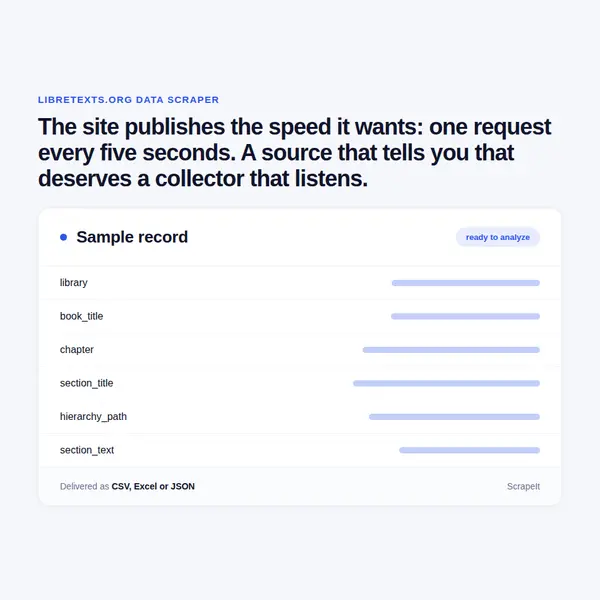
The site publishes the speed it wants: one request every five seconds. A source that tells you that deserves a collector that listens.

LibreTexts Scraper
Solutions

Managed open textbook data, run end to end by us

ScrapeIt runs the collection as a managed service. You name the libraries, subjects or books; we build the pipeline keeping the book, chapter and section hierarchy, record licence and contributors per page, and hand back CSV, JSON, Excel or a push into your warehouse.

Collection is paced to the request rate the site publishes, which makes large jobs slow and reliable rather than fast and fragile. We quote the realistic duration up front instead of discovering it during delivery.

We collect published content only, honour the crawl rules the site publishes and keep operational paths out of scope. Licence terms are recorded per page so any reuse decision rests on what the licence says, and your counsel should see the intended use before the project starts.

LibreTexts fields in every export

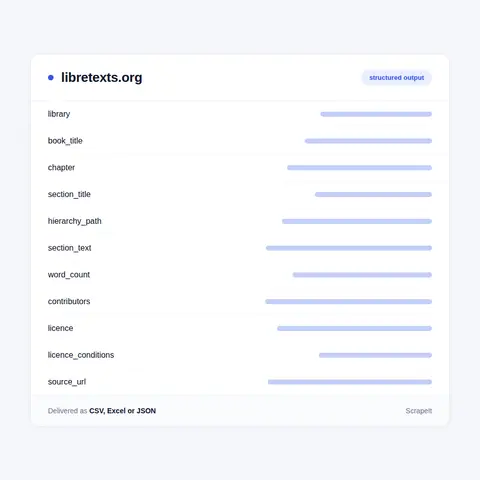
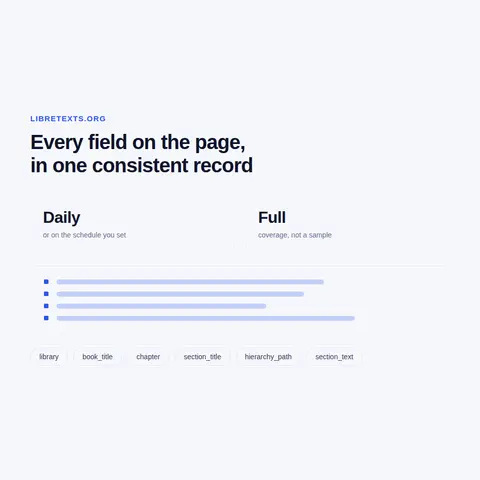
Records carry the library or subject, book title, chapter, section title, the hierarchy path, the section text, and the contributors and licence as published on the page.

The hierarchy path is kept as a field rather than reconstructed from breadcrumbs afterwards. It is what allows a section to be placed in its book and chapter without guesswork, and it is free to capture at collection time and expensive to recover later.

Licence is recorded per page rather than assumed for the project. Open licences on this platform are common and they vary between books and sometimes within them, and a dataset intended for reuse needs the licence attached to the material rather than stated once in a covering note.

Contributors are collected as credited on the page, since attribution is a condition of most of the licences involved and a dataset that drops the credits makes compliance impossible downstream.

Every row carries the collection timestamp and the source address.

LibreTexts fields in every export
Coverage mapping, course alignment and licensing

Coverage mapping, course alignment and licensing

Coverage mapping across libraries answers which topics are well served by open material and which are thin, which for anyone building or funding open education is the question that directs the next investment.

Course alignment is the most practical institutional use: matching an existing syllabus against available open sections to find what could replace a commercial textbook and what has no open equivalent yet. It works only with the hierarchy intact.

Change tracking over time shows which books are actively maintained and which have gone quiet, which matters to anyone planning to depend on a text.

On licensing we record rather than advise. Licences here permit a great deal and they carry conditions - attribution, share-alike, sometimes non-commercial - that differ between books. We capture what each page states, and the decision about your specific use belongs with you and your counsel, made against the recorded terms.

Open textbooks organised as a hierarchy

LibreTexts is an open education project publishing free textbooks across chemistry, biology, mathematics, physics, engineering, social sciences and more, each subject on its own library. The material is openly licensed and written or adapted by academic contributors.

Structurally it is a nested hierarchy rather than a list of documents. A library contains books, a book contains chapters, a chapter contains sections, and the text lives at the section level. Flattened into a list of pages, the material loses the structure that makes it a textbook rather than an archive of articles - and the structure is often exactly what a client needs, because course alignment and coverage analysis are questions about the hierarchy.

The crawl rules are unusually explicit and worth reading as an instruction rather than a formality. They publish a crawl delay of five seconds and a request rate of one request per five seconds, and they disallow the operational parts of the platform - templates, user pages, actions and internal API paths - while leaving the content open.

Content pages respond directly with substantial text, and a sitemap is published per library.

Get a Quote

dev_w
25

Developers

customers
500+

Customers worldwide

pages
1 500 000 000+

Pages extracted

stime
15000+

Hours saved for our clients

Plans

Airplane

€199 / one-time

setup fee - included

Data limits100,000
Frequencyone-time
Run timeup to 5 days
Data storing7 days

Helicopter

€169 / mo

setup fee €499

Data limits250,000
Frequencymonthly
Run timeup to 5 days
Data storing14 days

Glasses

€229 / mo

setup fee €499

Data limits1,000,000
Frequencyweekly
Run timeup to 5 days
Data storing30 days

DNA

€549 / mo

setup fee €799

Data limits3,000,000
Frequency3 times daily
Run timesame day
Data storing90 days

Why structure and licence travel with the text

Open educational content is one of the few sources in this field where the text itself can be used rather than only analysed, and that changes what a good dataset looks like.

If material may be reused, then licence and attribution stop being metadata and become part of the payload. A section of text without its licence and contributor credits cannot be used for the thing it was released for, which makes a collection that dropped them worse than useless - it looks complete and cannot be acted on.

The second point is the hierarchy. Coverage analysis, course alignment and gap finding are all questions about where material sits in a book rather than about the text in isolation. Keeping the path means those are queries; losing it means they are manual work.

The third is pacing. This source publishes the rate it expects, and honouring it is both the right thing and the practical one: a collector that respects a stated five second interval runs indefinitely, and one that does not gets blocked and takes the project with it. Large collections here are therefore slow by design and we schedule them that way rather than promising speed we should not deliver.

The fourth is that this is academic material maintained by contributors, so it changes - corrections, revisions, new editions - and a client relying on specific text should re-collect rather than assume permanence.

Our Blog

Reads Our Latest News & Blog

Learn how to use web scraping to solve data problems for your organization

How Artificial Intelligence Is Used In Web Scraping

How Artificial Intelligence Is Used In Web Scraping

Leveraging advances in technology, the AI-powered web scraper has skyrocketed in demand and is helping to expand capabilities by automating tedious daily tasks and speeding up data collection from thousands of websites several times over.

What is Web Scraping and What is it Used For?

What is Web Scraping and What is it Used For?

Web scraping is a method of obtaining web data by extracting it from pages of web resources with the help of a program, that is, in automatic mode. It is used to syntactically convert web pages into more usable forms.

Web Scraping for Machine Learning

Web Scraping for Machine Learning

If you specialize in machine learning, you need to feed large amounts of data to the algorithms. Web scraping is the easiest and the most efficient method of collecting the data from all over the Internet.

scrapeit logo

Who builds and keeps your LibreTexts feed

ScrapeIt is a managed extraction company, not a tool you have to learn. Our team builds the pipeline, follows the per-library sitemaps as books are added and revised, and repairs the collector when page templates change.

You see a sample first, in your format, over the subjects you actually need, with the hierarchy preserved and licences recorded so you can judge both structure and reuse on real sections.

FAQ

How fast can you collect this?

Slowly, deliberately. The site publishes a five second crawl delay and a request rate of one per five seconds, and we honour both. A collector that respects that runs indefinitely; one that does not gets blocked and takes the project with it. We quote the real duration up front.

Why keep the chapter and section structure?

Because coverage analysis, course alignment and gap finding are all questions about where material sits in a book. With the hierarchy path those are queries; without it they are manual work, and the path is free to capture at collection and expensive to recover later.

Can I reuse the text?

Usually, under conditions that vary between books - attribution, share-alike, sometimes non-commercial. We record the licence and the credited contributors per page so the decision rests on what the licence actually says. The decision itself belongs with you and your counsel.

Why collect contributor names?

Because attribution is a condition of most of the licences involved. A dataset that drops the credits looks complete and makes compliance impossible downstream, which is worse than a dataset that is obviously missing something.

Does the content change?

Yes - corrections, revisions and new editions, since it is maintained by contributors. Anyone depending on specific text should re-collect rather than assume permanence, and change tracking also shows which books are actively maintained and which have gone quiet.

How does it Work?

Step 1 - Make a Request

You share your needs, expectations, and desired timeframe. We’ll suggest the best solution based on your request and budget.

Step 2 - Configuring Custom Web Crawlers

Our specialists configure the crawlers and extract a sample dataset for your review before proceeding with the full-scale extraction.

Step 3 - Collect and Deliver

Once you approve the sample, we launch the project and start full data collection. We gather, filter, and structure the data for easy use, delivering it on time in your preferred format.

Step 4 - Maintain and Support

Our team manages ongoing processes, monitors website changes, and supports all data extraction cycles. We can also help integrate data into your systems or create dashboards to simplify analysis.

Request a Quote

Tell us more about you and your project information.
Which sites, which fields, how often. A couple of lines is enough.

We reply within 1 business day. No obligation.

scrapiet

Scrapeit Sp. z o.o.
10/208 Legionowa str., 15-099, Bialystok, Poland
NIP: 5423457175
REGON: 523384582