arXiv Data Collection for Preprint Metadata and Versions

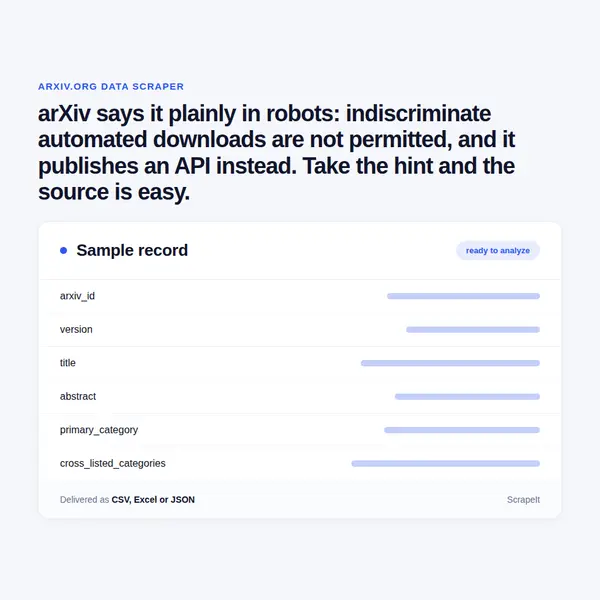
arXiv says it plainly in robots: indiscriminate automated downloads are not permitted, and it publishes an API instead. Take the hint and the source is easy.

arXiv Scraper
Solutions

Managed arXiv data collection, run end to end by us

ScrapeIt builds and runs the pipeline as a managed service. You define the corpus by category, author, institution or date range; we retrieve through the official query and harvesting interfaces at the rates the site asks for, resolve authors and affiliations, keep versions and cross listings intact, and hand back CSV, JSON, Excel or a push into your warehouse.

This is a compliant integration rather than a crawl, and we are explicit about it. The site states that indiscriminate automated downloads are not permitted and sets a fifteen second delay for crawlers, while publishing interfaces built for programmatic access. Using those, properly, is both the correct answer and the reason we can promise a schedule we will keep.

Metadata is open and meant to be used. Manuscript text carries a per paper licence chosen by the author, so full text is delivered only where the licence permits and the licence is recorded on every row. Bring the use case to your own counsel before the project starts, particularly if the corpus is destined for model training.

arXiv fields in every export

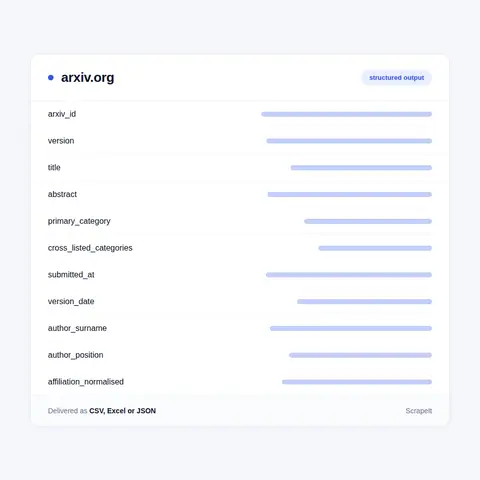
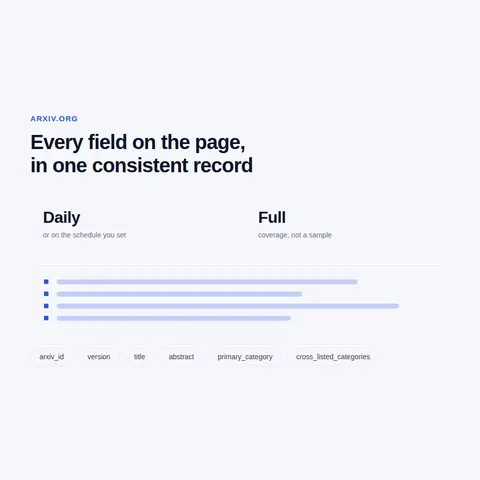
The paper record covers arXiv identifier, version number, title, abstract, primary category, cross listed categories, submission date per version, latest version date, comments field, journal reference where the author has supplied one, and DOI where a published version exists.

Authors come as rows with surname, given name, position in the list and affiliation as supplied. Affiliation on preprints is inconsistently populated and inconsistently written, so it is normalised to institutions with the raw string preserved, exactly as on our literature work elsewhere.

Version history is a first class part of this dataset rather than an afterthought. Each version carries its own date and, where the author supplied one, its own comment describing what changed. A paper that has been revised four times over two years is telling a different story from one posted once, and abstracts do change between versions in ways that matter to anyone doing text analysis.

Cross listing is preserved as a list rather than reduced to the primary category. Interdisciplinary work is precisely what most research trend analysis is looking for, and it lives in the cross listings.

Where a published journal version is later linked, that link is captured, along with the retrieval timestamp on every row.

arXiv fields in every export
Full text, licensing and joining to published versions

Full text, licensing and joining to published versions

Licensing on this source is per paper and has to be treated that way. Authors choose a licence at submission, and while many permit broad reuse, others do not, and the metadata is not the same thing as the manuscript. We record the licence on every row and deliver full text only where the licence permits it, rather than assuming that a freely readable paper is a freely reusable one. This distinction has caught out a number of machine learning datasets.

Metadata itself is intended to be harvested through the interfaces provided, which is exactly how we retrieve it, and that is why access here is stable and predictable rather than a running battle.

Joining to published versions is the usual extension. Where a preprint later appears in a journal, the DOI and journal reference connect the two, and clients typically want both the preprint date and the publication date on one row to measure the lag. That join is more reliable through identifiers than through title matching, and we use identifiers wherever the author supplied them.

Author disambiguation runs the same way as on our other literature work: co-authorship networks, category overlap and affiliation history, with confidence marked rather than assumed. Preprint servers are, if anything, harder than indexed literature here because affiliation is optional.

What arXiv publishes and how it asks to be accessed

arXiv is the preprint server for physics, mathematics, computer science, quantitative biology, finance and statistics. For fast moving fields, particularly machine learning, it is where results appear first, often months before any journal version exists.

It is also unusually direct about automated access. Its robots file states that indiscriminate automated downloads are not permitted and sets a fifteen second crawl delay, while the site publishes a documented query API and a metadata harvesting interface designed for exactly this purpose. That is not an obstacle, it is a signpost, and we follow it: our pipelines here run on the official interfaces at civil rates rather than crawling listing pages.

The metadata is rich. Each paper carries an identifier, title, abstract, authors with affiliations where supplied, primary and cross listed categories, submission date, and a version history, since papers are revised in place under the same identifier with v1, v2 and so on.

Categories are the native taxonomy and they are genuinely useful: a paper is filed under a primary subject class and often cross listed into others, which makes selecting a corpus by field far more reliable than keyword matching over titles.

Get a Quote
dev_w
25

Developers

customers
500+

Customers worldwide

pages
1 500 000 000+

Pages extracted

stime
15000+

Hours saved for our clients

Plans

Airplane

€199 / one-time

setup fee - included

Data limits100,000
Frequencyone-time
Run timeup to 5 days
Data storing7 days

Helicopter

€169 / mo

setup fee €499

Data limits250,000
Frequencymonthly
Run timeup to 5 days
Data storing14 days

Glasses

€229 / mo

setup fee €499

Data limits1,000,000
Frequencyweekly
Run timeup to 5 days
Data storing30 days

DNA

€549 / mo

setup fee €799

Data limits3,000,000
Frequency3 times daily
Run timesame day
Data storing90 days

Why versions and cross listings carry the research signal

Most people asking for arXiv data want to see where a field is moving. That question is answered badly by counting papers and well by looking at structure: which categories are growing, where cross listings are forming between fields, which institutions and groups are producing the work, and how quickly a new idea propagates from one subject class into others.

Cross listings are the clearest early indicator. When a technique from one field starts appearing cross listed into another, that is the beginning of a trend and it is visible months before it shows up in journals or in a survey paper. It requires the category list preserved in full, which naive pipelines flatten to a single primary value.

Version history is the second signal and it is routinely thrown away. A preprint revised repeatedly over a long period may be struggling through review or may be actively developing; either way the trajectory is information. Abstract text also changes between versions, which matters a great deal if you are training or evaluating anything on that text and assumed it was fixed.

The third is timing. Because this is a preprint server, submission dates are close to when work was actually done, unlike publication dates which lag by many months. For any analysis of research velocity, that is the more honest clock.

The fourth is the join outward. Preprints connect to published versions, to code repositories and to citation graphs, and the useful product is usually the joined view rather than this source alone.

Our Blog

Reads Our Latest News & Blog

Learn how to use web scraping to solve data problems for your organization

How Artificial Intelligence Is Used In Web Scraping

How Artificial Intelligence Is Used In Web Scraping

Leveraging advances in technology, the AI-powered web scraper has skyrocketed in demand and is helping to expand capabilities by automating tedious daily tasks and speeding up data collection from thousands of websites several times over.

What is Web Scraping and What is it Used For?

What is Web Scraping and What is it Used For?

Web scraping is a method of obtaining web data by extracting it from pages of web resources with the help of a program, that is, in automatic mode. It is used to syntactically convert web pages into more usable forms.

Web Scraping for Machine Learning

Web Scraping for Machine Learning

If you specialize in machine learning, you need to feed large amounts of data to the algorithms. Web scraping is the easiest and the most efficient method of collecting the data from all over the Internet.

scrapeit logo

Who builds and keeps your preprint feed

ScrapeIt is a managed extraction company, not a tool you have to learn. Our team builds the pipeline, watches it as interfaces and metadata formats change, and repairs it before your corpus goes stale.

You see a sample first, in your format, over your corpus definition, with versions and cross listings intact and authors disambiguated so you can judge the hard part on real records.

FAQ

Is scraping arXiv allowed?

Crawling it is not, and the site says so directly: its robots file states that indiscriminate automated downloads are not permitted and sets a fifteen second delay. It publishes a query API and a metadata harvesting interface instead. We use those, at the rates asked for, which is both the correct answer and the reason access stays stable. We would rather build a compliant integration than a fragile crawl.

Do you keep the version history of a paper?

Yes, as its own rows: each version with its date and the author comment where supplied. Papers are revised in place under one identifier, abstracts change between versions, and a paper revised four times over two years tells a different story from one posted once. Most pipelines keep only the latest version and lose all of that.

Can I use the full text for model training?

Only where the per paper licence permits it, and that varies. Authors choose a licence at submission; some allow broad reuse, others do not, and a paper being freely readable does not make it freely reusable. We record the licence on every row and deliver text only within it. This distinction has caught out several published datasets, so take it to your counsel before the corpus is built.

Why do cross listed categories matter?

Because interdisciplinary movement is where research trends start, and it lives in the cross listings. A technique appearing cross listed from one field into another is an early signal, visible months before journals or survey papers reflect it. Pipelines that reduce a paper to its primary category throw that away.

Can you link preprints to their published versions?

Yes, through DOIs and journal references where the author has supplied them, which is far more reliable than matching titles. Clients usually want the preprint date and the publication date on one row to measure the lag, and that join is the standard extension on this source.

How does it Work?

Step 1 - Make a Request

You share your needs, expectations, and desired timeframe. We’ll suggest the best solution based on your request and budget.

Step 2 - Configuring Custom Web Crawlers

Our specialists configure the crawlers and extract a sample dataset for your review before proceeding with the full-scale extraction.

Step 3 - Collect and Deliver

Once you approve the sample, we launch the project and start full data collection. We gather, filter, and structure the data for easy use, delivering it on time in your preferred format.

Step 4 - Maintain and Support

Our team manages ongoing processes, monitors website changes, and supports all data extraction cycles. We can also help integrate data into your systems or create dashboards to simplify analysis.

Request a Quote

Tell us more about you and your project information.
Which sites, which fields, how often. A couple of lines is enough.

We reply within 1 business day. No obligation.

scrapiet

Scrapeit Sp. z o.o.
10/208 Legionowa str., 15-099, Bialystok, Poland
NIP: 5423457175
REGON: 523384582