Alison Scraper for Free Courses and Certificate Tiers

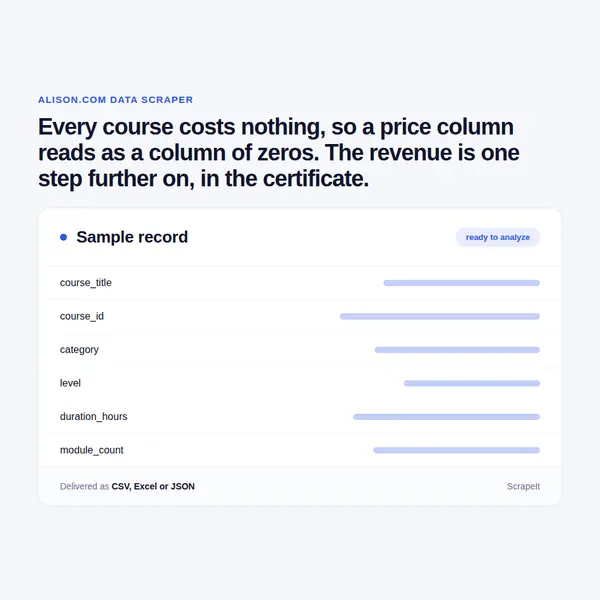
Every course costs nothing, so a price column reads as a column of zeros. The revenue is one step further on, in the certificate.

Alison Scraper
Solutions

Managed course catalogue data, run end to end by us

ScrapeIt runs the collection as a managed service. You name the categories or take the full catalogue; we build the pipeline with certificate options as priced rows, group language variants under one course identifier, and hand back CSV, JSON, Excel or a push into your warehouse.

Where catalogue growth matters we run repeat collection and keep every observation, so additions and retirements are records rather than a diff somebody has to reconstruct.

We collect published catalogue data only, honour the crawl rules the site publishes - search query addresses are disallowed across the language paths and we do not use them - and pace requests. No learner data, no account access. Terms restrict commercial reuse, so the dataset is for analysis rather than republication, and your counsel should see the use case first.

Alison fields in every export

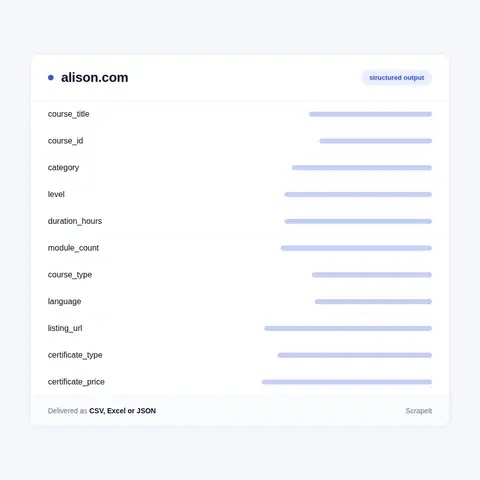
The course record covers the course title, category, level, stated duration, course type such as certificate or diploma, description, module structure where published, and the language of the listing.

A course identifier groups the language variants of the same course, so a client can count distinct courses or count listings and get the right answer to each question rather than one number that answers neither.

Certificate options are their own rows with type and price, since that is where the commercial model actually lives. A course row with a zero price and no certificate rows is a description of a product with its business model removed.

Module structure is captured where published, because course length in hours and course depth in modules are different measures and providers vary widely in how they relate.

Every row carries the collection timestamp and the language path it came from, so the deduplication can be audited rather than trusted.

Alison fields in every export
Certificate pricing, language coverage and limits

Certificate pricing, language coverage and limits

Certificate price comparison across providers is the output most clients arrive for, and it is straightforward once certification is modelled as its own record type on both sides of the comparison.

Language coverage analysis answers which parts of the catalogue are translated and how the language catalogues differ in size and category mix - a direct read on where a provider is investing.

Catalogue growth tracking needs repeat collection and gives the clearest picture of direction: which categories are being added to and which have stopped moving.

What we leave out is learners. No student data, no account access, no enrolment counts inferred from review numbers. Course, certificate and category data needs none of it.

Free to learn, paid to certify

Alison is an Irish online learning platform offering a large catalogue of free courses across business, technology, health, languages and personal development. The learning is free; the revenue comes from certificates, diplomas and advertising.

That model breaks the default course marketplace schema in a specific way. A price field collected naively returns zero for every row, which is technically correct and analytically useless. The commercial structure lives one level down, in what a learner can buy after completing: digital certificates, physical certificates, framed versions, each at its own price.

The catalogue is also multilingual, and the crawl rules make that visible - separate paths exist for Spanish, Portuguese and French course listings. The same course therefore appears under several addresses, which is a deduplication problem that has to be handled during collection rather than discovered in the delivered file.

Course listings respond directly with substantial content, and crawl rules are published, disallowing search query URLs across the language paths while leaving the catalogue itself open.

Get a Quote
dev_w
25

Developers

customers
500+

Customers worldwide

pages
1 500 000 000+

Pages extracted

stime
15000+

Hours saved for our clients

Plans

Airplane

€199 / one-time

setup fee - included

Data limits100,000
Frequencyone-time
Run timeup to 5 days
Data storing7 days

Helicopter

€169 / mo

setup fee €499

Data limits250,000
Frequencymonthly
Run timeup to 5 days
Data storing14 days

Glasses

€229 / mo

setup fee €499

Data limits1,000,000
Frequencyweekly
Run timeup to 5 days
Data storing30 days

DNA

€549 / mo

setup fee €799

Data limits3,000,000
Frequency3 times daily
Run timesame day
Data storing90 days

Why a free catalogue still needs a pricing model

Free course platforms are routinely misread in competitive analysis, because the obvious metric returns nothing and the analysis stops there.

What matters is the certification layer. Comparing what a free platform charges to certify against what a paid platform charges to teach is the comparison that actually informs a pricing decision, and it needs certificate options as priced rows rather than a zero in a price column.

The second reason is catalogue breadth. A free model supports a much larger catalogue than a paid one, and the shape of that catalogue - which categories go deep, which are thin - is a different strategic picture from a curated paid marketplace. Counting it accurately means resolving the language duplicates first.

The third is that the multilingual structure is itself informative. Which courses are translated, into which languages, and how large each language catalogue is shows where a provider believes its growth is, and that is only visible if the variants are grouped rather than either merged or double counted.

The fourth is course depth. Duration and module count together describe how substantial a course is, and the relationship between them varies enough across providers that one without the other misleads.

Our Blog

Reads Our Latest News & Blog

Learn how to use web scraping to solve data problems for your organization

How Artificial Intelligence Is Used In Web Scraping

How Artificial Intelligence Is Used In Web Scraping

Leveraging advances in technology, the AI-powered web scraper has skyrocketed in demand and is helping to expand capabilities by automating tedious daily tasks and speeding up data collection from thousands of websites several times over.

What is Web Scraping and What is it Used For?

What is Web Scraping and What is it Used For?

Web scraping is a method of obtaining web data by extracting it from pages of web resources with the help of a program, that is, in automatic mode. It is used to syntactically convert web pages into more usable forms.

Web Scraping for Machine Learning

Web Scraping for Machine Learning

If you specialize in machine learning, you need to feed large amounts of data to the algorithms. Web scraping is the easiest and the most efficient method of collecting the data from all over the Internet.

scrapeit logo

Who builds and keeps your Alison feed

ScrapeIt is a managed extraction company, not a tool you have to learn. Our team builds the pipeline, maintains the language grouping as translations are added, and repairs the collector before a course count quietly doubles.

You see a sample first, in your format, over the categories you actually track, with certificate tiers priced and language variants grouped so you can judge the structure on real courses.

FAQ

If the courses are free, what is there to price?

The certificates. Digital, physical and framed versions each carry their own price, and that is where the business model lives. A course row with a zero price and no certificate rows is a product description with the commercials removed.

Will the same course appear several times?

It does across the language paths, and we group the variants under one course identifier. That way you can count distinct courses or count listings and get the right answer to each, instead of one number that quietly answers neither.

Can I compare this against paid platforms?

Yes, and it is usually the point. Comparing what a free platform charges to certify against what a paid platform charges to teach is what informs a pricing decision, and it needs certification modelled as its own record type on both sides.

Why collect module structure as well as duration?

Because they measure different things and the relationship between them varies a lot between providers. Hours alone make a shallow course look substantial; modules alone say nothing about time. Together they describe depth.

Do you collect learner data?

No. No student data, no account access, and no enrolment counts inferred from review numbers. Course, certificate and category data is what these projects need and it contains none of it.

How does it Work?

Step 1 - Make a Request

You share your needs, expectations, and desired timeframe. We’ll suggest the best solution based on your request and budget.

Step 2 - Configuring Custom Web Crawlers

Our specialists configure the crawlers and extract a sample dataset for your review before proceeding with the full-scale extraction.

Step 3 - Collect and Deliver

Once you approve the sample, we launch the project and start full data collection. We gather, filter, and structure the data for easy use, delivering it on time in your preferred format.

Step 4 - Maintain and Support

Our team manages ongoing processes, monitors website changes, and supports all data extraction cycles. We can also help integrate data into your systems or create dashboards to simplify analysis.

Request a Quote

Tell us more about you and your project information.
Which sites, which fields, how often. A couple of lines is enough.

We reply within 1 business day. No obligation.

scrapiet

Scrapeit Sp. z o.o.
10/208 Legionowa str., 15-099, Bialystok, Poland
NIP: 5423457175
REGON: 523384582