FutureLearn Scraper for Courses, Start Dates, Prices and Partners

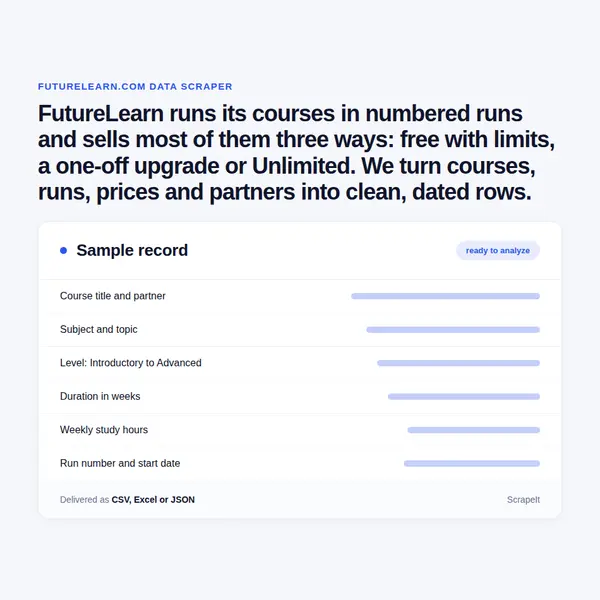
FutureLearn runs its courses in numbered runs and sells most of them three ways: free with limits, a one-off upgrade or Unlimited. We turn courses, runs, prices and partners into clean, dated rows.

Plans from €169/month · Free project assessment · Reply within 1 business day

FutureLearn Scraper
Solutions

How We Scrape FutureLearn Data Across Courses, Runs and Currencies

ScrapeIt runs FutureLearn data scraping as a managed service: we build the collector, host it and repair it when templates change. Anti-bot handling, proxy rotation and CAPTCHA solving are part of the job. We walk subjects, topics, the course listing and the partner directory, then every course, run, ExpertTrack, certification and degree page, and extract FutureLearn data from public pages only, with no logins. Sitemaps keep slugs that no longer resolve, so the live listings decide what is current. Each row keeps slug, run number, currency and collection time. A sample comes first; then runs follow your schedule as JSON, CSV or XLSX in S3, SFTP or your warehouse, or through the FutureLearn scraper API we host.

FutureLearn Dataset: Course Card, Run and Partner Fields

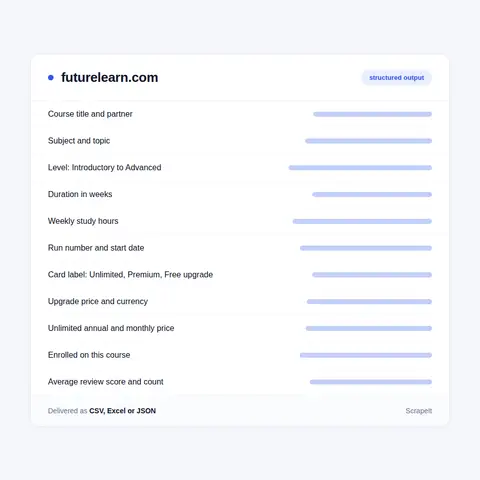
We key every record on FutureLearn's own course slug and run number, because a course and its runs change on different clocks. Every field below is printed on public FutureLearn pages or embedded in them.

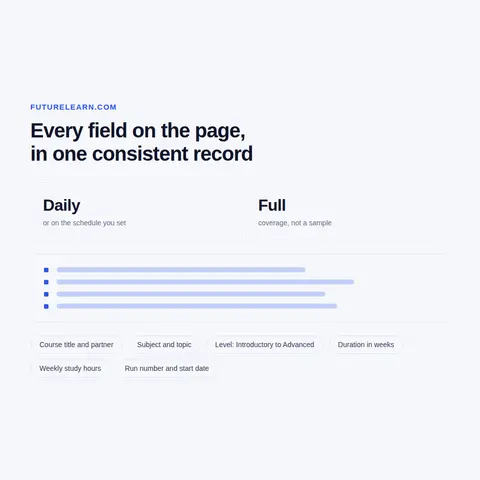
  • Course. Title, short description, subject and topic, partner and co-creating organisations, level (Introductory, Intermediate or Advanced), Duration in weeks, Weekly study in hours, Languages (English, plus Italian, Spanish, French and Portuguese on many courses) and the card labels: Included in Unlimited, Premium course, Free digital upgrade, Part of an ExpertTrack, New.
  • Run and start dates. Run number, start and end date, whether the run is Available now or opens on a stated date, the weeks of limited access a free learner gets and the date that access would run out for someone joining today.
  • Prices. The one-off upgrade shown as Buy this course, the premium course price, the Unlimited annual and monthly plans with any sale price and its end time, and the currency; the page's structured data adds the sterling price for the run.
  • Demand and ratings. The live counter of learners enrolled on this course, the average review score and the review count. Teaching English Online, from Cambridge University Press & Assessment, shows 4.9 from about 2,000 reviews and about 413,000 learners.
  • Outline. Syllabus by week and activity with short descriptions, the learning outcomes under What will you achieve, Who is the course for, requirements, whether tests are scored and which certificate is issued: a Certificate of Achievement, printed and digital with an upgrade or digital only with Unlimited.
  • Partner and accreditation. Who developed the course, the university profile (established, location, world ranking with its source and year), endorsers and supporters such as HM Government, and accreditors such as The CPD Certification Service.

FutureLearn Dataset: Course Card, Run and Partner Fields
FutureLearn Data Scraping for ExpertTracks, Microcredentials and Degrees

FutureLearn Data Scraping for ExpertTracks, Microcredentials and Degrees

ExpertTracks are subscriptions rather than purchases. Applied Data Analysis from CloudSwyft, co-created with Microsoft, runs about 14 weeks at 3-5 hours per week, costs EUR 36 a month after a free 2-day trial and lists its courses with a weekly syllabus and key skills; we record the monthly price, trial, course count, level and enrolments.

Microcredentials, bootcamps and professional certificates share one certifications listing. A microcredential page states the credit on offer - 10 UK Level 7 credits on most Nottingham Business School microcredentials, 0.5 Deakin credits on Deakin University's Leadership in Healthcare and Aged Care - plus level, weeks, a Started on date, a Join by deadline and a full price paid upfront. Professional certificates come from AWS, and bootcamps from The University of Law prepare for the SQE.

Online degrees sit on FutureLearn's separate degrees site with award (Master's, Bachelor's, MBA, PGCE and more), subject, university, time investment, cost - currently GBP 20,865 for Arden University's three-year BA (Hons) Business Management - and entry and English requirements. Partner pages add the partner's profile and course count.
How FutureLearn Courses Work: Runs, Weeks, Steps and Partners

A FutureLearn scraper reads futurelearn.com, the UK online learning platform that The Open University founded in 2012. Today FutureLearn is a private company owned by Global University Systems, and its partner directory puts universities such as The Open University, the University of Leeds and Deakin University next to specialist organisations such as the British Council, Cambridge University Press & Assessment, ACCA and Amazon Web Services.

FutureLearn courses are organised in time, not as a flat library. A short course is split into weeks, activities and steps and is delivered in numbered course runs: /courses/introduction-to-cyber-security/26 is the 26th run of that course, with its own start date, end date and price validity. The page gives length in weeks and study time in hours per week, so a course reads as 8 weeks at 3 hours rather than as a total runtime.

Around the short courses sit ExpertTracks, series of courses sold as a monthly subscription; microcredentials that carry professional or academic accreditation; professional certificates; bootcamps; and online degrees on a separate degrees site. At the end of September 2026 the course listing held 1,828 short courses - 1,166 included in Unlimited, 293 with a free digital upgrade and 100 premium courses - next to 75 ExpertTracks and 47 certifications. Each family has its own card, price logic and dates, and a usable dataset keeps them apart.

Get a Quote
dev_w
25

Developers

customers
500+

Customers worldwide

pages
1 500 000 000+

Pages extracted

stime
15000+

Hours saved for our clients

Plans

FutureLearn Scraping Plans and Pricing

Airplane

€199 / one-time

setup fee - included

Data limits100,000
Frequencyone-time
Run timeup to 5 days
Data storing7 days

Helicopter

€169 / mo

setup fee €499

Data limits250,000
Frequencymonthly
Run timeup to 5 days
Data storing14 days

Glasses

€229 / mo

setup fee €499

Data limits1,000,000
Frequencyweekly
Run timeup to 5 days
Data storing30 days

DNA

€549 / mo

setup fee €799

Data limits3,000,000
Frequency3 times daily
Run timesame day
Data storing90 days

FutureLearn Price Tracking: Limited Access, Upgrades and Unlimited

How much FutureLearn costs depends on the route a learner takes, and that is the first reason to track it. Most short courses can be joined free with limited access - lessons arrive week by week, tests and the certificate stay locked and access ends with the course length - or bought outright as an upgrade, or opened through FutureLearn Unlimited, sold as an annual or a monthly plan and cut in seasonal sales such as 30 percent off the annual plan. Premium courses are paid upfront, and courses with a free digital upgrade are paid for by the partner.

FutureLearn prices are set per currency rather than converted: an upgrade shown as EUR 74 to a eurozone visitor carries GBP 59 in the page's structured data. A FutureLearn price tracker therefore stores price, currency, access type and label per course and per run, and flags each change.

The second reason is supply. Universities, business schools and edtech teams read the catalog to see who publishes what: which partners cover which subjects, at what level and over how many weeks, and how quickly new courses appear. Enrolment counters and rating aggregates, read over time, show which subjects are gaining learners and which have stalled.

Our Blog

Reads Our Latest News & Blog

Learn how to use web scraping to solve data problems for your organization

How Artificial Intelligence Is Used In Web Scraping

How Artificial Intelligence Is Used In Web Scraping

Leveraging advances in technology, the AI-powered web scraper has skyrocketed in demand and is helping to expand capabilities by automating tedious daily tasks and speeding up data collection from thousands of websites several times over.

What is Web Scraping and What is it Used For?

What is Web Scraping and What is it Used For?

Web scraping is a method of obtaining web data by extracting it from pages of web resources with the help of a program, that is, in automatic mode. It is used to syntactically convert web pages into more usable forms.

Web Scraping for Machine Learning

Web Scraping for Machine Learning

If you specialize in machine learning, you need to feed large amounts of data to the algorithms. Web scraping is the easiest and the most efficient method of collecting the data from all over the Internet.

scrapeit logo

Working With ScrapeIt on a FutureLearn Course and Price Feed

ScrapeIt is a managed web scraping agency. You name the subjects, partners, product families and currencies; we deliver a FutureLearn dataset that loads without cleaning, with tables for courses, runs, prices, ExpertTracks, certifications, degrees and partners, joined on FutureLearn's own slugs and run numbers. Pricing follows scope and refresh rate, and you check a sample before committing.

FAQ

Do you offer a FutureLearn API?

Yes. The ScrapeIt FutureLearn API returns courses and runs as JSON: title, partner, subject, level, weeks and hours per week, start and end dates, card label, upgrade, premium and Unlimited prices with currency, the enrolment counter, average review score and review count. ExpertTracks, certifications, degrees and partners come as their own objects. You set the schedule, from a daily price check to a weekly catalog pass, and the same data arrives as CSV and XLSX exports or in S3, SFTP or your warehouse.

Are FutureLearn courses free, and how do you record the price?

Most can be started free with limited access for the length of the course, but tests, the certificate and lasting access need an upgrade or FutureLearn Unlimited. Premium courses are paid upfront, and the Free digital upgrade label marks FutureLearn courses with free certificate access paid for by the partner, such as Introduction to Cyber Security from The Open University. We store the access type, the label and every price shown, with its currency, so free and paid never share a column.

Can you track FutureLearn start dates and course runs?

Yes. Each run has a number in its URL, a start date and an end date, and the course page says whether it is Available now or opens on a later date; the listing splits courses into Start now and Start later. Microcredentials add a Started on date and a Join by deadline. We keep every run as its own record, so you see when a course reopens, how many runs it has had - Introduction to Cyber Security is on run 26 - and whether its price moved between runs.

Can you limit the feed to subjects, partners or languages?

Yes. The catalog has 14 subjects, each with topic pages; FutureLearn courses for teachers, for example, sit under Teaching with topics from Early Childhood Education to SEN Education and STEM Teaching. You can scope by subject, topic, partner, card label, level or start availability, and by language, since the listing filters German, Spanish, French, Italian and Portuguese besides English. A partner scope follows the partner directory, which groups universities, specialist organisations, centres of excellence and associate partners.

Is it legal to scrape FutureLearn?

We collect only publicly available data - everything a visitor can see on FutureLearn - and we collect it legally. That covers course and run pages, prices, rating aggregates, ExpertTrack, certification and degree pages and partner profiles. No logins, no paywalls: course steps, comments and learner progress sit behind an account and stay out. Learner reviews and testimonials carry names, so we keep only the score and the count, and personal data is handled under GDPR.

How does it Work?

Step 1 - Make a Request

You share your needs, expectations, and desired timeframe. We’ll suggest the best solution based on your request and budget.

Step 2 - Configuring Custom Web Crawlers

Our specialists configure the crawlers and extract a sample dataset for your review before proceeding with the full-scale extraction.

Step 3 - Collect and Deliver

Once you approve the sample, we launch the project and start full data collection. We gather, filter, and structure the data for easy use, delivering it on time in your preferred format.

Step 4 - Maintain and Support

Our team manages ongoing processes, monitors website changes, and supports all data extraction cycles. We can also help integrate data into your systems or create dashboards to simplify analysis.

Request a Quote

Tell us more about you and your project information.
Which sites, which fields, how often. A couple of lines is enough.

We reply within 1 business day. No obligation.

scrapiet

Scrapeit Sp. z o.o.
10/208 Legionowa str., 15-099, Bialystok, Poland
NIP: 5423457175
REGON: 523384582