Coursera Scraper for Course Catalog, Prices and Ratings

Ask what a Coursera course costs and the honest answer is a question back: in which country, on which plan, and audited or certified?

Coursera Scraper
Solutions

Managed Coursera collection, run end to end by us

ScrapeIt runs the collector as a managed service. You name the subjects, partners, product types and the countries you need prices for; we build the pipeline, run it on your cadence and hand back CSV, JSON, Excel or a push into your warehouse, with list and effective price separate, country on every row and the syllabus broken to module level.

Cadence is per purpose. Price monitoring justifies frequent passes because discounts move; catalogue and syllabus collection runs monthly, since a syllabus does not change weekly and re-reading it does not buy anything.

We work within the crawl rules the site publishes, collecting catalogue and course pages rather than search or application endpoints, and we pace requests. Course descriptions and syllabi are the platform and its partners copyright, so the dataset is built for analysis rather than republication, and we do not touch lecture content. Bring the use case to your own counsel before the project starts.

Coursera fields in every export

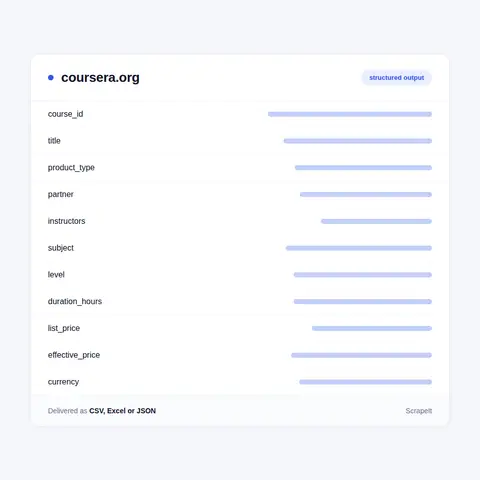
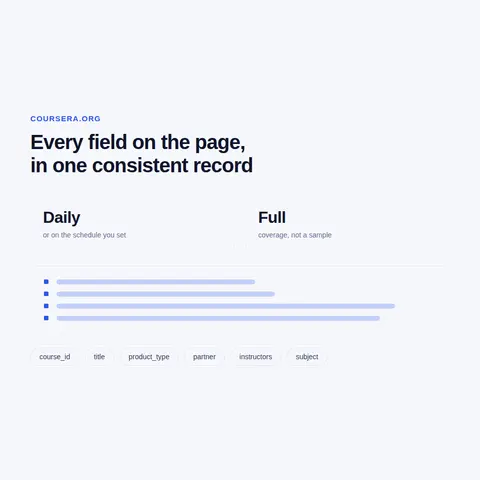
The catalogue record covers course or programme identifier, title, product type, canonical URL, partner institution or company, instructors, subject and subcategory, level, stated duration and workload, language and available subtitles, and the certificate type offered.

Pricing is delivered as several fields rather than one. List price, the price actually displayed after any discount, the currency, the country the price was collected for, whether a free audit track exists, and whether the item is included in a subscription plan. Collapsing that into a single number is how price studies of this platform go wrong.

Syllabus detail is collected to module level: module titles, ordering, stated hours and the assessment types listed. That is what makes catalogue comparison possible at any depth beyond the marketing card, and it is the part clients most often find missing from data they bought elsewhere.

Demand signals come as published: average rating, review count, enrolment figure where shown, and the number of courses inside a specialisation. These are self reported platform metrics rather than audited numbers, and we describe them that way.

Every row carries the country it was collected for and the collection timestamp, because on this platform a price without both is not a fact about anything.
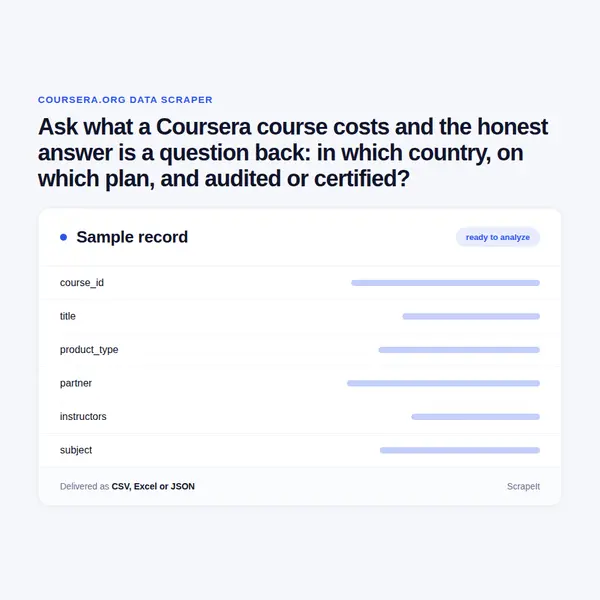
Coursera fields in every export
Degrees, partners and tracking the catalogue over time

Degrees, partners and tracking the catalogue over time

Degrees and professional certificates deserve their own treatment. They are priced in a different order of magnitude, they carry admission requirements and start dates rather than open enrolment, and mixing them into a course price distribution destroys it. We type them explicitly so they can be analysed separately or excluded.

Partner institutions are the axis that makes competitive analysis work. A university or company appears across many items, and normalising those names to a single entity turns a course list into a portfolio view: what this institution offers, at what level, in which subjects, and how that has changed.

Change tracking is where repeat collection pays. New courses appear, old ones are retired, prices move, ratings drift and specialisations gain or lose components. We deliver changes as their own records so a client sees what moved rather than diffing two full exports by hand.

Cross platform comparison is the usual extension. A catalogue gap analysis is only meaningful against competitors, so this collection is normally bought alongside one or two other learning platforms with a shared subject taxonomy mapped across them. Doing that mapping at collection time is far cheaper than reconciling three vendor exports afterwards.

How Coursera arranges courses, specialisations and degrees

Coursera is not a flat catalogue of courses. It carries individual courses, multi course specialisations, professional certificates, guided projects and full university degrees, and those product types are priced and packaged in entirely different ways. A collector that treats them as one type produces a price column that means five different things.

Most content is also available on two footings. A course can often be audited for free, with the certificate and graded assignments behind payment, and much of the catalogue is additionally covered by a subscription plan rather than sold outright. So the question what does this cost has at least three answers on the same page, and the useful dataset carries all of them separately.

Structurally the catalogue is enumerable. A browse surface lists courses, a course sitemap is published, and each course, specialisation and degree has a stable page carrying the provider university or company, the instructors, the syllabus broken into modules, the level, the duration, the language and subtitle list, the rating and review count, and the enrolment figure where shown.

The crawl rules are explicit and worth reading before scoping: the site disallows its application and search paths while leaving catalogue and course pages open. We collect the catalogue, not the search endpoints, and that line is one of the reasons access here stays stable.

Get a Quote
dev_w
25

Developers

customers
500+

Customers worldwide

pages
1 500 000 000+

Pages extracted

stime
15000+

Hours saved for our clients

Plans

Airplane

€199 / one-time

setup fee - included

Data limits100,000
Frequencyone-time
Run timeup to 5 days
Data storing7 days

Helicopter

€169 / mo

setup fee €499

Data limits250,000
Frequencymonthly
Run timeup to 5 days
Data storing14 days

Glasses

€229 / mo

setup fee €499

Data limits1,000,000
Frequencyweekly
Run timeup to 5 days
Data storing30 days

DNA

€549 / mo

setup fee €799

Data limits3,000,000
Frequency3 times daily
Run timesame day
Data storing90 days

Why one price column is always the wrong answer

The large learning marketplaces discount almost permanently, and the crossed out figure is close to fiction. Any comparison built on the list price describes a world nobody buys in; any comparison built on the discounted price without recording that it was discounted describes a moment nobody can reproduce. Both numbers, with a timestamp, is the only version that survives review.

Country is the second axis and it is not decoration. Price, currency and even catalogue availability differ by market, and some items simply do not appear in some countries. Collecting once from one location and calling the result a global price list is the most common error on this source, and it is invisible in the output.

The track question is the third. A course that can be audited free with a paid certificate is a different commercial object from one sold outright, and a course bundled into a subscription is a third thing again. For anyone benchmarking their own pricing, those distinctions are the analysis rather than a footnote to it.

Beyond price, the catalogue itself answers the question most edtech teams actually have: where is the coverage. Which subjects are served deeply, which are thin, which partner institutions dominate which fields, how fast a new topic gets covered after it appears. That needs syllabus level collection across the catalogue rather than a sample of course cards.

The fourth use is demand proxying. Ratings, review counts and enrolment figures are self reported, but tracked over time they show which topics are growing and which have stalled, which is usually enough to direct a content roadmap.

Our Blog

Reads Our Latest News & Blog

Learn how to use web scraping to solve data problems for your organization

How Artificial Intelligence Is Used In Web Scraping

How Artificial Intelligence Is Used In Web Scraping

Leveraging advances in technology, the AI-powered web scraper has skyrocketed in demand and is helping to expand capabilities by automating tedious daily tasks and speeding up data collection from thousands of websites several times over.

What is Web Scraping and What is it Used For?

What is Web Scraping and What is it Used For?

Web scraping is a method of obtaining web data by extracting it from pages of web resources with the help of a program, that is, in automatic mode. It is used to syntactically convert web pages into more usable forms.

Web Scraping for Machine Learning

Web Scraping for Machine Learning

If you specialize in machine learning, you need to feed large amounts of data to the algorithms. Web scraping is the easiest and the most efficient method of collecting the data from all over the Internet.

scrapeit logo

Who builds and keeps your Coursera feed

ScrapeIt is a managed extraction company, not a tool you have to learn. Our team builds the pipeline, watches it as the catalogue and templates change, and repairs it before your price series develops a hole.

You see a sample first, in your format, for the subjects and countries you actually care about, with both prices on the row so you can judge the pricing data before committing.

FAQ

Why do you collect two prices for the same course?

Because the crossed out list price is close to fiction on this platform and the discounted price alone is not reproducible. Recording both, with the currency, the country and the moment they were seen, is the only version of a price study that survives someone checking it. We also flag whether a free audit track exists and whether the item is bundled into a subscription, because those are different commercial objects again.

Does the catalogue really differ by country?

Yes, in price, currency and availability. Some items do not appear in some markets at all. Collecting from one location and presenting the result as a global price list is the most common mistake on this source and it is invisible in the output, so every row we deliver carries the country it was collected for.

Can you collect the syllabus, not just the course card?

Yes, to module level: module titles, order, stated hours and the assessment types listed. Gap analysis against your own catalogue is meaningless at card level, because two courses with the same title can differ by a factor of five in depth. This is usually what clients find missing in data they bought elsewhere.

Are degrees and certificates included?

Yes, and typed separately. They are priced in a different order of magnitude and carry admission requirements and intake dates rather than open enrolment, so mixing them into a course price distribution wrecks it. You can analyse them on their own or exclude them cleanly.

Do you collect the course videos or materials?

No. We collect catalogue metadata: titles, syllabus outlines, prices, ratings, instructors and dates. Lecture videos and course materials are copyrighted content belonging to the platform and its partner institutions, and collecting them is not something we do. The dataset is built for analysis rather than republication.

How does it Work?

Step 1 - Make a Request

You share your needs, expectations, and desired timeframe. We’ll suggest the best solution based on your request and budget.

Step 2 - Configuring Custom Web Crawlers

Our specialists configure the crawlers and extract a sample dataset for your review before proceeding with the full-scale extraction.

Step 3 - Collect and Deliver

Once you approve the sample, we launch the project and start full data collection. We gather, filter, and structure the data for easy use, delivering it on time in your preferred format.

Step 4 - Maintain and Support

Our team manages ongoing processes, monitors website changes, and supports all data extraction cycles. We can also help integrate data into your systems or create dashboards to simplify analysis.

Request a Quote

Tell us more about you and your project information.
Which sites, which fields, how often. A couple of lines is enough.

We reply within 1 business day. No obligation.

scrapiet

Scrapeit Sp. z o.o.
10/208 Legionowa str., 15-099, Bialystok, Poland
NIP: 5423457175
REGON: 523384582