How Can Web Scraping Technology Help the Finance Industry?
Web scraping automates the extraction and aggregation of financial data, makes it easier to find stocks, and allows you to predict the market based on the information.
Euronext runs eight national markets, and every stock page is keyed by ISIN and market code. Our Euronext scraper reads quotes, order book, company facts and IPOs.
Plans from €169 a month · Free project assessment · Reply within 1 business day
CSV · Excel · JSON · XML · FTP · SFTP · Amazon S3 · Google Cloud
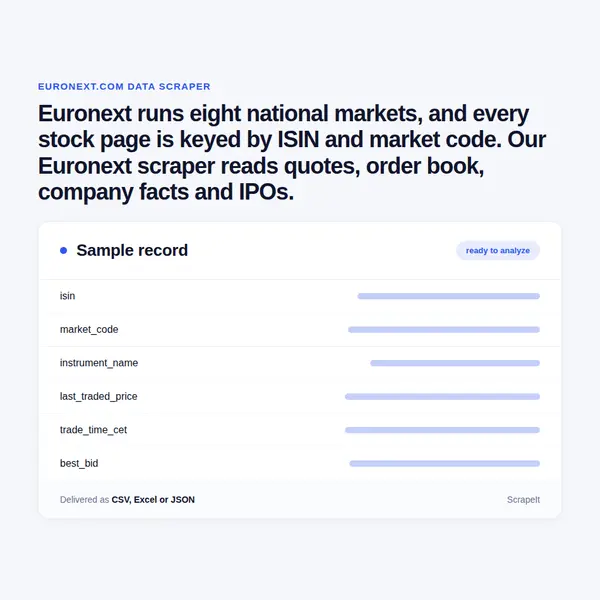
API, JSON feed or CSV, XLSX and JSON files
ScheduleOne-time, monthly, weekly, daily or 3 times a day
Euronext pages, filters, fields and a schedule
Built, monitored and repaired by our team
API, JSON feed or CSV, XLSX and JSON files
Tell us which of the eight markets, which segments and which instruments - a CAC 40 basket, every Euronext Growth stock in Oslo, the agricultural futures board - and how often. We build the crawlers for live.euronext.com, run them on that schedule and fix them when the site changes. Quote blocks and order books are filled in by scripts once the page has opened; we render them, and pacing, proxy rotation and CAPTCHA handling are included.
Every row carries the ISIN and the market identifier code from the page address, so Air France-KLM, with one page under XPAR for Euronext Paris and another under BGEM for the Euronext Global Equity Market, stays two rows that never merge by mistake. Delivery is CSV, XLSX, JSON or XML, via our API, SFTP, Google Cloud Storage or a direct load into your database, with field documentation.
A Euronext product page is addressed by ISIN and market code - NL0010273215-XAMS is ASML on Euronext Amsterdam - and splits into four tabs: Quotes, Characteristics, Company Information and ESG. We collect them as one record per instrument and market.
Bonds, ETFs, funds, structured products and derivatives have product pages of their own, with fields that follow the instrument type.
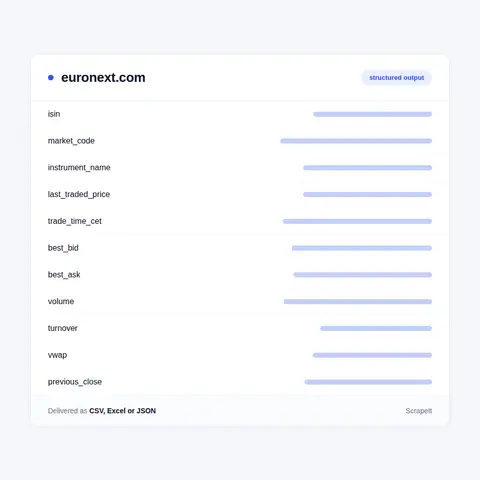
Each market has its own stock list. Paris, for example, separates All stocks, CAC 40 stocks, Euronext regulated, Euronext Growth, Euronext Access and CAC 40 ESG stocks, with an A to Z index. The list gives name, ISIN, symbol, market code, last price, percentage change and the time of the last trade - enough to enumerate a market before the product pages are read.
The All IPOs table lists each admission with date, company name, ticker, ISIN, location and market. To track Euronext new listings we save it daily and add rows the morning they appear.
Commodities sit on a board of their own. The agricultural quotes page shows Milling Wheat, Corn and Rapeseed futures by delivery month with last, change, volume, open, high, low, settlement and open interest. Saved every evening, the settlement column becomes a series of settlement prices per contract - the wheat prices and corn curves grain desks follow. Repeated runs do the same for shares: quotes captured on a schedule add up to a price history per ISIN and market.
Euronext operates the stock exchanges of Amsterdam, Athens, Brussels, Dublin, Lisbon, Milan, Oslo and Paris. Its live.euronext.com site publishes market data for seven of them, while Athens keeps a site of its own, Euronext Athens, with a separate stock list. The live site reads in English, French, Norwegian, Dutch, Portuguese, German, Italian and Greek, but the logic behind a page is the same everywhere: one ISIN, quoted on one or more markets, each with its own page.
Inside every market the listing segments matter. Euronext regulated is the main market, divided into compartments by size; Euronext Growth and Euronext Access keep separate lists; Milan adds Euronext Star Milan and EuroTLX, and Oslo adds Euronext Oslo Børs and Euronext Expand. Bonds have venues of their own, from MOT to Nordic ABM, and Dublin publishes Irish Government Bonds and a Daily Official List.
Beyond shares the site covers indices, ETFs, funds, structured products and the derivatives markets - index, stock and dividend futures and options, the agricultural contracts and the Euronext Nord Pool Power Futures on the Nordic System Price and EPAD contracts. Market status pages, suspended instruments and corporate action notices complete the picture.
Delivery: CSV, JSON or XLSX files, our API or a JSON feed. MCP server on request.
Full plan detailsThe order book and the quotes table describe liquidity as well as price: turnover, number of transactions, VWAP and the depth on each side show how easily a position can be built in a small Euronext Growth company compared with a CAC 40 stock. Execution and market-structure analysts track exactly these columns across markets.
Events are the second use. Regulated news headlines and corporate action notices give an event calendar per issuer, and the All IPOs table is a running record of who came to market where. Index teams read the index membership list and the ICB codes to map stocks to baskets; the PEA and SRD flags matter to anyone building products for French investors.
Agricultural desks use the futures board: daily settlement prices and open interest for Milling Wheat, Corn and Rapeseed feed hedging models and basis comparisons. Company information adds key figures by fiscal year and the shareholder table for fundamental screens across all the markets.
Learn how to use web scraping to solve data problems for your organization
Web scraping automates the extraction and aggregation of financial data, makes it easier to find stocks, and allows you to predict the market based on the information.
Data and analytics are opening the door to uncovering ways to combat financial crime based on smart data. And advanced AI analytics and cognitive techniques, machine learning, and automation will improve the inefficiency of existing investigative processes.
Data scraping is the wide term that includes documents, scans and old screens; web scraping is the part that works on websites. We compare sources, daily work, output and cost drivers, give a briefing checklist and walk through two of our projects.

ScrapeIt is a managed data extraction service. Exchange sites have a shape of their own: many markets under one domain, instruments keyed by codes rather than names, and figures that change by the minute in one block and once a year in the next. We build the crawlers, keep them running and deliver the tables with field documentation; a free project assessment and a sample come first. Personal data such as executives' names is handled under GDPR and left out unless your project needs it.
Still unsure? Write to info@scrapeit.io
All eight: Amsterdam, Athens, Brussels, Dublin, Lisbon, Milan, Oslo and Paris, with segments such as Euronext Growth, Euronext Access, Euronext Expand and EuroTLX. Athens comes from the separate Euronext Athens site, the other seven from live.euronext.com, and every row carries its market code, so a stock quoted in two places stays two rows.
Yes. We read the daily history rows from each product page and, from the start of the project, add our own end-of-day captures of open, high, low, close, volume, turnover and VWAP. Keyed on ISIN and market code, the series stays consistent when a company changes its name or ticker.
The agricultural board shows delayed quotes during the session, and the settlement column is filled after the close. One run after settlement each day gives a clean series per contract and delivery month; intraday runs work for last price and volume.
Yes. The ScrapeIt Euronext API returns the last traded price, VWAP, best bid and ask, ISIN, market code and IPO date as JSON from an endpoint we host, refreshed on the schedule you set. The same data also comes as CSV or XLSX files, a JSON feed or straight into your database.
Yes. Quotes, order book depth, characteristics, company information, IPO lists and the commodity board are shown on live.euronext.com to any visitor, without an account. We collect only publicly available data - everything a visitor can see on Euronext - and we collect it legally.
You share your needs, expectations, and desired timeframe. We'll suggest the best solution based on your request and budget.
Our specialists configure the crawlers and extract a sample dataset for your review before proceeding with the full-scale extraction.
Once you approve the sample, we launch the project and start full data collection. We gather, filter, and structure the data for easy use, delivering it on time in your preferred format.
Our team manages ongoing processes, monitors website changes, and supports all data extraction cycles. We can also help integrate data into your systems or create dashboards to simplify analysis.
Tell us which sites, which fields and how often. A couple of lines is enough to start.
Euronext data from €169/month. Free project assessment, reply within 1 business day.