How Can Web Scraping Technology Help the Finance Industry?
Web scraping automates the extraction and aggregation of financial data, makes it easier to find stocks, and allows you to predict the market based on the information.

CoinMarketCap ranks tens of thousands of coins across hundreds of exchanges. We collect the price, market cap, volume and trading pair tables it publishes, on the schedule you set.
Plans from €169/month · Free project assessment · Reply within 1 business day
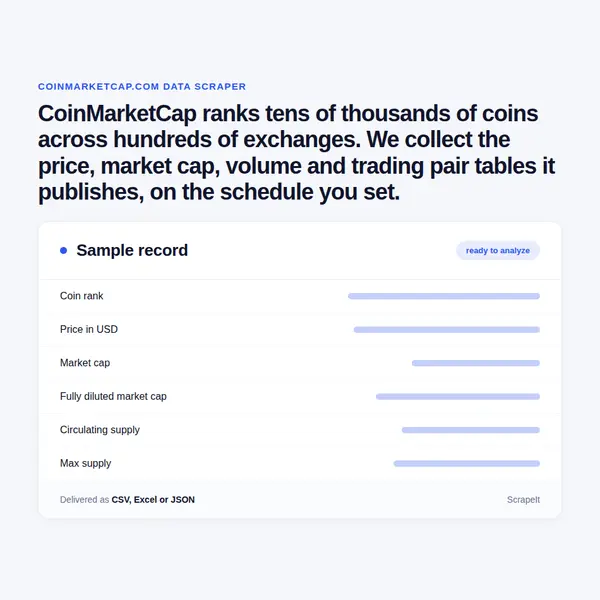
You send a coin list, or ask for the whole ranked universe, and name the tabs you need. ScrapeIt builds a dedicated crawler with parsing logic written for CoinMarketCap, runs it on your cadence and returns a sample before the full pass. Anti-bot handling, proxy rotation and CAPTCHA solving are part of the service, not an extra line on the invoice.
Coverage is planned from the coin address list rather than by walking the ranking table, because that table paginates in hundreds and draws itself in the browser. Frequency is an agreement, not a claim of live data: crypto moves every second, and any dataset is a series of snapshots taken at the interval you choose. Minutes, hours or once a day - we set it, hold it and stamp every row with the moment it was taken.
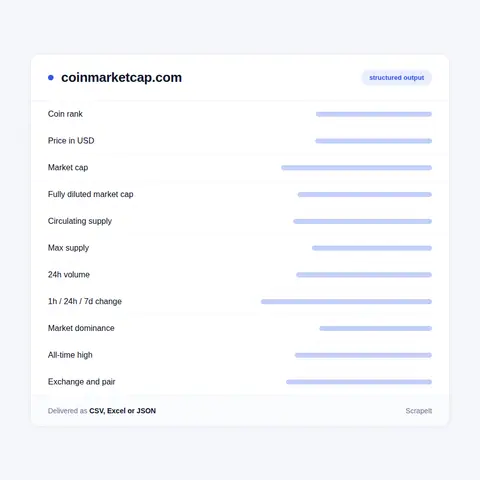
A coin page carries a fixed block of fields. We take them as published, with no renaming and no derived columns:
Output is CSV, Excel, JSON or whatever format your pipeline prefers. Every row carries the slug, the numeric id, the quote currency and the capture timestamp, because CoinMarketCap price data with no capture time cannot be reconciled against anything later.
Exchanges and pairs. The markets tab is the richest cross section on the site and the one no single quote can replace. A major asset trades in thousands of pairs, and each row carries the exchange, the pair such as BTC/USDT, the pair category - spot, perpetual or futures - the venue price, 24 hour volume in USD, volume share, plus 2 percent and minus 2 percent order book depth, the liquidity score, the confidence indicator that grades reported volume on a zero to a hundred scale, and flags for outlier price or excluded volume. One coin, dozens of venues, dozens of prices: that spread is the dataset.
Exchange profiles. A venue page publishes spot, perpetual and futures volume, derivatives open interest, maker and taker fees, the supported fiat list, launch date and reserve figures. Ranking screens add exchange score, average liquidity, weekly visits, number of markets and number of coins.
History. The historical data tab yields daily open, high, low, close, volume, market cap and circulating supply per asset, and the weekly snapshot archive currently reaches back to April 2013 with the whole ranking table as it stood that day. Around seven hundred snapshots exist, which is a clean backbone for rebuilding rank and dominance over time.
Beyond coins. Category and tag screens, real world asset pages, derivatives and liquidation boards, and DEX pair data all sit on the same domain under the same identifiers.
CoinMarketCap is an aggregator, not a venue. It pulls quotes from centralized and decentralized exchanges, weights them, and publishes one reference price per asset next to market cap, circulating supply and 24 hour volume. Nothing trades on it: the prices are made on the venues it watches, and CoinMarketCap publishes the reference view.
The address plan is stable and easy to plan against. Every asset sits at /currencies/{slug}/, with tabs for markets, historical data, news and community hanging off it. Behind the slug is a numeric id that survives renames - Bitcoin is id 1 - so a project changing its name shows up as a new slug, not a lost row. Exchanges live at /exchanges/{slug}/, sector and tag screens at /view/{tag}/, weekly archives at /historical/{YYYYMMDD}/, and unit converters at /currencies/{slug}/{symbol}/{fiat}/.
Scale, as of September 2026: about 39,600 assets carry a live ranking, roughly 975 exchanges are active, and the site follows about 116,600 individual markets. The coin sitemap alone lists about 38,600 addresses, which is what a coverage plan is built from. Pages are published in around thirty language folders, among them /de/, /es/, /fr/, /ja/, /ko/, /pt-br/, /ru/, /tr/ and /zh-tw/, with the same numeric ids underneath, so a multilingual pull joins back on id and never on name.
Get a Quote
Developers

Customers worldwide

Pages extracted

Hours saved for our clients
€199 / one-time
setup fee - included
€169 / mo
setup fee €499
€229 / mo
setup fee €499
€349 / mo
setup fee €499
€549 / mo
setup fee €799
Delivery: CSV, JSON or XLSX files, our API or a JSON feed. MCP server on request.
Full plan details →The cross section no single quote gives. The markets tab lists every tracked pair for an asset - exchange, pair, spot, perpetual or futures category, venue price, 24 hour volume, volume share, plus and minus 2 percent depth, liquidity score and confidence indicator - and a single large coin can carry more than twelve thousand pairs. Collected on a schedule, the spread between venues becomes a measurable series rather than an anecdote.
The flags travel with the numbers. Supply figures carry the flag that says whether the CoinMarketCap team verified them or the project self-reported them, and volume comes both as the figure exchanges report and as the adjusted figure the ranking uses. On major assets the two differ several times over, so both land in the dataset as separate fields.
History at full width. The historical data tab yields daily open, high, low, close, volume, market cap and circulating supply per asset, and the weekly snapshot archive reaches back to April 2013 with the whole ranking table as it stood that day. We collect only publicly available data - everything a visitor can see on CoinMarketCap - and we collect it legally.
Learn how to use web scraping to solve data problems for your organization

Web scraping automates the extraction and aggregation of financial data, makes it easier to find stocks, and allows you to predict the market based on the information.

Data and analytics are opening the door to uncovering ways to combat financial crime based on smart data. And advanced AI analytics and cognitive techniques, machine learning, and automation will improve the inefficiency of existing investigative processes.

Leveraging advances in technology, the AI-powered web scraper has skyrocketed in demand and is helping to expand capabilities by automating tedious daily tasks and speeding up data collection from thousands of websites several times over.
ScrapeIt runs the CoinMarketCap scraper as a managed service. We build, run and repair the crawlers, and you receive files or an endpoint. There is nothing to install on your side and no infrastructure to keep alive.
We publish no signals, no forecasts and no trading calls, and we do not collect personal information about individuals - wallet owners, community posters or anyone else. We deliver market data. What you conclude from it is your work.
Yes. The ScrapeIt CoinMarketCap API returns reference price, market cap, circulating supply with its verified flag, 24 hour volume and the market pairs for each asset as JSON from an endpoint we host, refreshed on the schedule you set. The same data also comes as CSV or XLSX files or straight into your database.
Price in your chosen fiat, rank and volume rank, market cap and fully diluted market cap, circulating, total and max supply with the verified or self-reported flag, 24 hour volume split between centralized and decentralized venues, reported against adjusted volume, percentage change over one hour, 24 hours, seven days and longer windows, highs and lows including all time high and all time low with timestamps, market dominance, turnover, tags and categories, launch date, holder counts, and the website, whitepaper, explorer and source code links. Every row is stamped with the slug, the numeric id and the capture time.
Yes, and that is where a CoinMarketCap scraper usually pays for itself. The markets tab lists every tracked pair for an asset with the exchange name, the pair, the category of spot, perpetual or futures, the price on that venue, 24 hour volume and volume share, order book depth at plus and minus 2 percent, liquidity score and confidence indicator. A single large coin can carry more than twelve thousand pairs across categories, which is how price dispersion between venues becomes measurable rather than anecdotal.
On whatever cadence you set: every few minutes for a short watchlist, hourly for a mid sized one, daily for a full sweep of the ranked universe. Crypto quotes move continuously, so no collection is live by definition - each row is a snapshot with a timestamp, and the interval is an agreement we hold to rather than a promise of real time. Delivery is CSV, Excel, JSON or another format that suits your systems, as a scheduled file drop, a bucket we write to, or an endpoint we host and keep current.
Yes. We collect prices, market caps, supply, volume, market pairs, exchange profiles and price history from CoinMarketCap's public pages, and we do not collect personal information about individuals. We collect only publicly available data - everything a visitor can see on CoinMarketCap - and we collect it legally.
Step 1 - Make a Request
You share your needs, expectations, and desired timeframe. We’ll suggest the best solution based on your request and budget.
Step 2 - Configuring Custom Web Crawlers
Our specialists configure the crawlers and extract a sample dataset for your review before proceeding with the full-scale extraction.
Step 3 - Collect and Deliver
Once you approve the sample, we launch the project and start full data collection. We gather, filter, and structure the data for easy use, delivering it on time in your preferred format.
Step 4 - Maintain and Support
Our team manages ongoing processes, monitors website changes, and supports all data extraction cycles. We can also help integrate data into your systems or create dashboards to simplify analysis.
CoinMarketCap data from €169/month. Free project assessment, reply within 1 business day.

Scrapeit Sp. z o.o.
10/208 Legionowa str., 15-099, Bialystok, Poland
KRS: 0000996672
NIP: 5423457175
REGON: 523384582