How Can Web Scraping Technology Help the Finance Industry?
Web scraping automates the extraction and aggregation of financial data, makes it easier to find stocks, and allows you to predict the market based on the information.
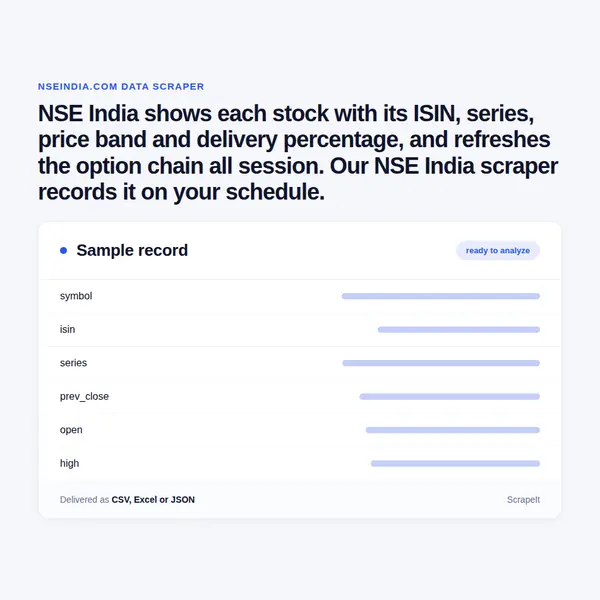
NSE India shows each stock with its ISIN, series, price band and delivery percentage, and refreshes the option chain all session. Our NSE India scraper records it on your schedule.
Plans from €169 a month · Free project assessment · Reply within 1 business day
CSV · Excel · JSON · XML · FTP · SFTP · Amazon S3 · Google Cloud
API, JSON feed or CSV, XLSX and JSON files
ScheduleOne-time, monthly, weekly, daily or 3 times a day
NSE India pages, filters, fields and a schedule
Built, monitored and repaired by our team
API, JSON feed or CSV, XLSX and JSON files
Pick the segments you need - equity quotes for a symbol list, the full option chain for index and stock options, the day's announcements across Equity, SME and Debt, or the deal and flow reports - and the times of day at which a snapshot matters. We build the crawler for nseindia.com, schedule it around trading hours in IST and keep it running as the exchange revises its pages. Web scraping NSE India well is mostly about timing and units: rendering, pacing and proxy rotation are handled on our side, values printed in lakh (L) and crore (Cr) come back as plain numbers, and every row keeps the exchange's own timestamp. The field guide arrives with the first file.
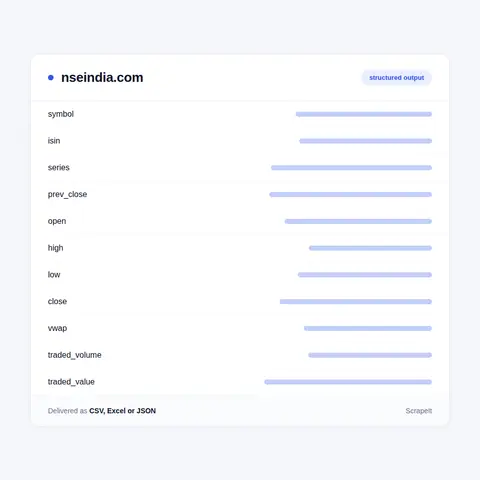
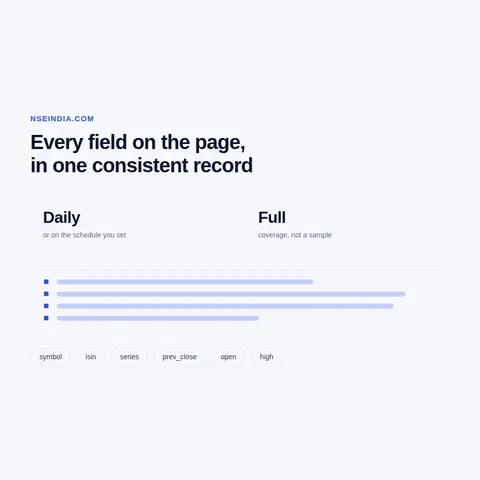
A quote page on nseindia.com is keyed by the trading symbol, prints the ISIN beside the company name and names the series the stock trades in - EQ for the normal market, T0 for same-day settlement. Those three identifiers anchor every row we deliver:
Why the delivery column matters. The delivery percentage separates shares that changed owners from intraday turnover, and the exchange prints it on the quote page for the latest session only - the daily trade table does not carry it. Desks that read accumulation from it need the figure captured every day, so we store each session's value with its date.
Beyond the quote, the exchange publishes registers that matter more to many buyers than the price itself.
Client names in deal reports can belong to individuals; for natural persons we leave the name out by default and keep the trade.
nseindia.com is the public website of the National Stock Exchange of India Ltd, and it carries far more than a quote board. Its top menu includes Market Data, Invest, List, Trade, Regulation, Learn, Resources and Research, and the market data side alone splits into equity and SME market watches, indices, ETFs, sovereign gold bonds, REITs and InvITs, SLB, and equity, currency, commodity and interest rate derivatives.
Every page carries its own clock. The equity market watch shows a market status line, the advances, declines and unchanged count for the chosen index and an "As on" time; the option chain names the underlying value and the minute it was taken. A symbol such as TCS can trade in the cash market, the F&O segment and the SLB market at once, and its quote page carries a tab for each.
Corporate filings are the other half of the site. Under Corporate Filings sit announcements, annual reports, board meetings, corporate actions, financial results, shareholding patterns, insider trading, SAST disclosures, voting results and dozens more registers, most of them split by segment and searchable by company, subject and period. For a buyer of NSE data the point is that one exchange publishes both the market tape and the disclosures behind it under the same symbols, which makes the two easy to join.
Delivery: CSV, JSON or XLSX files, our API or a JSON feed. MCP server on request.
Full plan detailsEach register on the site answers a different desk's question, and most of them only become useful as a series.
Learn how to use web scraping to solve data problems for your organization
Web scraping automates the extraction and aggregation of financial data, makes it easier to find stocks, and allows you to predict the market based on the information.
Data and analytics are opening the door to uncovering ways to combat financial crime based on smart data. And advanced AI analytics and cognitive techniques, machine learning, and automation will improve the inefficiency of existing investigative processes.
Data scraping is the wide term that includes documents, scans and old screens; web scraping is the part that works on websites. We compare sources, daily work, output and cost drivers, give a briefing checklist and walk through two of our projects.

ScrapeIt is a managed scraping service: our team designs, runs and maintains the crawlers, and you receive the data. Exchange websites are among the most demanding sources we handle, because values change by the second during trading and one quote page spreads a stock's figures across several tabs. For NSE India we time runs to the IST trading day, keep the exchange's timestamps, normalise lakh and crore units and hand over a field guide with the dataset. Start with a free assessment of your symbol list and the reports you need.
Still unsure? Write to info@scrapeit.io
Yes. The ScrapeIt NSE India API serves option chain rows by strike, last price, VWAP, delivery percentage, price band and the latest announcements in JSON, from an endpoint we run and refresh at the intervals you pick during the trading day. The same records can arrive as CSV or XLSX files or be loaded straight into your database; an MCP server is available on request.
Yes. Quote pages, the option chain, deal reports and corporate filings on nseindia.com open to any visitor. We collect only publicly available data - what anyone browsing NSE India can see - and we collect it legally. What we deliver is market data and filings, never trading advice.
Each quote page has a Historical Data tab with a session-by-session trade table - open, high, low, close, VWAP, volume, value and number of trades - plus views for bulk and block deals and periodic highs and lows. We collect that table for each symbol and series over the periods the page offers, and scheduled runs then add every new session, so the record stays continuous from the first delivery on.
During market hours the chain moves with every trade: OI, change in OI, IV, bid and ask shift from one refresh to the next, and the page stamps the underlying value with the time it was read. Intraday studies usually snapshot the near expiries every few minutes and the far ones less often, while end-of-day users need one run after the close. We schedule either and keep every snapshot with its timestamp.
Each row carries the symbol, company name, the subject - Outcome of Board Meeting, Acquisition, Press Release and so on - the details line, the broadcast date and time to the second, and a link to the attachment with its size. Filters by segment, company and subject cut the stream to your universe, and attachments such as results PDFs can be delivered as files on SFTP or Google Cloud Storage.
You share your needs, expectations, and desired timeframe. We'll suggest the best solution based on your request and budget.
Our specialists configure the crawlers and extract a sample dataset for your review before proceeding with the full-scale extraction.
Once you approve the sample, we launch the project and start full data collection. We gather, filter, and structure the data for easy use, delivering it on time in your preferred format.
Our team manages ongoing processes, monitors website changes, and supports all data extraction cycles. We can also help integrate data into your systems or create dashboards to simplify analysis.
Tell us which sites, which fields and how often. A couple of lines is enough to start.
NSE India data from €169/month. Free project assessment, reply within 1 business day.